


Growth Without Prosperity ~ Part I
This is the first part of three short essays. Essay 1 explains the disease. Essay 2 shows the symptoms mutating into something more extreme. Essay 3 provides a counter argument to balance the debate.
Part I, Why Workers Keep Losing Even When the Economy Grows
Labour loses bargaining power.
The economy becomes structurally imbalanced.
Part II, AI Is Breaking the Link Between Growth and Prosperity
GDP disconnects from prosperity.
The economy begins to “boom” while society weakens underneath it.
Part III, Will Artificial Intelligence Take Your Job?
Is AI eating the world?
Or does AI create a bigger pie to feed more mouths?
Shut out of the Economy, AI may Lock the Door
There has been a fundamental shift in how the fruits of economic prosperity are distributed.
For most of the twentieth century, the economy generated income and workers received most of it through wages and benefits. Owners of capital received the rest through profits, dividends, interest and rent.
Roughly 70% of national income went to labour, while 30% went to capital. It had remained that way for decades and so economists believed that this ratio was relatively fixed.
In fact, it became one of the central pillars of capitalism.
But that assumption no longer holds.
Today, labour’s share of income has fallen to just above 51% and the decline is not isolated to one country. It’s visible across 13 of the world’s 16 wealthiest economies and increasingly across the global economy itself.
It becomes clear that something structural has changed.
Globalisation expanded the effective labour pool by billions of people, enabling companies to offshore parts of their operation. Production shifted to lower-cost jurisdictions.
This weakened wage bargaining power across developed markets. Capital became increasingly mobile while labour remained geographically anchored.
Falling interest rates amplified the trend. Cheap money encouraged firms to substitute even more capital for labour. Investment increased, while the workforce suffered.
The result has been a gradual but profound transfer of economic leverage from labour to owners of capital. It explains why the labour/capital ratio shifted from 70/30 to 51/49.
The nature of investment has changed as well. Seventy years ago, much of corporate spending went into factories, machinery and physical infrastructure. Today, an increasing share flows into intellectual property, software, research and development.
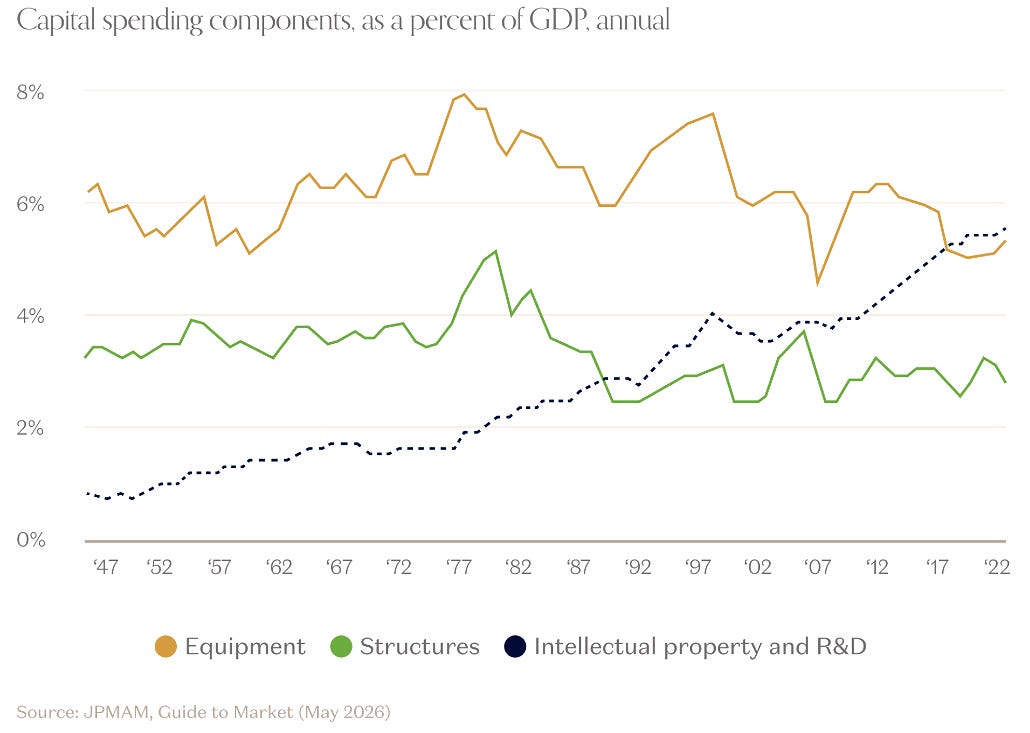
That distinction matters because tangible investment tends to create jobs across the economy. Building factories, warehouses and transport networks requires construction workers, engineers, manufacturers and suppliers, supporting large numbers of middle income jobs.
Those wages circulate through the economy, boosting consumption and creating the foundations for the next wave of growth.
It doesn’t work that way when Investment is in intangible assets.
Spending on software, algorithms and intellectual property disproportionately benefits a relatively small group of highly educated workers such as AI researchers, software engineers and biotech scientists. At the other end of the employment spectrum, demand continues for low paid service work that cannot easily be automated. For instance the gig economy thrives and there will always be demand for care workers. Yet the traditional middle of the labour market is being increasingly squeezed.
Intangible assets produce exceptional operating leverage and economies of scale. Once software is written or a platform is built, serving additional users costs little or nothing at all. When this is combined with network effects, proprietary data and the protection afforded to intellectual property, it allows a handful of firms to dominate entire markets.
Economic profits become concentrated in a small number of companies rather than being spread more broadly across the economy.
Factories can be built almost anywhere, bringing jobs and investment to local communities. In contrast, research and development clusters in a handful of established technology hubs where talent is already concentrated.
Places such as Silicon Valley, Boston and Austin continue to attract capital, while many former industrial regions struggle. This exacerbates regional inequality as a few areas boom, while the deindustrialized "Rust Belt" or rural areas suffer from capital flight, hollowed-out tax bases, and deteriorating social infrastructure.
That concentration has wider consequences for the health of the economy more generally.
Wealth becomes more concentrated, limiting the broad-based consumer spending that has historically fuelled economic expansion. This shows through in the numbers.
Despite increasing levels of capital flowing into intangible assets, productivity growth across many developed economies has remained surprisingly weak since the early 2000s.
Perhaps the biggest change is that technology is no longer simply making workers more productive.
Historically, new machinery complemented human labour; a worker with a bulldozer is more productive than one with a shovel. But much of today’s investment in artificial intelligence is aimed at removing the human operator altogether. People are losing agency.
Workers are no longer competing only with lower cost labour overseas. They are increasingly competing with algorithms. This helps explain why labour’s share of national income continues to decline relative to the share flowing to those providing the capital.
If AI continues to automate both manual and cognitive work, that long running trend may even accelerate.
But even that understates the problem.
A person who sells their time, even at a high price, cannot match the compounding rate of someone who owns a scalable assets.
This is the architecture of capitalism, but taken to extremes it eventually begins to destabilise the entire system.
Workers spend most of what they earn. Owners of capital typically do not. When a smaller share of national income flows to employees, consumer demand weakens.
Over time, that suffocates long-term economic growth by depriving it of the oxygen it needs to breathe.
There is no internal pressure within the system to rebalance itself.
The link between local consumption and local wage-setting breaks.
Corporate profits are global. Wage decisions are local.
Weak demand in one country no longer forces companies to pay workers more in that country.
Instead, it often creates a fragile low-growth trap that can persist for decades.
If consumption weakens, profits eventually come under pressure. Companies respond by cutting costs. They move more production abroad, automate further, squeeze suppliers, or reduce headcount.
The incentives inside corporations have also changed.
Since the 1980s, management focus has steadily shifted away from reinvesting profits into productive capacity and workers. The priority became maximising shareholder returns through stock buybacks, margin expansion and dividends.
Profits increasingly flow back to capital owners rather than circulating through wages.
Over time the imbalance compounds.
What happens next will sound all too familiar.
When workers no longer earn enough to sustain consumption, economies often turn to debt to maintain growth.
This is exactly what happened in the years leading up to the 2008 financial crisis.
Stagnant wages were supplemented by home equity loans, cheap mortgages and credit card debt. Consumption was artificially sustained through borrowing rather than income growth.
But that doesn’t bring the economy back into equilibrium. It creates fragility.
Eventually the debt can no longer be serviced and the system breaks.
Governments then intervene to stabilise the economy, but typically without addressing the underlying imbalance.
Fearing unemployment and recession, policymakers cut interest rates, expand monetary stimulus and support asset prices. Corporations are rescued. Financial markets recover.
Capital benefits again.
Low interest rates inflate the value of stocks, housing and financial assets, further enriching those who already own capital.
Meanwhile labour’s position continues to weaken.
Over time, this structural imbalance tends to produce one of three outcomes.
The first is secular stagnation.
This is what Japan experienced after the 1990s and much of the West experienced after 2008. Demand remains chronically weak. Growth slows. Inflation stays subdued. The economy drifts below its productive potential with no internal mechanism capable of restoring balance.
The second is repeated boom-and-bust debt cycles.
Without sufficient wage growth, economies sustain demand through expanding credit. That creates temporary booms followed by severe financial crises once the debt burden becomes unsustainable. Each cycle often leaves labour weaker than before.
The third is political destabilisation.
When living standards stagnate for large parts of the population, political pressure eventually erupts. Populism rises. Protectionism rises. Governments intervene through tariffs, subsidies and industrial policy because market forces alone fail to restore balance.
These are not random political accidents.
They are symptoms of a system struggling to distribute prosperity broadly enough to sustain itself.
And now a new force is emerging that may make the situation a whole lot worse.
Artificial Intelligence (A.I.).
If A.I. makes knowledge work cheaper, robotics makes physical work more productive, and networks distribute products globally at near-zero marginal cost, then ownership of the underlying systems becomes increasingly valuable. The economy may produce more total wealth than ever while disproportionately rewarding those who own platforms, AI models, energy infrastructure, and other scalable assets.
For decades, technology displaced labour gradually.
A.I. may compress that process into years instead of generations.
If you enjoyed this, please continue with the second essay in this series, “GDP: Booming on Paper, Crumbling Everywhere Else”
What do you think? Please leave a comment:

