

3/3: Will Artificial Intelligence Take Your Job?
Media sensationalism says 'YES' - History and economics say, 'NO'.

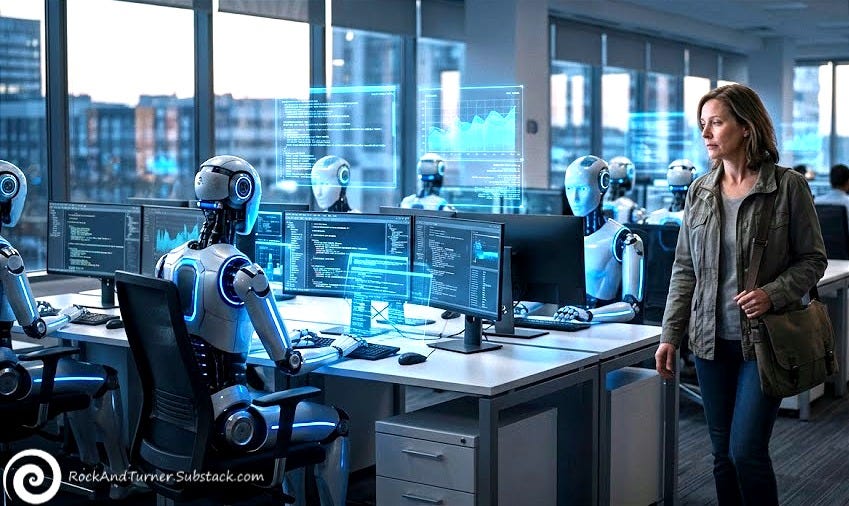
Growth Without Prosperity ~ Part III
This is the third and final part in a series of three short essays. Essay 1 explains the disease. Essay 2 shows the symptoms mutating into something more extreme. Essay 3 provides a counter argument to balance the debate.
Part I, Why Workers Keep Losing Even When the Economy Grows
Labour loses bargaining power.
The economy becomes structurally imbalanced.
Part II, AI Is Breaking the Link Between Growth and Prosperity
GDP disconnects from prosperity.
The economy begins to “boom” while society weakens underneath it.
Part III, Will Artificial Intelligence Take Your Job?
Is AI eating the world?
Or does AI create a bigger pie to feed more mouths?
Feeling Threatened By Artificial Intelligence?
One of the most common assumptions about artificial intelligence is also one of the oldest mistakes in economics.
People see a machine doing a task that previously required a human and conclude that the human will no longer be needed. It sounds logical. History suggests otherwise.
Every major leap in productivity has sparked predictions of mass unemployment. Every generation has found compelling reasons why “this time is different.”
Yet the same pattern keeps repeating. Technology automates specific tasks, lowers costs, expands access and creates far more demand than existed before.
The spreadsheet is a perfect example.
When Dan Bricklin released VisiCalc for the Apple II in 1979, accountants immediately grasped its significance. Bricklin later recalled demonstrating what the software could do almost instantly. Financial professionals would stare at the screen in disbelief before saying, “I spent all week doing that!”
The prevailing view was that computers would dramatically reduce the need for accountants. If calculations that once took days could be completed in minutes, why would companies continue employing so many people to do them?
But calculations were never the scarce resource.
The real constraint was the cost of analysis. Before spreadsheets, modelling different scenarios, updating forecasts or testing assumptions was slow and expensive. Once software removed that bottleneck, businesses didn’t perform the same amount of financial analysis with fewer people. They performed vastly more analysis than had ever been practical before.
The profession expanded rather than contracted. The United States went from roughly 340,000 accountants and accounting clerks in 1980 to around 1.4 million accountants and auditors today. Entire categories of work, from financial planning departments, quantitative analysts on trading floors, leveraged buyout modelling and sophisticated corporate planning, flourished because spreadsheets made them economically viable.
Desktop publishing followed almost exactly the same trajectory.
When PageMaker arrived for the Macintosh in 1985, many believed it would destroy professional design. Acclaimed designer Massimo Vignelli famously described desktop publishing as “a disaster of mega proportions,” arguing that giving everyone publishing tools would produce little more than visual chaos.
He was partly right.
The barriers to entry collapsed. Amateurs flooded in. Traditional typesetting jobs declined and long established unions faded away.
But what happened next was unexpected. As design became cheaper, demand exploded. Small businesses could suddenly afford marketing materials. Local organisations could produce newsletters. Startups could build brands. Millions of projects that would never previously have justified hiring a designer became worthwhile.
The profession didn’t disappear. It adapted to a much larger market. Today there are substantially more graphic designers than before desktop publishing arrived, even though the tools available to each designer are incomparably more powerful.
Radiology offers perhaps the most relevant modern comparison.
In 2016, Geoffrey Hinton (father of Artificial Intelligence and Neural Networks) argued that training radiologists would soon become unnecessary because deep learning would outperform them. His prediction became one of the defining soundbites of the AI revolution.
Almost a decade later, demand for radiologists remains exceptionally strong. Residency positions continue to increase. Leading medical centres have expanded their radiology departments. Compensation has remained among the highest in medicine. Hinton himself later acknowledged that his prediction had been too broad.
The reason is straightforward.
Reading scans is only one component of a radiologist’s role. The value lies in integrating information, exercising clinical judgement, communicating uncertainty and making decisions in complex real world settings. AI can accelerate those processes, but it also makes imaging cheaper, faster and more widely available, increasing the number of scans that clinicians can order and specialists must oversee.
Today’s AI systems are remarkably capable, but they remain highly specialised.
Whether it’s AlphaZero mastering chess and Go or ChatGPT generating text, each system excels within the domain it has been trained for.
A chess engine can learn the geometry of a 64-square board and calculate the probabilities behind millions of possible positions. A Go engine can do the same on a 19×19 grid. Yet neither understands strategy in a transferable sense. Success in one game provides no meaningful advantage in the other. Each new problem requires new training, new data, and a new framework.
That’s because modern AI doesn’t reason about the world in the way humans do. It doesn’t build a flexible mental model that can be applied across different contexts. Instead, it identifies patterns within a defined environment and optimises for a specific objective. The result is extraordinarily powerful within its domain, but surprisingly fragile outside it.
This distinction matters in the workplace.
Most valuable human work isn’t the repeated execution of a single task. It’s multi-disciplinary thinking, constructing mental models, navigating ambiguity, exercising judgement, and adapting when circumstances change. People regularly transfer lessons learned in one context to another. We improvise when rules break down. We make decisions despite incomplete information.
That doesn’t mean AI poses no threat to jobs. It clearly does.
AI will automate a growing number of routine cognitive tasks, just as machines automated many forms of physical labour. The fact that AI lacks human-level general intelligence doesn’t make workers immune from disruption. History shows that replacement doesn’t require human equivalence.
The more likely outcome is reconfiguration rather than outright substitution. AI will increasingly handle the predictable layers of many professions, while humans focus on exceptions, oversight, judgement, and adaptation. In some industries that may reduce demand for certain mid-level roles even as productivity rises.
For the foreseeable future, however, the final layer of complex work remains difficult to automate. Strategic thinking, ethical judgement, cross-disciplinary creativity, and genuine human relationships continue to resist standardisation.
The reason humans remain valuable isn’t because we can play every game. It’s because we know when the game itself needs to change.
This is the distinction many discussions about AI miss.
Technology rarely eliminates occupations wholesale. It automates individual tasks within occupations. The easier those tasks become, the more work society chooses to do.
That observation has deep roots in economics. In the nineteenth century, William Stanley Jevons noted that improvements in steam engine efficiency did not reduce Britain’s coal consumption. They increased it. More efficient engines lowered costs enough to make entirely new applications commercially attractive, causing overall demand for coal to surge.
The same dynamic appears repeatedly throughout history.
Lower the cost of computation and businesses run more models. Lower the cost of design and organisations create more content. Lower the cost of medical image interpretation and healthcare systems perform more diagnostic imaging.
Artificial intelligence is likely to follow the same path.
As the cost of producing software, research, legal drafting, marketing campaigns and creative content falls, demand for those outputs is unlikely to remain fixed. Companies will build tools they previously couldn’t justify. Entrepreneurs will launch products that were uneconomic before. Individuals will access expertise that was once available only to large enterprises.
Some jobs will certainly disappear, just as typesetters were displaced by desktop publishing. But history suggests that focusing only on the tasks machines replace misses the bigger story.
The more important effect is that lower costs expand markets. They bring in new users, enable new business models and create entirely new categories of work. Professionals spend less time on repetitive production and more time applying judgement, taste, context and accountability.
If previous technological revolutions are any guide, AI will not simply divide the existing pie differently.
It will make the pie much larger.
What do you think? Please leave a comment:
This is the third and final essay in this series, if you haven’t read the other two, please circle back.


Solid!