


First, A Note From The Author
Dear Reader
I am not normally a thematic investor. Macro economics and trends are notoriously difficult to forecast, and so allocating capital to such predictions is usually a fools errand.
I usually prefer the Buffett approach:
“I make no attempt to forecast the general market; my efforts are devoted to finding undervalued securities.” Warren Buffett
But on this occasion, I’m making an exception.
The macro situation is so compelling, and the potential implications so profound, that I believe it warrants stepping back and looking at the bigger picture before zooming in to find the investment opportunities within the theme.
I’m not interested in joining the herd and chasing A.I. momentum into over-crowded trades at unattractive valuations.
This is about second level thinking.
I’m trying to identify opportunites further up the value chain where a number of relatively unfashionable companies are positioned to benefit handsomely from the A.I. arms race between hyperscalers.
And I believe that I may have found exactly what I set out to find, so here I shall share my thinking with you.
Best regards


The Investment Theme
I like to think of data centers as AI factories. They take power, convert it into compute, and then convert that compute into valuable output.
Electricity sits at the very top of that funnel.
That’s the first clue as to where we are heading in this thematic investment thesis.
The technology companies have collectively guided towards roughly $3 trillion of AI infrastructure capex over the next few years. The chips are ordered, the land acquired and data centers are being designed.
There’s just one problem. They need electricity and lots of it.
This is where the AI infrastructure boom is running headfirst into a significant constraint: there simply isn’t enough power available in the places where these data centers want to be built.
Microsoft’s 2026 annual filing acknowledges that the availability, reliability and cost of electricity are critical to its data-center expansion. It notes that electricity infrastructure is facing increasing demand and that capacity constraints exist in many regions. It states unequivocally as a risk that limitations on power availability could restrict its ability to develop or expand capacity.
That language in a 10-K is arguably one of the most important disclosures in the entire AI investment story. Power availability is no longer an engineering footnote; it’s becoming a first-order constraint on the growth of the AI industry.
As we have seen during 2026 in the computer memory industry, when a new revolutionary technology such as AI hits a supply constraint, the economics of the bottleneck can become far more interesting than the economics of the technology itself.
Bottlenecks
Memory chips and semiconductors are in high demand today because the data centers are being built. But that demand will wane once the mega-buildout phase is complete.
Memory has historically been a highly cyclical industry, and there’s little reason to believe that has fundamentally changed. Today’s peak in activity is likely to be followed by a steep decline.
Demand for electricity is different. It hasn’t fully arrived yet. It comes only after the data centers are built and, when it arrives, it is likely to remain.
Once all of those data centers have been built, they’ll continue consuming enormous quantities of electricity indefinitely.
There’s another enormous advantage that power has over memory. China can’t destroy it.
When China enters a room, profits usually walk out. I can think of dozens of examples: steel, aluminium, chemicals, solar panels, shipbuilding and, increasingly, electric vehicles. The pattern is remarkably consistent.
Chinese companies enter an industry, benefit from cheap capital and abundant state-sponsored financing, build enormous amounts of capacity and eventually overwhelm the market with supply. Prices collapse, returns on capital deteriorate, and profit margins disappear, including those of the Chinese producers themselves.
China is now pushing aggressively into semiconductors and memory. That creates a very real risk for investors in those industries.
But the power industry is different.
China can’t flood the U.S. with subsidised electrons.
This is why power becomes the focus of this analysis, but not the subject of the investment theme.
I don’t believe the real opportunity is electricity itself. I think it’s all about the fuel required to produce it.
The Power Squeeze & The Fuel Source
Data-center construction is exploding and the associated power requirements are even more extraordinary.
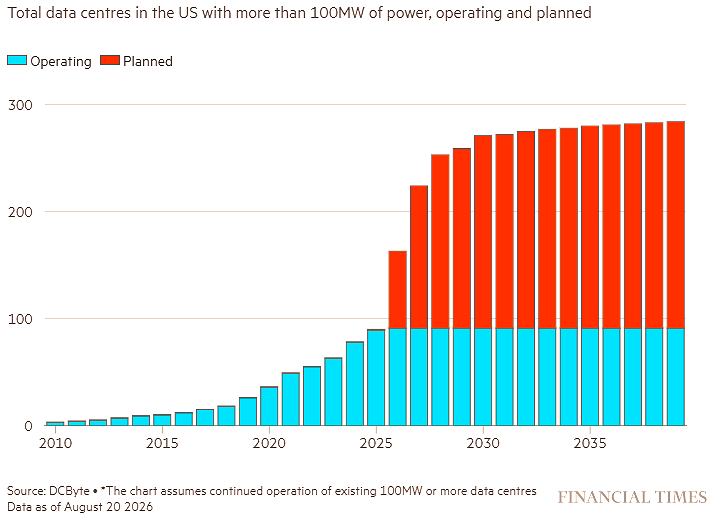
BloombergNEF now estimates that U.S. data centers could consume around 20% of the country’s electricity by 2035, compared with just 5.9% today.
Its latest estimate puts 2035 data-center demand at 194 GW. That number has been revised upwards repeatedly, increasing 2.5x in just the last 15 months.
The reason is simple. AI growth rates show no sign of abating.
The timing could hardly be worse.
Data centers are arriving at precisely the moment when electricity demand is already being pushed higher by electric vehicles, the growing number of HVAC systems associated with climate warming and the reshoring of U.S. manufacturing.
The Department of Energy forecasts that U.S. electricity demand could ultimately double by 2050.
The problem is that the U.S. power infrastructure can’t accommodate that demand quickly enough.
Nuclear plants can take 10–15 years to develop. Geothermal has historically taken 5-8 years from lease acquisition to power delivery and is geographically constrained. Solar and wind are intermittent and require storage, which becomes prohibitively expensive at the scale required.
The Trump administration’s reversal of Biden-era renewable-energy policy may exacerbate the problem by reversing course on wind, solar, storage and offshore-wind projects.
Even if it were possible to generate the requisite volume of electricity, that doesn’t solve the problem. The grid has to deliver it.
Decades of under-investment have left the transmission system without the capacity required to move all this additional power.
New transmission lines can take 7-10 years once permitting and construction are included.
AI infrastructure, meanwhile, is being built on a much shorter timetable.
Hyperscalers are turning to natural gas. It’s scalable, it’s dispatchable, and most importantly, it’s fast to deploy.
Amazon, which already operates more data centers than anyone else, is building a natural gas power plant in Pecos County, Texas, to power a new data center at the same site. The facility will generate up to 7.65 GW from 35 gas turbines.
Elon Musk’s Colossus 2 facility provides another example. It installed 59 natural gas turbines.
Oracle’s “Project Jupiter” data center in southern New Mexico swapped a planned gas‑fired plant for Bloom fuel cells after local pushback on pollution, but the fuel cells still need a steady natural‑gas supply. That’s where the 18‑mile “Green Chile” pipeline extension comes in.
The message is becoming difficult to ignore. Natural gas is rapidly becoming the fuel of choice for the AI power buildout.
Further evidence is found in the growing backlogs at the manufacturers that produce the equipment required to generate power from natural gas.
GE Vernova booked $2.7 billion of data-center orders in its Electrification segment in the second quarter of 2026 alone. First-half data-center orders exceeded $5 billion, which is more than double the entire amount booked during 2025.
Other major suppliers, including Siemens and Hitachi, have gas turbine and heavy-duty transformer production slots booked well into the 2028–2030 period.
Investing in those companies would have served you well a year ago. But those trades are now becoming increasingly crowded.
The strange thing is that investors are piling into the companies making the turbines, but not yet into the fuel required to run them.
That looks like the better trade.
This brings us to the real focus of this investment theme: natural gas.
Forward demand looks increasingly likely to outpace supply, creating the next major bottleneck in the AI buildout.
Just as memory companies captured extraordinary profits when memory became the constraint on AI deployment, I believe certain natural gas companies could benefit handsomely when the fuel required to power the AI buildout becomes the next constraint.
The Natural Gas Theme
Given the limitations of an ageing electricity grid, which currently lacks the capacity to transmit the volumes of power demanded by the AI revolution, planning approval for new data centers is increasingly contingent on their power generation being behind the meter, effectively taking them off-grid.
A secondary driver behind this policy is a widespread misconception that if data centers generate their own electricity, they are not competing with households for power and therefore will not push prices higher.
But it doesn’t quite work like that.
In wholesale power markets, electricity prices are generally set by the marginal generator.
Natural gas is frequently that marginal source.
As a result, changes in Henry Hub gas prices flow through into wholesale electricity prices across the market.
If incremental data-center demand drives up the price of natural gas, that higher gas price raises the clearing price of electricity for everyone, including electricity generated by cheaper grid-connected sources such as wind, solar and nuclear.
You can take the data center off-grid, but you can’t take its demand for energy out of the market.
That distinction is important. The issue isn’t simply whether hyperscalers are competing with households for electrons. It’s whether they are competing for the fuel required to produce those electrons.
The Global Picture
As explained, the U.S. is entering a new electricity-demand cycle at precisely the moment when its power infrastructure is least capable of accommodating it.
But this isn’t just a U.S. problem, there’s a global element to this theme.
Europe has spent the past four years reducing its dependence on Russian pipeline gas following sanctions imposed after the Ukrainian invasion.
Then, in March this year, Qatar’s Ras Laffan facility was hit by Iranian missiles. Ras Laffan is responsible for roughly a fifth of global LNG (liquid natural gas) supply.
The attack removed around 12.8 million tonnes, or 17.8%, of its annual export capacity, and full repairs could take up to five years.
More particularly, the Strait of Hormuz, which normally carries about 20% of global LNG, has been effectively closed to commercial shipping since late February and there is no sign of an immediate resolution.
European and Asian buyers are therefore competing more aggressively for alternative supply, and both are looking towards North America.
The U.S. is adding significant LNG export capacity. Golden Pass LNG began ramping operations in mid-2026, joining Sabine Pass, Corpus Christi, Freeport, and Calcasieu Pass as major Gulf Coast exporters.
On paper, the U.S. is now the world’s largest LNG exporter by volume.
Canada is also joining the party, reinforcing North America’s status as the world’s largest regional source of seaborne natural gas.
LNG Canada Phase 1 began commercial shipments in 2025, and brings a capacity of roughly 14 MTPA (Million Tonnes Per Annum).
Other Canadian LNG projects are under construction (more on this later) and Canadian exports are expected to reach approximately 48 MTPA by the end of the decade.
That changes the dynamics of the Canadian gas market.
Canada has natural gas in abundance, but historically it had only one international customer: the United States, which it supplied through pipelines. This provided the U.S. with enormous pricing power and it depressed the domestic Canadian natural gas price which naturally trends towards the price paid by the marginal customer.
But Canada’s new LNG infrastructure changes that. It will increasingly have access to global markets, particularly Europe and Asia, where it can compete for international prices.
If Canada no longer depends on the U.S. to absorb its surplus production, but can instead sell gas into whichever market offers the highest price, the implications extend beyond Canada.
The U.S. could lose access to the marginal Canadian supply it has historically relied upon, which would exacerbate any domestic U.S. natural gas supply deficit caused by a wave of data centers all arriving at the same time.
The Numbers
The Electric Power Research Institute (EPRI) estimates that U.S. data-center power demand could reach 183 GW by 2030, compared with roughly 50 GW today; approximately 133 GW of incremental capacity is required.
Nobody knows exactly how much of that incremental demand will be supplied by natural gas, but it would be safe to assume it would fall somewhere in a range of 30-60%.
That range would imply an additional 6–12 Bcf/d (billion cubic feet per day) of natural-gas demand1.
Of critical importance to this thesis is that this number far exceeds current market forecasts.
The Energy Information Administration (EIA), East Daley Analytics, and RBC Capital Markets (RBC) generally project 30–80 GW of incremental capacity being required by 2030, with gas capturing approximately 35–50% of that demand.
So the market anticipates incremental natural-gas demand of roughly 2–6 Bcf/d, while the EPRI numbers suggest it will be significantly higher at 6-12 Bcf/d.
So what’s going on? Which estimate is more accurate, and why the divergence?
Until the Iranian war broke out in February 2026, market analysis from the IEA (International Energy Agency), Wood Mackenzie, Bernstein, BNP Paribas and Kpler were all pointing to a substantial LNG glut through 2028.
Several analysts explicitly described this as a shift "from a seller's market to a buyer's market". Benchmark Asian spot prices were forecast to fall from ~$12/mmBtu toward $8–9.
This analysis was based on a wave of nameplate capacity reaching FID (final investment decision) and coming online in the US, Qatar, and Canada between 2025 and 2028.
That structural buildout is still real, but the million dollar question is whether the anticipated glut has merely been delayed or if the outlook has now fundamentally changed?
Qatari supply has been impaired, and the huge demand from AI data centers was not fully accounted for.
Assumptions regarding AI adoption speed, grid interconnect bottlenecking, and behind-the-meter gas adoption seem to have been weak. Key factors were not properly accounted for in the analysis. For instance, off-grid generation is far less efficient than large-scale combined-cycle generation; in other words, more gas is required to produce each gigawatt of behind-the-meter electricity.
So the supply versus demand equation has shifted substantially, but the U.S. natural gas market seems not yet to have responded.
Even more interesting is that other global benchmarks have moved in response to a changing macro, but Henry Hub natural gas pricing in the U.S. remains depressed.
Whereas analysts had previously forecast Asian spot prices falling from ~$12/mmBtu toward $8, instead they have risen to $21. This is no buyer’s market, at least in the short-term.
In addition to the new U.S. and Canadian capacity coming online, if the Iran conflict resolves and Ras Laffan is repaired faster than the 3-5 year estimate, the underlying oversupply dynamic could reassert itself. But in all likelihood, the supply squeeze endures until at least the end of the decade.
This is why the natural gas forward curve can be a misleading distraction. A forward curve is not a forecast of where gas prices will be in the future. It is simply a snapshot of the market’s current supply-and-demand dynamics for delivery at different points in time.

So why might the forward curve appear this way despite a high likelyhood of a supply deficit from around 2028?
Natural gas is bulky, difficult to store and expensive to transport. Storage capacity is therefore finite, and once it fills up, the producer’s bargaining power can disappear.
If storage fills completely, the local spot price can collapse to zero or even turn negative. Producers may literally pay someone to take the gas rather than shut down a producing well.
That creates a powerful incentive to sell gas forward when inventories are high, as they are presently (more on this shortly). Rather than risk having a live well producing gas with nowhere to put it, a producer can lock in future offtake, even if that means sacrificing some potential upside.
This is less a bet on where gas prices are heading than a form of insurance. The producer is not necessarily saying, “I think gas prices will be lower in the future.” He is saying, “I don’t want to find myself producing gas with nowhere to put it.”
This is why gas producers typically hedge on a declining scale. They might have 75% of 2026 production sold forward, but only 40% of 2027 output and less than 20% of 2028 output hedged.
That distinction matters. Producers are not giving away all of their future upside. The further out you go, the smaller the proportion of expected production is hedged, which means the price signal from the forward curve becomes progressively weaker.
A downward-sloping forward curve, therefore, does not necessarily mean the market expects gas prices to fall. It may simply reflect producers’ willingness to sacrifice some future upside in exchange for the certainty of being able to sell their gas.
The Inventory Signal
In the near term, the domestic market is experiencing a severe supply overhang.
The U.S. entered 2026 with inventories at 3,065 Bcf (6% above the five-year average), driven by record dry gas production of 111.2 Bcf/d, weaker industrial power demand, and a mild summer.
This surplus was compounded in July when the Freeport LNG terminal entered an extended maintenance shutdown, trapping roughly 2.0 Bcf/d of feedgas inside the country.
Unable to reach global buyers, this localized excess pushed regional prices sharply lower, even sending hubs like Waha deeply negative, and is projected to push pre-winter storage near 4,000 Bcf by October, the largest cushion since 2016.
However, this domestic surplus hides a tightening structural picture over the rest of the decade.
Back in 2010, inventories were sufficient to cover roughly 72 days of demand; today, that coverage has already dropped to under 50 days.
As new export infrastructure comes online to move trapped gas out of the U.S., and as surging data-center electricity demand hits the market, consumption will outpace inventory growth.
By the end of the decade, global coverage could fall toward the mid-30 days of inventory cover.
The issue is that it’s difficult for the market to see a big-picture shortage when gas appears abundant, and Henry Hub prices have been depressed by the short-term supply glut.
The irony is that today’s low prices are discouraging the investment required to increase forward supply capacity, strengthening this investment thesis still further.
Low prices discourage investment. Low investment creates future scarcity. Scarcity eventually drives prices higher: The best cure for low prices is low prices!
The Supply Response May Be Too Slow
A logical person may ask why U.S. gas producers wouldn’t simply ramp up production from the vast reserves under North America to solve this problem.
Good question.
The issue is that it isn’t simply a matter of turning the tap on more wells.
Everything depends upon drilling economics, decline rates, basin productivity, gathering and processing capacity and interstate pipelines.
The cheap and easy to reach reserves are already being extracted. Much of what remains comprises harder to reach deep natural gas pockets under hard rock.
These reserves only become economic when market prices for natural gas rise sufficiently to justify extracting them. At the moment, Henry Hub prices are at a cyclical low of about £2.5/MMBtu.
If the price rose closer to $8–10/MMBtu, more than three times today’s levels, higher-cost legacy basins could become economic again.
Even then, the incentive to develop harder-to-reach reserves only exists if higher prices arrive and remain high enough for producers to justify the investment in new extraction wells
A temporary price spike isn’t enough.
Producers need confidence that there will be a structural, potentially permanent, shift in the price of gas before investing in drilling.
Higher natural gas prices are not the consequence of the shortage. They are the mechanism that ultimately solves it.
So increasing production may eventually solve the volumetric problem, but it will not solve the natural gas inflation problem. The market needs higher gas prices to create the very supply response required to restore balance.
In any event, ramping up production is not an immediate solution. It typically takes 2-3 years to bring additional supply online.
Then there’s another issue to consider.
You can drill more wells, but you still need pipes to move the gas.
Only one large interstate gas pipeline, the Mountain Valley Pipeline, has been built over the past decade. Major U.S. gas infrastructure takes years to permit and build.
If the pipes needed to solve a 2028 supply deficit aren’t under construction today, they aren’t going to solve that problem in 2028.
The response from E&P companies to higher prices is therefore likely to be slow, measured and potentially insufficient.
We could be looking at several years of structural undersupply.
The LNG Factor
As discussed, by 2028, total U.S. natural gas demand is forecast to exceed domestic supply for the first time in the modern LNG era.
This is the transition I believe the market is currently missing.
U.S. gas demand is already around 111 Bcf/d. That comprises roughly 91 Bcf/d of domestic consumption and 20 Bcf/d of LNG and pipeline exports.
Near term production is anticipated to expand by around 20 Bcf/d, to ~130 Bcf/d.
At the same time, LNG export capacity is expected to increase from roughly 20 Bcf/d to around 29 Bcf/d by 2030.

If domestic demand grows as strongly as this investment thesis imagines it might, while LNG exports continue expanding, the arithmetic no longer works.
The market can move from balance to structural deficit surprisingly quickly.
This is where the investment theme really begins to take shape. If natural gas demand is moves towards a deficit, the market will experience a supply squeeze (a bottleneck).
Now consider that Canada’s LNG expansion, combined with continued U.S. Gulf Coast LNG expansion, means North America’s share of global LNG exports could rise towards 35% in coming years.
This raises an obvious question: Why export all this gas when a domestic supply squeeze may be on the horizon?
There are two parts to the answer.
First, LNG has already been sold forward through long-term contracts. Those contracts underpin the economics of more than $100 billion of U.S. Gulf Coast LNG infrastructure investment. They are legally binding, and the cash flows they produce are economically necessary.
Second, the international price differentials are enormous. While Henry Hub currently trades at depressed levels below $3/MMBtu, European Dutch TTF is roughly $18 and Asian JKM is around $21.
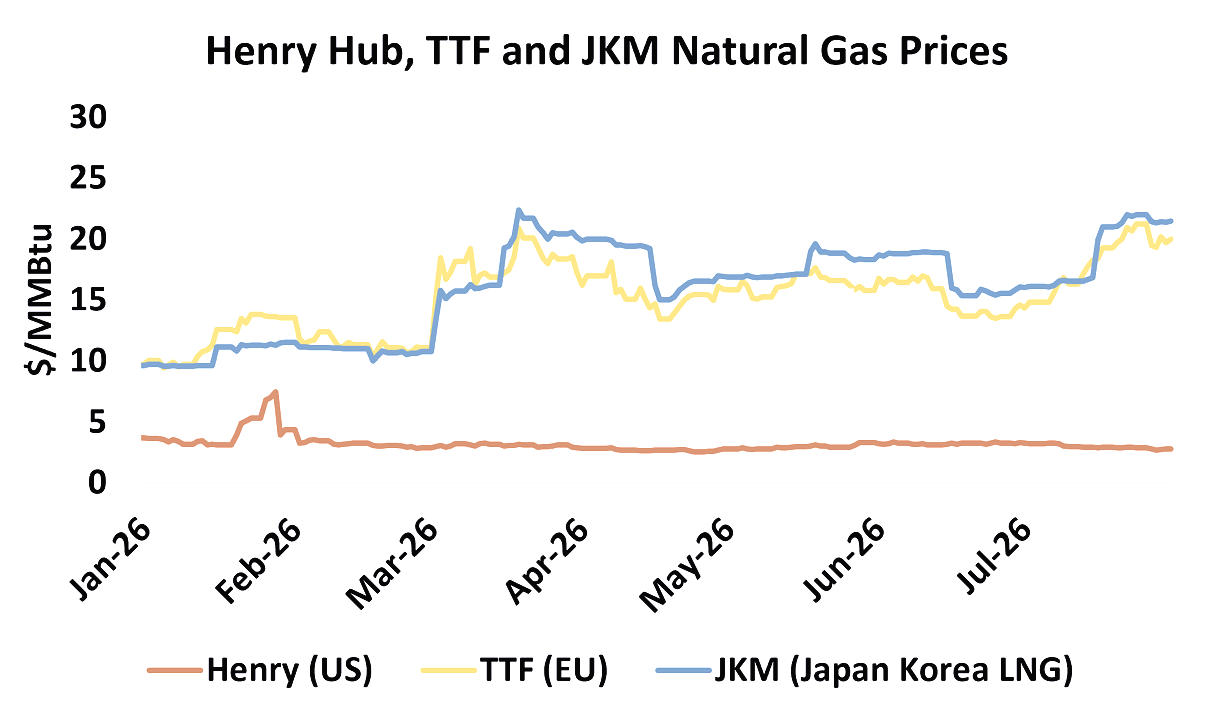
The spreads have widened considerably since the damage to Qatar’s LNG infrastructure combined with the impact of the blockade in the Straits of Hormuz.
As global LNG prices spike, North American exporters maximise utilisation, and any uncontracted cargoes naturally flow towards the highest-paying market.
The dynamic of this market has changed, and that’s important to understand.
In the past, cheap U.S. shale gas effectively set the floor for global LNG pricing, but as export capacity expands, the relationship is beginning to work in the opposite direction.
Higher global LNG prices draw more North American gas towards export terminals. That reduces domestic supply and will ultimately pull Henry Hub prices higher.
The U.S. gas market is therefore transitioning from a domestic supply-push environment to a global demand-pull market.
The implications for the domestic gas market are obvious. Higher gas and power prices are coming.
The Market Is Already Sending Signals
The Industrial Energy Consumers of America is aggressively lobbying Washington against further LNG infrastructure expansion.
Manufacturers argue that the share of domestic gas consumed by LNG producers could rise from 13% towards 20% by 2030, and their concern is straightforward.
A tighter domestic gas market translates directly into higher electricity and raw-material bills for U.S. families and manufacturing sites.
Oil and gas major, Shell, sees the same tightening dynamic, although from a global rather than U.S.-centric perspective. The world’s largest LNG trader argues that additional global export capacity will be required through the 2030s and 2040s even under its lowest demand scenarios.
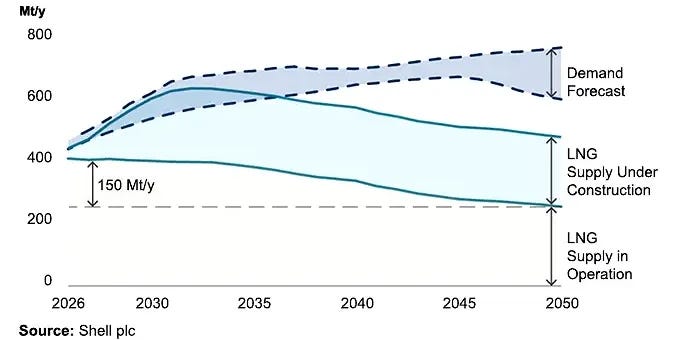
Shell isn’t just talking about it, it’s acting. It agreed to acquire ARC Resources for approximately US$16.4 billion. ARC’s principal attraction is its high-quality position in the Montney, a major gas and liquids basin in British Columbia and Alberta.
The acquisition gives Shell more direct control over a large, relatively low-cost gas resource, additional feedgas linked to LNG Canada, greater exposure to North American natural gas and a long-life production base capable of supporting international exports for decades.
It has a 40% interest in LNG Canada Phase 1 and is targeting a final investment decision by the end of 2026 on the expansion. Phase 2 could potentially double export capacity.
The ARC acquisition and LNG Canada Phase 2 are therefore two pieces of the same puzzle. Shell wouldn’t need to acquire ARC’s Montney resources to secure future feedgas if LNG Canada Phase 2 wasn’t moving forward. So the acquisition is another signal that Shell expects Canadian gas to become increasingly valuable in global LNG markets.
There are numerous LNG projects underway across Canada which will see capacity increase from 14 MMtpa today to 48 MMtpa by the end of the decade. In addition to LNG Canada Phase 2, there is Cedar LNG, Woodfibre LNG, and Ksi Lisims. Collectively these major infrastructure investments reflect a shared consensus among global capital allocators that the investment opportunity in the LNG market is very attractive.
Then there’s another, less obvious signal that is equally revealing.
In September 2025, MidOcean Energy, led by former Shell executive De la Rey Venter, agreed to acquire a 20% interest in Petronas’s key Canadian entities, the North Montney Upstream Joint Venture and the North Montney LNG Limited Partnership, in a transaction valued at just over $3 billion.
The deal gives MidOcean exposure to an estimated 53 trillion cubic feet of reserves and contingent resources, together with downstream liquefaction and export infrastructure through Petronas’s 25% stake in LNG Canada.
What makes the transaction particularly interesting is who is backing MidOcean. Its investors include Saudi Aramco and Mitsubishi.
These are not speculative investors chasing the latest commodity trade. They are global energy and industrial powerhouses that clearly see strategic value in an undervalued natural gas market.
Other investors are beginning to act on these signals.
Chronometer Partners, an investment firm focused on energy markets, is now directionally aligned with the tightening narrative. Matt Smith, its CIO, uses a bottom-up model incorporating well-level data across public and private producers, midstream infrastructure and actual acreage. His conclusion is striking: The U.S. could face a deficit of more than 5 Bcf/d by 2030, with storage depleting well before the end of the decade.
The signals are compelling on this investment theme. Once you see it, it can’t be unseen.
The Investment Opportunity
We have two very different views of the future. The forward curve argues for supply equilibrium. Qualified voices with detailed bottom-up models are arguing for significant tightening.
One of them is going to be wrong.
If the market is right, there is little to see here. Gas remains plentiful. Data-center demand is lower than expected. LNG exports absorb the additional supply. Prices remain subdued. Fine.
But if the market is wrong, the asymmetry changes dramatically. A structural shortage creates a bottleneck. A bottleneck creates pricing power. Pricing power creates profits.
We have already seen exactly this dynamic play out in the memory sector.
My expectation is that the effect of this bottleneck could begin becoming visible around the middle of 2027 and run into the early 2030s.
Eventually, the capital cycle will solve the problem: Additional gas production will arrive, nuclear will expand, geothermal will contribute and most importantly, the electricity grid will eventually be upgraded.
But those things take time. That’s what creates this opportunity.
Of course, there are risks.
Politicians could intervene if household electricity bills rise sharply. LNG exports could be restricted or taxed on national-security grounds. A.I. data-center construction could disappoint. Improvements in A.I. efficiency could reduce electricity requirements. Ras Laffan could be repaired faster than expected. A change in Russian leadership could bring additional gas back onto global markets.
Any of these developments could materially change the economics.
That doesn’t make the opportunity unattractive, it just makes the setup interesting rather than obvious.
This looks like a superior bet, with good convexity and a favourable asymmetric risk-reward profile.
The question therefore moves from whether the opportunity exists to how best to play it.
Finding The Picks
I have spent several months researching different ways to express this theme.
I looked at hundreds of companies that, in one way or another, stand to benefit from a stronger natural gas and LNG market.
Most were quickly dismissed. Some had poor management. Others had poor unit economics. Some had impaired balance sheets. Many lacked meaningful differentiation and therefore had no sustainable competitive advantage.
The objective wasn’t to find companies that simply rise when the gas price rises. That’s too easy.
The objective was to find businesses with the characteristics that could allow them to capture an outsized share of the economics as the bottleneck develops.
After working through the universe, I found five hidden gems, all occupying a different niche in the natural gas eco-system.
These companies offer a compelling way to participate in what could become one of the most significant investment opportunities of the coming decade.
All five are actionable ideas. All six have substantial upside potential. Most importantly, I believe the downside risk is limited relative to the potential reward.
That level of research has value, so the next part of the thesis will sit behind a paywall.
I believe the small subscription fee represents excellent value for what is, ultimately, an attempt to identify a handful of potentially very attractive long-term investments.