


First, A Note From The Author
Dear Reader
I am not normally a thematic investor. Macro economics and trends are notoriously difficult to forecast, and so allocating capital to such predictions is usually a fools errand.
I usually prefer the Buffett approach:
“I make no attempt to forecast the general market; my efforts are devoted to finding undervalued securities.” Warren Buffett
But on this occasion, I’m making an exception.
The macro situation is so compelling, and the potential implications so profound, that I believe it warrants stepping back and looking at the bigger picture before zooming in to find the investment opportunities within the theme.
I’m not interested in joining the herd and chasing A.I. momentum into over-crowded trades at unattractive valuations.
This is about second level thinking.
I’m trying to identify opportunites further up the value chain where a number of relatively unfashionable companies are positioned to benefit handsomely from the A.I. arms race between hyperscalers.
And I believe that I may have found exactly what I set out to find, so here I shall share my thinking with you.
Best regards


The Investment Theme
I like to think of data centers as AI factories. They take power, convert it into compute, and then convert that compute into valuable output.
Electricity sits at the very top of that funnel.
That’s the first clue as to where we are heading in this thematic investment thesis.
The technology companies have collectively guided towards roughly $3 trillion of AI infrastructure capex over the next few years. The chips are ordered, the land acquired and data centers are being designed.
There’s just one problem. They need electricity and lots of it.
This is where the AI infrastructure boom is running headfirst into a significant constraint: there simply isn’t enough power available in the places where these data centers want to be built.
Microsoft’s 2026 annual filing acknowledges that the availability, reliability and cost of electricity are critical to its data-center expansion. It notes that electricity infrastructure is facing increasing demand and that capacity constraints exist in many regions. It states unequivocally as a risk that limitations on power availability could restrict its ability to develop or expand capacity.
That language in a 10-K is arguably one of the most important disclosures in the entire AI investment story. Power availability is no longer an engineering footnote; it’s becoming a first-order constraint on the growth of the AI industry.
As we have seen during 2026 in the computer memory industry, when a new revolutionary technology such as AI hits a supply constraint, the economics of the bottleneck can become far more interesting than the economics of the technology itself.
Bottlenecks
Memory chips and semiconductors are in high demand today because the data centers are being built. But that demand will wane once the mega-buildout phase is complete.
Memory has historically been a highly cyclical industry, and there’s little reason to believe that has fundamentally changed. Today’s peak in activity is likely to be followed by a steep decline.
Demand for electricity is different. It hasn’t fully arrived yet. It comes only after the data centers are built and, when it arrives, it is likely to remain.
Once all of those data centers have been built, they’ll continue consuming enormous quantities of electricity indefinitely.
There’s another enormous advantage that power has over memory. China can’t destroy it.
When China enters a room, profits usually walk out. I can think of dozens of examples: steel, aluminium, chemicals, solar panels, shipbuilding and, increasingly, electric vehicles. The pattern is remarkably consistent.
Chinese companies enter an industry, benefit from cheap capital and abundant state-sponsored financing, build enormous amounts of capacity and eventually overwhelm the market with supply. Prices collapse, returns on capital deteriorate, and profit margins disappear, including those of the Chinese producers themselves.
China is now pushing aggressively into semiconductors and memory. That creates a very real risk for investors in those industries.
But the power industry is different.
China can’t flood the U.S. with subsidised electrons.
This is why power becomes the focus of this analysis, but not the subject of the investment theme.
I don’t believe the real opportunity is electricity itself. I think it’s all about the fuel required to produce it.
The Power Squeeze & The Fuel Source
Data-center construction is exploding and the associated power requirements are even more extraordinary.
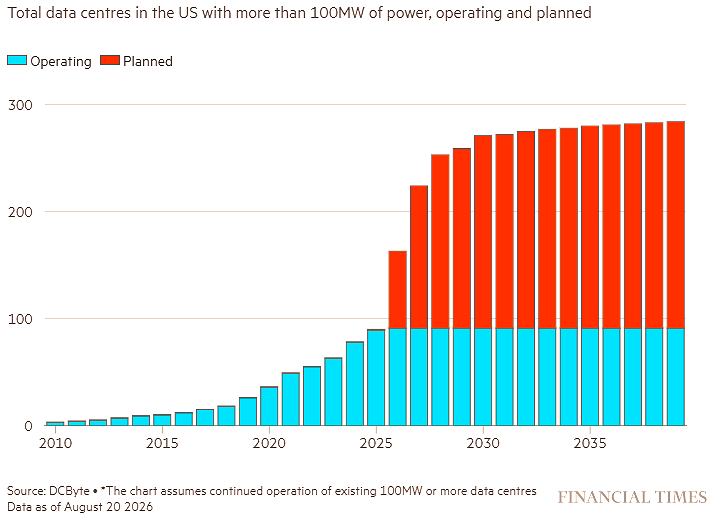
BloombergNEF now estimates that U.S. data centers could consume around 20% of the country’s electricity by 2035, compared with just 5.9% today.
Its latest estimate puts 2035 data-center demand at 194 GW. That number has been revised upwards repeatedly, increasing 2.5x in just the last 15 months.
The reason is simple. AI growth rates show no sign of abating.
Not only are the number of data centers increasing, but the size and scale of each data center is also expanding.
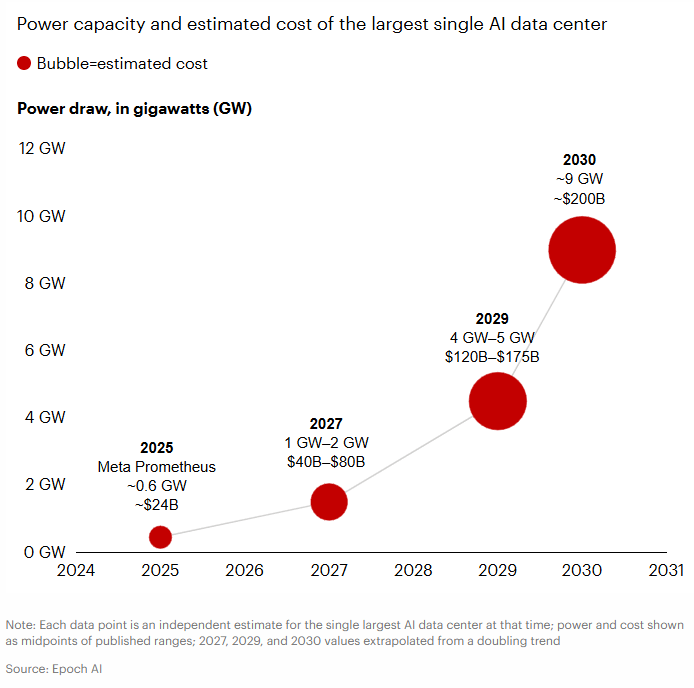
The timing could hardly be worse.
Data centers are arriving at precisely the moment when electricity demand is already being pushed higher by electric vehicles, the growing number of HVAC systems associated with climate warming and the reshoring of U.S. manufacturing.
The Department of Energy forecasts that U.S. electricity demand could ultimately double by 2050.
The problem is that the U.S. power infrastructure can’t accommodate that demand quickly enough.
Nuclear plants can take 10–15 years to develop. Geothermal has historically taken 5-8 years from lease acquisition to power delivery and is geographically constrained. Solar and wind are intermittent and require storage, which becomes prohibitively expensive at the scale required.
The Trump administration’s reversal of Biden-era renewable-energy policy may exacerbate the problem by reversing course on wind, solar, storage and offshore-wind projects.
Even if it were possible to generate the requisite volume of electricity, that doesn’t solve the problem. The grid has to deliver it.
Decades of under-investment have left the transmission system without the capacity required to move all this additional power.
New transmission lines can take 7-10 years once permitting and construction are included.
AI infrastructure, meanwhile, is being built on a much shorter timetable.
Hyperscalers are turning to natural gas. It’s scalable, it’s dispatchable, and most importantly, it’s fast to deploy.
Amazon, which already operates more data centers than anyone else, is building a natural gas power plant in Pecos County, Texas, to power a new data center at the same site. The facility will generate up to 7.65 GW from 35 gas turbines.
Elon Musk’s Colossus 2 facility provides another example. It installed 59 natural gas turbines.
Oracle’s “Project Jupiter” data center in southern New Mexico swapped a planned gas‑fired plant for Bloom fuel cells after local pushback on pollution, but the fuel cells still need a steady natural‑gas supply. That’s where the 18‑mile “Green Chile” pipeline extension comes in.
The message is becoming difficult to ignore. Natural gas is rapidly becoming the fuel of choice for the AI power buildout.
Further evidence is found in the growing backlogs at the manufacturers that produce the equipment required to generate power from natural gas.
GE Vernova booked $2.7 billion of data-center orders in its Electrification segment in the second quarter of 2026 alone. First-half data-center orders exceeded $5 billion, which is more than double the entire amount booked during 2025.
Other major suppliers, including Siemens and Hitachi, have gas turbine and heavy-duty transformer production slots booked well into the 2028–2030 period.
Investing in those companies would have served you well a year ago. But those trades are now becoming increasingly crowded.
The strange thing is that investors are piling into the companies making the turbines, but not yet into the fuel required to run them.
That looks like the better trade.
This brings us to the real focus of this investment theme: natural gas.
Forward demand looks increasingly likely to outpace supply, creating the next major bottleneck in the AI buildout.
Just as memory companies captured extraordinary profits when memory became the constraint on AI deployment, I believe certain natural gas companies could benefit handsomely when the fuel required to power the AI buildout becomes the next constraint.
The Natural Gas Theme
Given the limitations of an ageing electricity grid, which currently lacks the capacity to transmit the volumes of power demanded by the AI revolution, planning approval for new data centers is increasingly contingent on their power generation being behind the meter, effectively taking them off-grid.
A secondary driver behind this policy is a widespread misconception that if data centers generate their own electricity, they are not competing with households for power and therefore will not push prices higher.
But it doesn’t quite work like that.
In wholesale power markets, electricity prices are generally set by the marginal generator.
Natural gas is frequently that marginal source.
As a result, changes in Henry Hub gas prices flow through into wholesale electricity prices across the market.
If incremental data-center demand drives up the price of natural gas, that higher gas price raises the clearing price of electricity for everyone, including electricity generated by cheaper grid-connected sources such as wind, solar and nuclear.
You can take the data center off-grid, but you can’t take its demand for energy out of the market.
That distinction is important. The issue isn’t simply whether hyperscalers are competing with households for electrons. It’s whether they are competing for the fuel required to produce those electrons.
The Global Picture
As explained, the U.S. is entering a new electricity-demand cycle at precisely the moment when its power infrastructure is least capable of accommodating it.
But this isn’t just a U.S. problem, there’s a global element to this theme.
Europe has spent the past four years reducing its dependence on Russian pipeline gas following sanctions imposed after the Ukrainian invasion.
Then, in March this year, Qatar’s Ras Laffan facility was hit by Iranian missiles. Ras Laffan is responsible for roughly a fifth of global LNG (liquid natural gas) supply.
The attack removed around 12.8 million tonnes, or 17.8%, of its annual export capacity, and full repairs could take up to five years.
More particularly, the Strait of Hormuz, which normally carries about 20% of global LNG, has been effectively closed to commercial shipping since late February and there is no sign of an immediate resolution.
European and Asian buyers are therefore competing more aggressively for alternative supply, and both are looking towards North America.
The U.S. is adding significant LNG export capacity. Golden Pass LNG began ramping operations in mid-2026, joining Sabine Pass, Corpus Christi, Freeport, and Calcasieu Pass as major Gulf Coast exporters.
On paper, the U.S. is now the world’s largest LNG exporter by volume.
Canada is also joining the party, reinforcing North America’s status as the world’s largest regional source of seaborne natural gas.
LNG Canada Phase 1 began commercial shipments in 2025, and brings a capacity of roughly 14 MTPA (Million Tonnes Per Annum).
Other Canadian LNG projects are under construction (more on this later) and Canadian exports are expected to reach approximately 48 MTPA by the end of the decade.
That changes the dynamics of the Canadian gas market.
Canada has natural gas in abundance, but historically it had only one international customer: the United States, which it supplied through pipelines. This provided the U.S. with enormous pricing power and it depressed the domestic Canadian natural gas price which naturally trends towards the price paid by the marginal customer.
But Canada’s new LNG infrastructure changes that. It will increasingly have access to global markets, particularly Europe and Asia, where it can compete for international prices.
If Canada no longer depends on the U.S. to absorb its surplus production, but can instead sell gas into whichever market offers the highest price, the implications extend beyond Canada.
The U.S. could lose access to the marginal Canadian supply it has historically relied upon, which would exacerbate any domestic U.S. natural gas supply deficit caused by a wave of data centers all arriving at the same time.
The Numbers
The Electric Power Research Institute (EPRI) estimates that U.S. data-center power demand could reach 183 GW by 2030, compared with roughly 50 GW today; approximately 133 GW of incremental capacity is required.
Nobody knows exactly how much of that incremental demand will be supplied by natural gas, but it would be safe to assume it would fall somewhere in a range of 30-60%.
That range would imply an additional 6–12 Bcf/d (billion cubic feet per day) of natural-gas demand1.
Of critical importance to this thesis is that this number far exceeds current market forecasts.
The Energy Information Administration (EIA), East Daley Analytics, and RBC Capital Markets (RBC) generally project 30–80 GW of incremental capacity being required by 2030, with gas capturing approximately 35–50% of that demand.
So the market anticipates incremental natural-gas demand of roughly 2–6 Bcf/d, while the EPRI numbers suggest it will be significantly higher at 6-12 Bcf/d.
So what’s going on? Which estimate is more accurate, and why the divergence?
Until the Iranian war broke out in February 2026, market analysis from the IEA (International Energy Agency), Wood Mackenzie, Bernstein, BNP Paribas and Kpler were all pointing to a substantial LNG glut through 2028.
Several analysts explicitly described this as a shift "from a seller's market to a buyer's market". Benchmark Asian spot prices were forecast to fall from ~$12/mmBtu toward $8–9.
This analysis was based on a wave of nameplate capacity reaching FID (final investment decision) and coming online in the US, Qatar, and Canada between 2025 and 2028.
That structural buildout is still real, but the million dollar question is whether the anticipated glut has merely been delayed or if the outlook has now fundamentally changed?
Qatari supply has been impaired, and the huge demand from AI data centers was not fully accounted for.
Assumptions regarding AI adoption speed, grid interconnect bottlenecking, and behind-the-meter gas adoption seem to have been weak. Key factors were not properly accounted for in the analysis. For instance, off-grid generation is far less efficient than large-scale combined-cycle generation; in other words, more gas is required to produce each gigawatt of behind-the-meter electricity.
So the supply versus demand equation has shifted substantially, but the U.S. natural gas market seems not yet to have responded.
Even more interesting is that other global benchmarks have moved in response to a changing macro, but Henry Hub natural gas pricing in the U.S. remains depressed.
Whereas analysts had previously forecast Asian spot prices falling from ~$12/mmBtu toward $8, instead they have risen to $21. This is no buyer’s market, at least in the short-term.
In addition to the new U.S. and Canadian capacity coming online, if the Iran conflict resolves and Ras Laffan is repaired faster than the 3-5 year estimate, the underlying oversupply dynamic could reassert itself. But in all likelihood, the supply squeeze endures until at least the end of the decade.
This is why the natural gas forward curve can be a misleading distraction. A forward curve is not a forecast of where gas prices will be in the future. It is simply a snapshot of the market’s current supply-and-demand dynamics for delivery at different points in time.

So why might the forward curve appear this way despite a high likelyhood of a supply deficit from around 2028?
Natural gas is bulky, difficult to store and expensive to transport. Storage capacity is therefore finite, and once it fills up, the producer’s bargaining power can disappear.
If storage fills completely, the local spot price can collapse to zero or even turn negative. Producers may literally pay someone to take the gas rather than shut down a producing well.
That creates a powerful incentive to sell gas forward when inventories are high, as they are presently (more on this shortly). Rather than risk having a live well producing gas with nowhere to put it, a producer can lock in future offtake, even if that means sacrificing some potential upside.
This is less a bet on where gas prices are heading than a form of insurance. The producer is not necessarily saying, “I think gas prices will be lower in the future.” He is saying, “I don’t want to find myself producing gas with nowhere to put it.”
This is why gas producers typically hedge on a declining scale. They might have 75% of 2026 production sold forward, but only 40% of 2027 output and less than 20% of 2028 output hedged.
That distinction matters. Producers are not giving away all of their future upside. The further out you go, the smaller the proportion of expected production is hedged, which means the price signal from the forward curve becomes progressively weaker.
A downward-sloping forward curve, therefore, does not necessarily mean the market expects gas prices to fall. It may simply reflect producers’ willingness to sacrifice some future upside in exchange for the certainty of being able to sell their gas.
The Inventory Signal
In the near term, the domestic market is experiencing a severe supply overhang.
The U.S. entered 2026 with inventories at 3,065 Bcf (6% above the five-year average), driven by record dry gas production of 111.2 Bcf/d, weaker industrial power demand, and a mild summer.
This surplus was compounded in July when the Freeport LNG terminal entered an extended maintenance shutdown, trapping roughly 2.0 Bcf/d of feedgas inside the country.
Unable to reach global buyers, this localized excess pushed regional prices sharply lower, even sending hubs like Waha deeply negative, and is projected to push pre-winter storage near 4,000 Bcf by October, the largest cushion since 2016.
However, this domestic surplus hides a tightening structural picture over the rest of the decade.
Back in 2010, inventories were sufficient to cover roughly 72 days of demand; today, that coverage has already dropped to under 50 days.
As new export infrastructure comes online to move trapped gas out of the U.S., and as surging data-center electricity demand hits the market, consumption will outpace inventory growth.
By the end of the decade, global coverage could fall toward the mid-30 days of inventory cover.
The issue is that it’s difficult for the market to see a big-picture shortage when gas appears abundant, and Henry Hub prices have been depressed by the short-term supply glut.
The irony is that today’s low prices are discouraging the investment required to increase forward supply capacity, strengthening this investment thesis still further.
Low prices discourage investment. Low investment creates future scarcity. Scarcity eventually drives prices higher: The best cure for low prices is low prices!
The Supply Response May Be Too Slow
A logical person may ask why U.S. gas producers wouldn’t simply ramp up production from the vast reserves under North America to solve this problem.
Good question.
The issue is that it isn’t simply a matter of turning the tap on more wells.
Everything depends upon drilling economics, decline rates, basin productivity, gathering and processing capacity and interstate pipelines.
The cheap and easy to reach reserves are already being extracted. Much of what remains comprises harder to reach deep natural gas pockets under hard rock.
These reserves only become economic when market prices for natural gas rise sufficiently to justify extracting them. At the moment, Henry Hub prices are at a cyclical low of about £2.5/MMBtu.
If the price rose closer to $8–10/MMBtu, more than three times today’s levels, higher-cost legacy basins could become economic again.
Even then, the incentive to develop harder-to-reach reserves only exists if higher prices arrive and remain high enough for producers to justify the investment in new extraction wells
A temporary price spike isn’t enough.
Producers need confidence that there will be a structural, potentially permanent, shift in the price of gas before investing in drilling.
Higher natural gas prices are not the consequence of the shortage. They are the mechanism that ultimately solves it.
So increasing production may eventually solve the volumetric problem, but it will not solve the natural gas inflation problem. The market needs higher gas prices to create the very supply response required to restore balance.
In any event, ramping up production is not an immediate solution. It typically takes 2-3 years to bring additional supply online.
Then there’s another issue to consider.
You can drill more wells, but you still need pipes to move the gas.
Only one large interstate gas pipeline, the Mountain Valley Pipeline, has been built over the past decade. Major U.S. gas infrastructure takes years to permit and build.
If the pipes needed to solve a 2028 supply deficit aren’t under construction today, they aren’t going to solve that problem in 2028.
The response from E&P companies to higher prices is therefore likely to be slow, measured and potentially insufficient.
We could be looking at several years of structural undersupply.
The LNG Factor
As discussed, by 2028, total U.S. natural gas demand is forecast to exceed domestic supply for the first time in the modern LNG era.
This is the transition I believe the market is currently missing.
U.S. gas demand is already around 111 Bcf/d. That comprises roughly 91 Bcf/d of domestic consumption and 20 Bcf/d of LNG and pipeline exports.
Near term production is anticipated to expand by around 20 Bcf/d, to ~130 Bcf/d.
At the same time, LNG export capacity is expected to increase from roughly 20 Bcf/d to around 29 Bcf/d by 2030.

If domestic demand grows as strongly as this investment thesis imagines it might, while LNG exports continue expanding, the arithmetic no longer works.
The market can move from balance to structural deficit surprisingly quickly.
This is where the investment theme really begins to take shape. If natural gas demand is moves towards a deficit, the market will experience a supply squeeze (a bottleneck).
Now consider that Canada’s LNG expansion, combined with continued U.S. Gulf Coast LNG expansion, means North America’s share of global LNG exports could rise towards 35% in coming years.
This raises an obvious question: Why export all this gas when a domestic supply squeeze may be on the horizon?
There are two parts to the answer.
First, LNG has already been sold forward through long-term contracts. Those contracts underpin the economics of more than $100 billion of U.S. Gulf Coast LNG infrastructure investment. They are legally binding, and the cash flows they produce are economically necessary.
Second, the international price differentials are enormous. While Henry Hub currently trades at depressed levels below $3/MMBtu, European Dutch TTF is roughly $18 and Asian JKM is around $21.
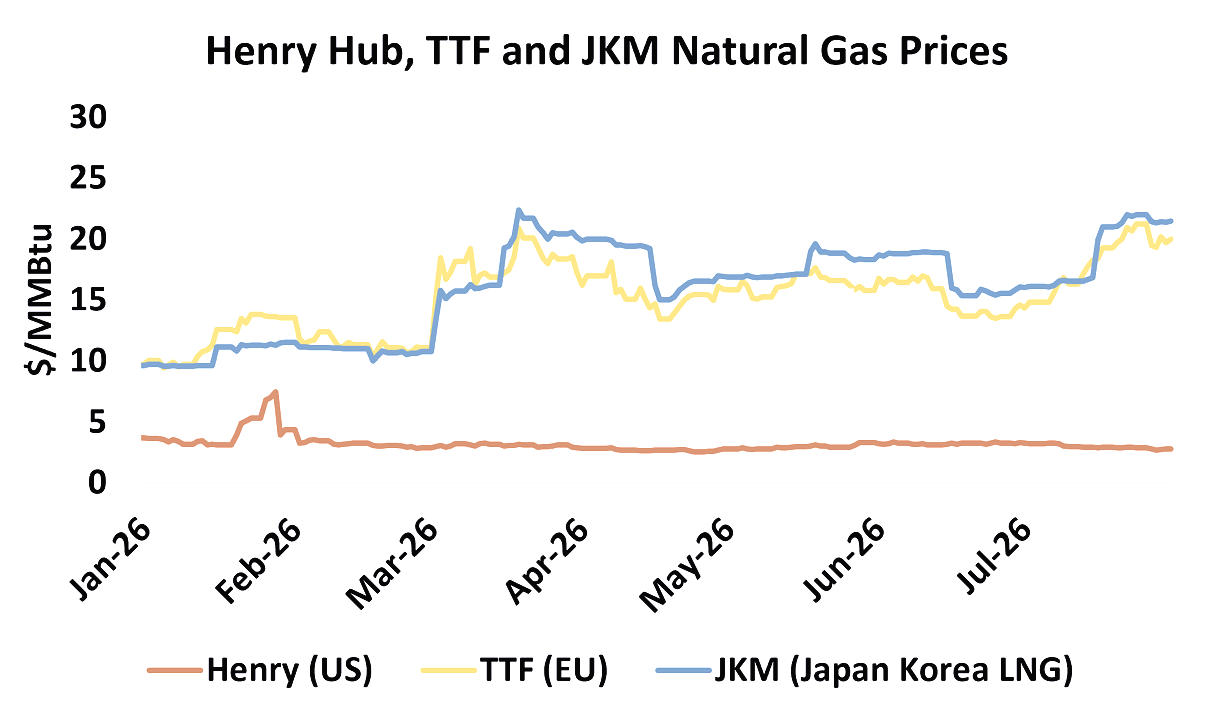
The spreads have widened considerably since the damage to Qatar’s LNG infrastructure combined with the impact of the blockade in the Straits of Hormuz.
As global LNG prices spike, North American exporters maximise utilisation, and any uncontracted cargoes naturally flow towards the highest-paying market.
The dynamic of this market has changed, and that’s important to understand.
In the past, cheap U.S. shale gas effectively set the floor for global LNG pricing, but as export capacity expands, the relationship is beginning to work in the opposite direction.
Higher global LNG prices draw more North American gas towards export terminals. That reduces domestic supply and will ultimately pull Henry Hub prices higher.
The U.S. gas market is therefore transitioning from a domestic supply-push environment to a global demand-pull market.
The implications for the domestic gas market are obvious. Higher gas and power prices are coming.
The Market Is Already Sending Signals
The Industrial Energy Consumers of America is aggressively lobbying Washington against further LNG infrastructure expansion.
Manufacturers argue that the share of domestic gas consumed by LNG producers could rise from 13% towards 20% by 2030, and their concern is straightforward.
A tighter domestic gas market translates directly into higher electricity and raw-material bills for U.S. families and manufacturing sites.
Oil and gas major, Shell, sees the same tightening dynamic, although from a global rather than U.S.-centric perspective. The world’s largest LNG trader argues that additional global export capacity will be required through the 2030s and 2040s even under its lowest demand scenarios.
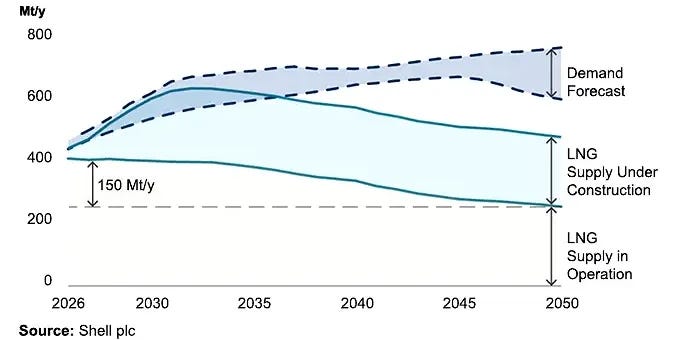
Shell isn’t just talking about it, it’s acting. It agreed to acquire ARC Resources for approximately US$16.4 billion. ARC’s principal attraction is its high-quality position in the Montney, a major gas and liquids basin in British Columbia and Alberta.
The acquisition gives Shell more direct control over a large, relatively low-cost gas resource, additional feedgas linked to LNG Canada, greater exposure to North American natural gas and a long-life production base capable of supporting international exports for decades.
It has a 40% interest in LNG Canada Phase 1 and is targeting a final investment decision by the end of 2026 on the expansion. Phase 2 could potentially double export capacity.
The ARC acquisition and LNG Canada Phase 2 are therefore two pieces of the same puzzle. Shell wouldn’t need to acquire ARC’s Montney resources to secure future feedgas if LNG Canada Phase 2 wasn’t moving forward. So the acquisition is another signal that Shell expects Canadian gas to become increasingly valuable in global LNG markets.
There are numerous LNG projects underway across Canada which will see capacity increase from 14 MMtpa today to 48 MMtpa by the end of the decade. In addition to LNG Canada Phase 2, there is Cedar LNG, Woodfibre LNG, and Ksi Lisims. Collectively these major infrastructure investments reflect a shared consensus among global capital allocators that the investment opportunity in the LNG market is very attractive.
Then there’s another, less obvious signal that is equally revealing.
In September 2025, MidOcean Energy, led by former Shell executive De la Rey Venter, agreed to acquire a 20% interest in Petronas’s key Canadian entities, the North Montney Upstream Joint Venture and the North Montney LNG Limited Partnership, in a transaction valued at just over $3 billion.
The deal gives MidOcean exposure to an estimated 53 trillion cubic feet of reserves and contingent resources, together with downstream liquefaction and export infrastructure through Petronas’s 25% stake in LNG Canada.
What makes the transaction particularly interesting is who is backing MidOcean. Its investors include Saudi Aramco and Mitsubishi.
These are not speculative investors chasing the latest commodity trade. They are global energy and industrial powerhouses that clearly see strategic value in an undervalued natural gas market.
Other investors are beginning to act on these signals.
Chronometer Partners, an investment firm focused on energy markets, is now directionally aligned with the tightening narrative. Matt Smith, its CIO, uses a bottom-up model incorporating well-level data across public and private producers, midstream infrastructure and actual acreage. His conclusion is striking: The U.S. could face a deficit of more than 5 Bcf/d by 2030, with storage depleting well before the end of the decade.
The signals are compelling on this investment theme. Once you see it, it can’t be unseen.
The Investment Opportunity
We have two very different views of the future. The forward curve argues for supply equilibrium. Qualified voices with detailed bottom-up models are arguing for significant tightening.
One of them is going to be wrong.
If the market is right, there is little to see here. Gas remains plentiful. Data-center demand is lower than expected. LNG exports absorb the additional supply. Prices remain subdued. Fine.
But if the market is wrong, the asymmetry changes dramatically. A structural shortage creates a bottleneck. A bottleneck creates pricing power. Pricing power creates profits.
We have already seen exactly this dynamic play out in the memory sector.
My expectation is that the effect of this bottleneck could begin becoming visible around the middle of 2027 and run into the early 2030s.
Eventually, the capital cycle will solve the problem: Additional gas production will arrive, nuclear will expand, geothermal will contribute and most importantly, the electricity grid will eventually be upgraded.
But those things take time. That’s what creates this opportunity.
Of course, there are risks.
Politicians could intervene if household electricity bills rise sharply. LNG exports could be restricted or taxed on national-security grounds. A.I. data-center construction could disappoint. Improvements in A.I. efficiency could reduce electricity requirements. Ras Laffan could be repaired faster than expected. A change in Russian leadership could bring additional gas back onto global markets.
Any of these developments could materially change the economics.
That doesn’t make the opportunity unattractive, it just makes the setup interesting rather than obvious.
This looks like a superior bet, with good convexity and a favourable asymmetric risk-reward profile.
The question therefore moves from whether the opportunity exists to how best to play it.
Finding The Picks
I have spent several months researching different ways to express this theme.
I looked at hundreds of companies that, in one way or another, stand to benefit from a stronger natural gas and LNG market.
Most were quickly dismissed. Some had poor management. Others had poor unit economics. Some had impaired balance sheets. Many lacked meaningful differentiation and therefore had no sustainable competitive advantage.
The objective wasn’t to find companies that simply rise when the gas price rises. That’s too easy.
The objective was to find businesses with the characteristics that could allow them to capture an outsized share of the economics as the bottleneck develops.
After working through the universe, I found five hidden gems, all occupying a different niche in the natural gas eco-system.
These companies offer a compelling way to participate in what could become one of the most significant investment opportunities of the coming decade.
All five are actionable ideas. All six have substantial upside potential. Most importantly, I believe the downside risk is limited relative to the potential reward.
That level of research has value, so the next part of the thesis will sit behind a paywall.
I believe the small subscription fee represents excellent value for what is, ultimately, an attempt to identify a handful of potentially very attractive long-term investments.
How to play this investment theme
Below I list six companies which all stand to benefit greatly from a strong natural gas market. They are not in competition with one another. Each dominates in a unique niche and stands to benefit if this investment theme plays out as anticipated.
Shell, the king of LNG
Expand Energy, the natural gas power house
Tenaz Energy, the niche natural gas exploration and production business
Golar LNG, the pure play Floating LNG (FLNG) operator
Gaztransport & Technigaz, the LNG royalty business
Evolution PowerX, the natural gas power platform
Each of these businesses finds itself at a critical inflection point in its evolutionary journey, and arguably at just the right moment in time. Every one of them has a strong durable moat, offering a defensible means of producing outsized returns with little scope to be disrupted.
All have strong management and favourable economics, but the primary focus will be on the qualitative aspects of these businesses rather than quant analysis. The next five years are likely to look very different from the last few years, and so modelling on historic data is arguably unhelpful.
Before diving in, if you have any suggestions on how best to play this theme, please share them in the comments section:
Shell (London, Amsterdam, NYSE: SHEL)
The Undisputed King of LNG
Shell is often viewed through the wrong lens.
The market still sees a European oil major wrestling with the energy transition. But that misses what the business has become.
Shell is one of the world’s most sophisticated integrated energy and trading businesses, and, most importantly for this thesis, the global leader in LNG.
That matters because the energy transition is undergoing a reality check.
The early 2020s were dominated by the belief that the world could rapidly electrify its way out of hydrocarbons. The late 2020s are demonstrating the limits of that thesis. AI data centers, heavy industry and rapidly modernising Asian economies are creating enormous demand for reliable electricity, while ageing grids are struggling to keep up.
The world still needs hydrocarbons, which means that natural gas is increasingly looking less like a transitional fuel, and more like a structural component of the global power system for decades to come.
That puts Shell in an unusually attractive position.
The crown jewel of the Shell business today is its LNG and Integrated Gas business.
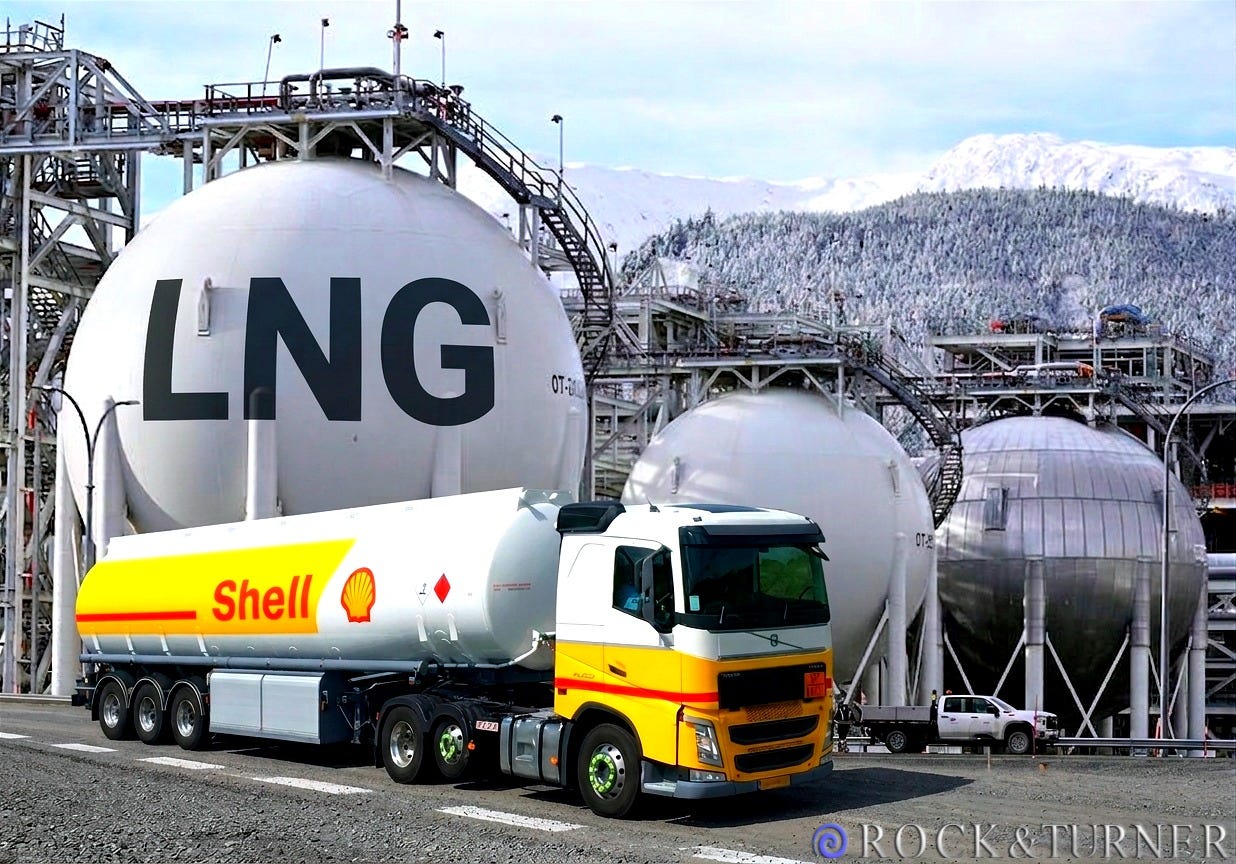
Shell markets more than 70 million tonnes of LNG a year, giving it an extraordinary position in the global gas market. It is not simply producing gas and selling it at the wellhead. Its enormous trading operation allows it to move molecules around the world, arbitraging differences between regional markets and capturing value whenever supply becomes constrained.
This is an important distinction. One must not think of Shell as an oil company with an LNG division bolted on. It’s a deeply integrated production, infrastructure, marketing and trading machine.
LNG and Integrated Gas account for roughly 25% to 35% of Shell’s adjusted earnings and that share is increasing year on year. As global gas markets become increasingly interconnected, that trading capability becomes even more valuable.
The market, however, continues to price Shell as a mature European oil company facing terminal decline and gradually liquidating the balance sheet through the payment of generous dividends.
That explains its very attractive valuation and it gives rise to in interesting investment opportunity.
The Transformation in Capital Allocation
To understand the opportunity, it is first important to understand how Shell has changed.
Historically, Shell was a quintessential European oil major. Dividends were sacrosanct. Management placed almost as much emphasis on the return of capital as the return on capital.
Ben van Beurden, CEO from 2014 to 2022, inherited three enormous jobs. First, he had to integrate the $70 billion acquisition of BG Group. Second, he had to repair the balance sheet and reduce leverage. Third, he had to position Shell as a credible participant in the energy transition towards net zero.
The problem was that these objectives increasingly conflicted with Shell’s traditional dividend culture.
Then Covid arrived. The pandemic gave Shell something it had not had for generations: a legitimate reason to cut the dividend without the market interpreting the move as a negative signal about the health of the business.
Shell cut its dividend from 47 cents to 16 cents per share. Incredibly, this was the first dividend reduction since the Second World War.
That was painful for shareholders, but it also broke a psychological constraint.
Once the dividend had been reset, management had much greater freedom to rethink how surplus capital should be allocated.
The progressive dividend was subsequently restored, albeit from a lower base. But the marginal dollar of surplus cash increasingly went towards buybacks.
That was a significant change in management philosophy.
Shell’s capital-allocation hierarchy today is much more disciplined:
Preserve an investment-grade balance sheet.
Fund high-return projects.
Maintain the progressive dividend.
Return surplus cash through buybacks.
That hierarchy matters.
It means Shell no longer needs to grow simply for the sake of growing. Projects across upstream, LNG, downstream and renewables are measured against each other on the basis of anticipated returns on capital.
Shell became less willing to fund low-return or strategically marginal growth simply because it fitted the broad narrative of the energy transition.
Sinead Gorman, who became CFO in 2022, has been central to this evolution. Finance, strategy, M&A, sustainability and business development were brought into a more integrated structure, helping to centralise decision-making and make capital allocation more financially comparable across the organisation.
Shell’s performance metric has also shifted. The emphasis is increasingly on free cash flow per share, rather than absolute growth.
That nuance is subtle, but critically important.
A management team targeting absolute production or revenue growth has an incentive to retain capital and keep expanding the business, even where the returns on capital are sub-optimal.
A management team targeting free cash flow per share has a very different incentive.
If Shell can repurchase shares below intrinsic value, buybacks directly increase the amount of free cash flow attributable to each remaining share.
The maths becomes particularly compelling when the company can buy back its own stock at a higher implied free-cash-flow yield than it can earn on incremental projects.
At the 2025 Capital Markets Day, Shell extended its target for normalised free cash flow per share growth of more than 10% annually through 2030. This is in addition to a very healthy 3.5% dividend.
The attraction of an investment in Shell ought to become self evident at this stage of the narrative.
Change at the Top
Wael Sawan is a Lebanese-Canadian executive, with an MBA from HBS, has spent his entire career at Shell. He replaced van Beurden as CEO in January 2023.
His mandate was straightforward: improve financial performance, reduce costs, sharpen the portfolio and allocate capital towards the highest-return opportunities.
The change in philosophy became increasingly visible. He’s pursued a “value-over-volume” strategy: cost discipline, portfolio simplification (including consolidating upstream and LNG into one integrated division), and shareholder returns over headline growth.
The company began concentrating capital around LNG, advantaged upstream assets, trading and high-return downstream businesses.
Shell withdrew from a German offshore-wind tender because the economics did not meet its capital-discipline requirements. It hasn’t abandoned the energy transition, but it has stopped treating every form of low-carbon investment as equally attractive.
The company can still invest in areas such as biofuels, carbon capture and LNG while refusing to put billions of dollars into businesses where returns depend on subsidies, volatile power prices or structurally poor economics.
From July 2023, Shell also introduced a smaller Executive Committee, organised around two principal business directorates alongside a single finance, strategy, M&A and sustainability directorate.
The objective was to simplify the organisation and improve decision-making.
The broader result has been a much sharper capital-allocation machine and the recent acquisition of ARC Resources (discussed in the introduction section above).
The post-Covid commodity recovery created enormous amounts of cash.
Once debt had been reduced and high-return investment funded, surplus cash had to go somewhere. While the dividend is relatively fixed, subject only to a small progressive increase annually, share repurchases were used as the mechanism of choice for the balance.
In FY2025, Shell allocated $22.4 billion to $13.9 billion of buybacks and $8.5 billion of dividends. This represented 52% of cash flow from operations, with the balance reinvested into the business.
The buyback case, of course, depends on valuation. Buying back shares only creates value if the shares are worth more than the price Shell pays for them.
Management has been explicit at its Capital Markets Days that it believes the shares are materially undervalued and that repurchases are therefore accretive.
That creates an interesting feedback loop. Higher free cash flow generates more surplus capital. Surplus capital funds buybacks. Buybacks reduce the share count. The same free cash flow is then spread across fewer shares. Free cash flow per share rises.
That, in turn, creates the potential for further capital returns.
The Natural Gas Business
This brings us to the most important part of the thesis.
The Shell story could be about to change from one of steady cash generation into one of structural growth.
As discussed, the world is heading into an enormous increase in electricity demand, yet electricity supply can’t be brought online overnight.
That creates an enormous potential mismatch between demand and supply.
Shell is already positioned on the right side of that equation.
The company expects LNG sales volumes to grow by roughly 4% to 5% annually through 2030, supported by projects including LNG Canada. That new supply is arriving just as global LNG demand is expected to rise dramatically.
The obvious question is what happens after 2030.
If demand continues to compound while relatively few new liquefaction projects are sanctioned, the market could move into a period of structural undersupply. This is where Shell’s existing position becomes extremely valuable.
You can’t build a new LNG terminal in response to a shortage next winter. These are multi-billion-dollar projects that require years of permitting, financing, construction and commissioning. The supply response is therefore slow.
Shell, by contrast, already has the infrastructure, contracts, shipping capacity, trading relationships and global customer network.
If the LNG market tightens, the value of Shell’s position increases, as does the value of its business.
This is why Shell is particularly interesting in the context of the natural-gas thesis.
You’re not paying a premium multiple for a speculative growth story. You’re buying one of the world’s largest energy companies at approximately 10.2x earnings, implying an earnings yield of around 10%.
On free cash flow, the multiple looks even better at only about 8.4x.
The EV/EBITDA multiple is roughly 4.3x.
Compared to its industry peers, Shell just looks too cheap.

You also receive a secure dividend yield of around 3.5%, while management is simultaneously buying back huge tranches of stock. Over the past four years the share count has reduced annually at an average of 6.5%.
The valuation is therefore attractive even before considering the potential change in the underlying commodity cycle. That’s the key point.
Shell does not need any heroic LNG price assumption to work.
The existing business generates substantial cash at today’s economics. The balance sheet is stronger and capital allocation is more disciplined.
Then you have the potential upside from a structural shortage of natural gas. That’s where the asymmetry becomes interesting.
If LNG markets remain well supplied, Shell still owns an extraordinarily strong global gas business and continues returning capital to shareholders.
If LNG demand accelerates faster than supply, Shell has the infrastructure and trading position to capture the upside.
When the market begins to recognise that natural gas is not a temporary bridge but an essential part of the world’s electricity system for decades to come, the valuation multiple is likely to expand as well.
The market may still see Shell as an old European oil major in managed decline. I see something different.
I see one of the world’s dominant LNG businesses, sitting at the intersection of two enormous trends: the explosion in global electricity demand and the increasingly constrained supply of natural gas.
The technology companies may be building the AI revolution. Shell may end up supplying the fuel that powers it. That is a pretty interesting business to own at 8.4x free cash flow and 4.3x EBITDA.
No investment is without risk, and Shell is no exception.
The first is that Shell remains an integrated oil major. Upstream and Refining & Chemicals are still significant earnings contributors, leaving group free cash flow exposed to oil prices and refining margins. A prolonged downturn in either could offset some of the benefit from a strong LNG cycle. The 10%+ free-cash-flow-per-share growth target through 2030 is therefore a group-wide target, not an LNG-only thesis.
Climate litigation is another live risk. Milieudefensie has taken its case to the Dutch Supreme Court, which heard the appeal in May 2026 following the Court of Appeal’s 2024 decision. A ruling later this year could impose a binding emissions-reduction target on Shell, potentially constraining upstream investment and creating a precedent for other oil majors. This is not a historical liability that can simply be written off; the legal battle is ongoing.
Then there is government policy. The UK’s Energy Profits Levy currently takes the effective headline tax rate, on oil and gas extraction activities in the UK and on the UK Continental Shelf, to around 78% and runs to 2030. More importantly, the very scenario underpinning the LNG thesis, sharply higher energy prices, is also the scenario most likely to attract further political intervention. If gas prices surge, governments may decide that energy companies are capturing too much of the upside.
Nigeria presents another potentially material liability. Shell faces a UK High Court trial in 2027 concerning historic pollution in the Niger Delta. The court has already ruled that Shell and its former Nigerian subsidiary can be held responsible for ongoing pollution, leaving the eventual liability uncertain.
Finally, there are the less visible but unavoidable costs of the legacy business. Decommissioning obligations on ageing North Sea assets will run into the coming decades, while tightening methane and flaring regulations could increase compliance costs across Shell’s upstream and LNG operations.
None of these risks necessarily breaks the investment thesis. They do, however, highlight an important point: Shell’s future is not simply a leveraged bet on LNG prices. Oil, refining, regulation, litigation and legacy liabilities all remain part of the equation.
The attraction is that the shares appear to price Shell as though these risks dominate the story. The opportunity is that they may not.
Expand Energy (Nasdaq: EXE)
The Natural Gas Power House
[Attribution for this idea goes to Matt Smith of Chronometer Partners who kindly brought this name to my attention.]
Expand Energy was created in October 2024 through the merger of Chesapeake Energy (restructured out of bankruptcy in 2020) and Southwestern Energy. The deal created the largest independent U.S. natural gas producer, with a premier portfolio in Appalachia (Marcellus) and Haynesville, close to key demand centers (Northeast power markets, Gulf Coast LNG/industrial).
The combined company targeted roughly 7.4 Bcf/d of production, around $12 billion of annual revenue, and an investment‑grade balance sheet, with significant free‑cash‑flow generation to fund buybacks/dividends and further M&A.
It stands to benefit from rising demand for gas. Expand controls approximately 70% of the remaining core Haynesville wells, some of the highest quality rock in the country.
The U.S. natural gas market may currently be modestly oversupplied, but Expand Energy uses an aggressive derivative strategy to insulate its cash flow.
It has 66% of its remaining 2026 production hedged. These contracts lock in prices well above current market strips to preserve near-term margins. Better still, the company has already locked in floors for 41% of its projected 2027 output. This helps navigate an expected supply overhang through the first half of 2027.
In addition to its hedging strategy, pursuant to a recent acquisition (more on this shortly), it is now able to leverage 44 billion cubic feet (Bcf) of physical gas storage to time physical sales. Store it when the price falls; release it when they spike.
Expand also navigates price volatility through dual-basin flexibility and aggressive commercial optimization. The company utilizes its balanced footprint between the low-cost Appalachian supply (generating steady cash flow during weak markets) and the Haynesville shale (offering high-upside exposure to Gulf Coast LNG demand).
Profitable drilling requires benchmark prices (such as Henry Hub) to clear operational breakeven costs. Its Haynesville asset yields 3.187 Bcf/d, representing roughly 42.6% of Expand’s output. It absorbs over half of corporate capital expenditures because its proximity to the Gulf Coast commands premium pricing. The remaining production (~4.3 Bcfe/d) is split between Northeast and Southwest Appalachia (Marcellus/Utica). This serves as the company’s low-cost base, anchoring free cash flow because its local breakevens sit below $2.64/Mcfe.
Pipeline activations, such as the Mountain Valley Pipeline, have helped relieve historic Appalachian takeaway constraints, making this dual basin flexibility possible.
This is where its recent acquisitoin of Twin Eagle Holdings comes to the fore. By acquiring physical marketing and storage assets, Expand moves beyond pure extraction to capture value from regional price spreads and direct end-user sales.
Management matches production pacing to prevailing market realities, shifting from volume growth to uncompleted well inventory management when prices soften. Its multi-decade reserves mean that this model has a long way to run.
Domenic “Nick” Dell’Osso (previously Chesapeake’s CEO) became CEO of the combined entity, overseeing integration of Southwestern and the early “Expand” strategy.
While Dell’Osso led the business for its first couple of years, the board wanted a different leadership setup: Houston‑centric, possibly more M&A‑oriented, and with a fresh ‘expand’ mandate after the Southwestern merger. It is also widely believed that Dell’Osso had no interest in relocating to Houston.
Dell’Osso stood down as president, CEO and director on February 9, 2026. It appeared to be a well orchestrated exit by mutual agreement. His exit was treated as a termination without cause, making him eligible for an estimated ~$21 million severance (per prior SEC disclosures).
The company is now in the process of relocating its headquarters from Oklahoma City to Houston, to be closer to energy industry partners, while keeping Oklahoma City as an operational hub.
Board Chairman Michael “Mike” Wichterich was appointed interim president and CEO immediately upon Dell’Osso’s departure. Dell’Osso agreed to stay on as an external adviser for a period to support the handover, but is no longer a director. In late July, the board launched a formal search for a permanent CEO (a process expected to take 6-9 months).
The management disruption caused a draw down in the share price, despite its premium asset position. Despite the leadership shuffle, Expand has been executing on its core plan. The company beat second‑quarter profit estimates, with adjusted EPS of $1.33 vs. $1.12 expected, as higher production offset weaker gas prices which caused a revenue miss. Management reaffirmed a full‑year production target around 7.5 Bcf/d, with output expected to peak in Q4, and highlighted strong well performance in Appalachia and Haynesville.
The corporate strategy is to pivot from a pure upstream producer to an integrated natural gas company, combining supply with marketing, storage and customer relationships.
The company has grown, at least in part, through acquisition. Dell’Osso had overseen the $7.4bn Southwestern acquisition (Oct 2024) and the creation of Expand.
More recently, Expand announced the immediately accretive, all cash, $1.25bn Twin Eagle acquisition, framed as the cornerstone of its shift to an integrated natural gas company. The deal is expected to add $200 million of EBITDA from the outset, increasing to $350 million as synergies are realized. This suggests ~6.25× initial EBITDA multiple, falling to 3.6x.
However, the value of the deal isn’t just EBITDA enhancement; it’s the ability to optimize a much larger molecule flow and capture basis/volatility.
Natural gas prices in 2025–26 have been volatile but structurally supported by LNG and power demand growth. Buying a marketing/optimization platform when the upstream is cash‑generative but the market is still debating the gas outlook lets Expand lock in optionality before the next upcycle leg is fully priced in.
The deal is expected to close in Q3 2026. The plan is to use the Twin Eagle acquisition to move down the value chain and build a coast‑to‑coast integrated platform.
Beyond the immediate returns, the purchase also opens the door for further growth opportunities in the midstream. Michael Wichterich, Expand’s chairman and CEO, sees the acquisition as one that “accelerates Expand’s evolution into a leading integrated natural gas company.”
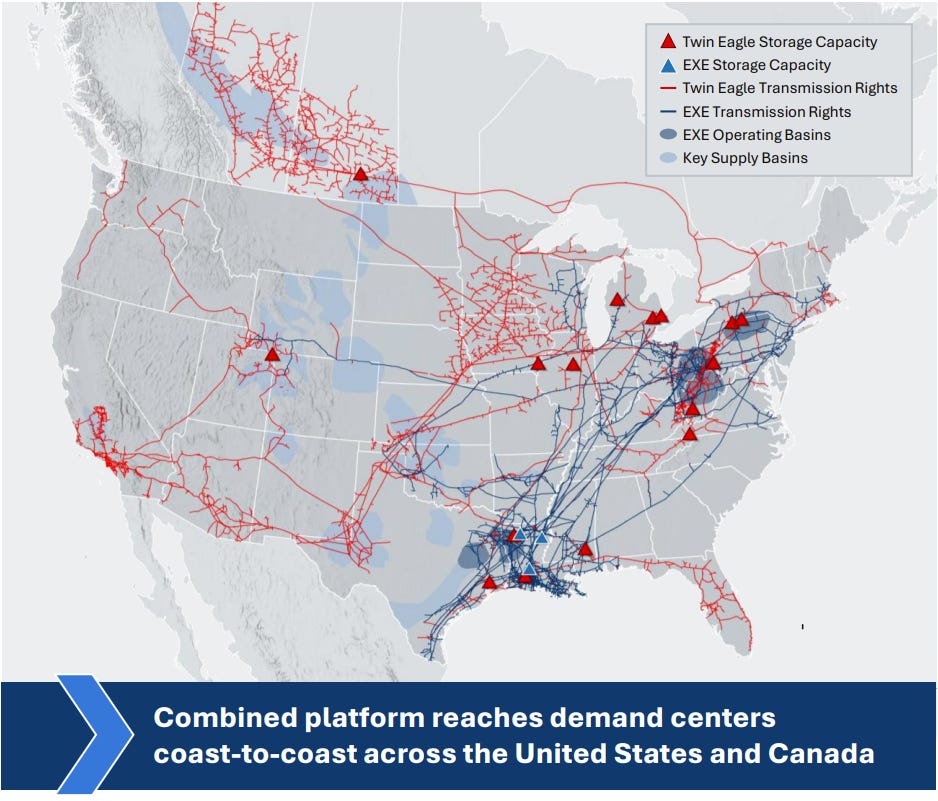
Expand frames the integrated model around three value pools:
Facilitating and capturing new demand through marketing technology, which will occur over a 3 to 5 year period and be back-end weighted.
Reaching premium markets by leveraging firm deliverability and storage to access constrained, higher‑value markets (Northeast power/data centers, Gulf Coast LNG, Midwest/Southeast/Southwest).
Monetizing volatility by using 49 Bcf of storage, a larger transport portfolio, and enhanced trading/valuation capability to capture basis dislocations and optimize molecules across the chain.
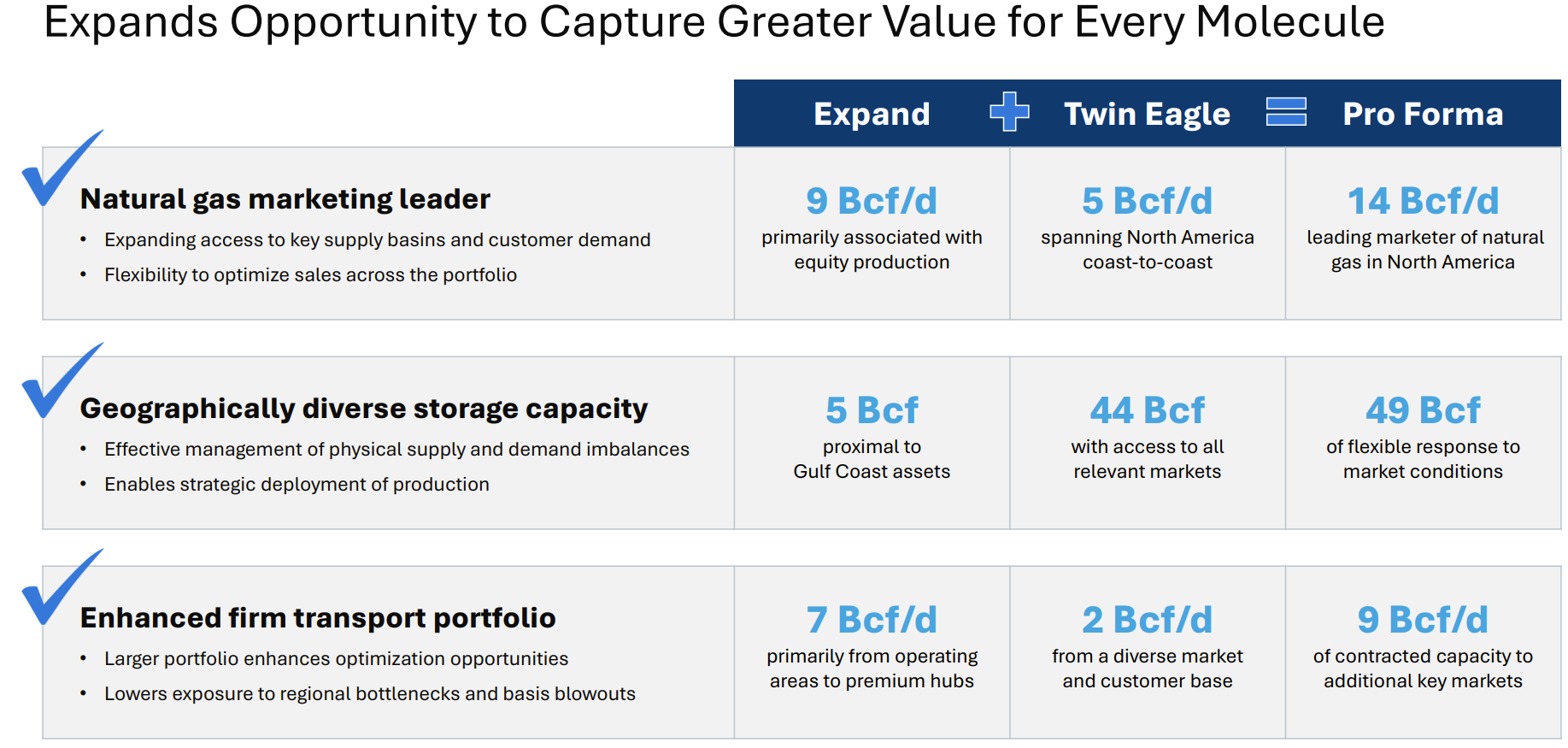
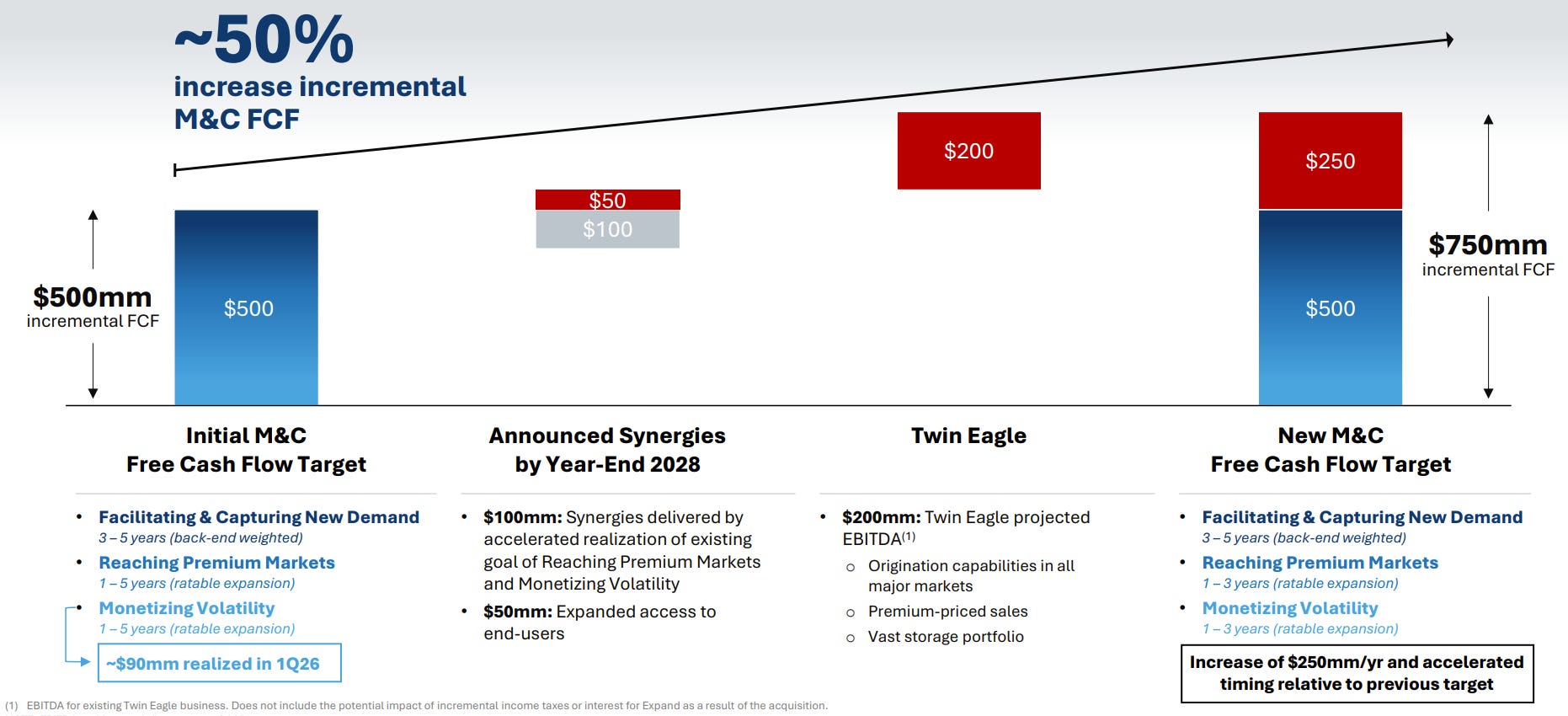
Through these initiatives, management raised its incremental ‘Marketing & Commercial’ segment free‑cash‑flow target to $750m, a 50% increase.
Twin Eagle’s storage assets increase Expand’s storage position nearly tenfold to just under 50 Bcf, and the marketing strength of Twin Eagle gives EXE more options to commercially optimize its production.
Importantly, the deal doesn’t include any direct pipeline ownership. This would be a logical next step in Expand’s evolution toward a truly integrated gas company. If the company intends to further develop into an integrated player, the Twin Eagle deal could be the foundation of future efforts to build out its midstream footprint.
The company’s entire narrative: scale in premium U.S. gas basins, low breakevens, optionality into LNG/power markets, and now an integrated marketing platform, rests on its ability to profitably develop unconventional shale resources using horizontal drilling and high‑intensity fracking.
Free cash flow and EBITDA impact
Returns are primarily driven by optimization of physical movement of gas, not solely dictated by commodity price exposure. Ultimately, it is about connecting growing demand to supply.
The deal is the cornerstone of Expand’s Marketing & Commercial (M&C) strategy upgrade:
Prior M&C incremental FCF target: ~$500 million/year.
New M&C incremental FCF target: $750 million/year (a ~50% increase).
EBITDA build‑up: $200 million at close → $350 million with synergies, with realization front‑loaded in “Reaching Premium Markets” and “Monetizing Volatility” over 1–3 years, and “Facilitating & Capturing New Demand” more back‑end weighted (3–5 years).
The story is less about who the permanent CEO will be and more about execution on integration, synergy capture, and maintaining production/capex discipline while gas prices fluctuate. If synergies and FCF targets are hit, the multiple could re‑rate as the market treats Expand more like an integrated gas/midstream‑adjacent business than a pure upstream producer.
Maintenance capex stands at around $2.8bn/year.
Expand paid down $1.3bn of gross debt in Q1, then used excess cash in Q2 to repurchase $850m of stock (~4% of shares) and authorized an additional $1bn buyback.
This may be the highest-quality upstream company in Appalachia, with substantial room to grow production and increase cash returns to investors as gas prices rise.
Tenaz Energy (Toronto: TNZ)
The Niche Exploration and Production Business

[Attribution for this idea goes to Mike Kruger of MPK Partners, who kindly brought this lesser-known name to my attention.]
Tenaz Energy is a Canadian exploration and production (E&P) company, but calling it that rather understates the story.
Under CEO Anthony Marino, Tenaz has evolved from a tiny recapitalisation play into the largest natural gas producer in the Netherlands outside the state-owned entity. More importantly, it has done so through disciplined dealmaking, careful asset selection and a willingness to wait patiently for the right opportunity.
The story is really about three things: management, assets and timing.
The Management
Anthony Marino has spent his career running much larger businesses. Before Tenaz, he led multi-billion-dollar Canadian E&Ps including Baytex and Vermilion, where he developed a reputation for disciplined capital allocation and value creation.
When he left Vermilion following a disagreement with the board during the COVID turmoil of early 2020, he took an unusual path.
Rather than joining another large producer, Marino and a small group of former colleagues recapitalised a nanocap E&P called Altura in August 2021.
The company raised $29.5 million, plus another $1.8 million through a rights offering, with the shares trading at approximately $1.80.
It was tiny compared with the companies Marino had previously run. But that was precisely the attraction. He now had control and a clean platform from which to execute his own strategy.
As an added bonus, the company had approximately $50 million of net operating losses on its balance sheet, which would shield the business from tax liabilities, boosting short-term profits.
The business began with a single Canadian asset just south of Edmonton, Alberta, in which Tenaz held an 87.5% interest. It was primarily an oil-producing asset, profitable and growing, but today it represents only around 10% of company production.
The Assets
Marino’s strategy was clear from the outset: he wanted to use Tenaz as a vehicle to buy more hydrocarbon assets.
Rather than compete for properties in the highly efficient North American market, Tenaz focused on Europe, with the Middle East and Latin America as potential secondary targets.
The investment criteria were demanding:
The ability to increase per-share value.
Assets capable of generating sufficient cash to fund their own growth.
Unlevered, after-tax IRRs of at least 20% before any asset improvements.
That last criteria is key. A 20% IRR is not achieved by overpaying. So that meant patience.
Tenaz made offers on dozens of assets, large and small, and received one rejection after another. The first two years after the recapitalisation were frustrating.
The problem was timing. Oil and gas prices surged following the post-COVID recovery and the outbreak of war in Ukraine. Sellers were generating so much cash from their reserves that they had little incentive to accept lowball offers.
Then, finally, the market turned.
In December 2022, sixteen months after the recapitalisation, Tenaz completed its first acquisition.
It was small: approximately 750 boe/d of natural gas production in the Dutch North Sea, together with an 11.34% interest in the NGT pipeline network.
A second acquisition followed in June 2023, when Tenaz bought another 500 boe/d asset from Exxon’s XTO Netherlands unit. That transaction came with positive working capital which was most welcomed.
But these were really small stepping stones.
The third transaction changed the company completely.
In July 2024, Tenaz agreed to acquire NAM Offshore BV, now renamed Tenaz Energy Netherlands, from NAM, the 50/50 joint venture between Shell and Exxon.
The acquisition brought approximately 11,000 boe/d of production, representing roughly 20% of all Dutch North Sea natural gas production.
Tenaz became operator with an 87.5% working interest.
It also became operator and part-owner of the Den Helder Gas Plant, which processes approximately 50% of all gas produced in the Dutch North Sea.
But the most remarkable part of the transaction was not the asset itself. It was the deal structure, which almost paid for itself.
The base consideration was $246 million, plus earnouts based on 50%, 50% and 25% of free cash flow generated in 2025, 2026 and 2027 respectively.
Then there was the lockbox clause. This allowed Tenaz to use all of the asset’s free cash flow generated from January 1, 2024 through to closing to fund the acquisition.
This was the point at which ‘lady luck’ smiled on Tenaz.
It paid a $34 million deposit and expected to receive approximately $185 million of free cash flow, leaving just $25 million to fund the balance of the purchase price at closing.
But then European TTF gas prices increased. The asset generated considerably more free cash flow than anticipated. Instead of having to pay the expected $25 million balance, Tenaz actually received a net $24 million in May 2025.
So what initially looked like a $246 million acquisition effectively cost Tenaz a net $10 million of capital investment ($34 million deposit, less the $24 million received) plus the earnout which amounts to approximately $75 million, paid out of income.
The asset had effectively generated enough cash during the period between signing and closing to almost pay for itself. A total cost of ~$85 million for ~$428 million of PDP reserves, $542 million of 1P reserves2 and $802 million of 2P reserves (all of which are understated, but more on that later).
This could be the deal of the century, and Tenaz closed it.
So, why were Shell and Exxon prepared to agree to such sale terms?
The answer had little to do with economics.
Shell and Exxon were deeply out of favour in the Netherlands. Their giant onshore Groningen gas field, operated through NAM, had induced seismic activity as a consequence of decades of gas extraction.
More than 1,000 minor earthquakes occurred in the region. Thousands of homes suffered structural damage, triggering public outrage, political investigations and substantial legal liabilities for NAM.
The response of the Dutch government was to progressively reduce production quotas, starting in 2014 and ultimately shut Groningen in April 2024.
What remained for NAM was a relatively small offshore stub in its portfolio. It was inconsequential for the likes of Shell and Exxon, almost a rounding error in their numbers. So they wanted it off their balance sheet.
However, for Tenaz, it was transformative. The acquisition nearly quadrupled its production. Tenaz happened to be in exactly the right place at exactly the right time.
The deal closed in early 2025, and the acquisition programme didn’t stop there.
In October 2025, Tenaz closed its largest acquisition to date, buying the ‘Gateway to the Ems’ (GEMS) project for approximately $339 million. In return, Tenaz received $394 million of 1P reserves, $590 million of 2P reserves.
Then there are three exploration fields with a risk adjusted valuation of another $306 million, which if successful would trigger contingent payments capped at $60 million, driving up the acqusition cost, but delivering a good return on that investment. Even if all of those payments are made, they represent only around 28% of the value Tenaz expects from the assets.
GEMs proved to be another shrewd deal executed by management.
One great deal could be put down to luck, but a series of them suggests first class management with the ability to do it again in future, many times over.
The GEMS assets straddle the Dutch-German nautical border and include the N05-A platform, installed in mid-2024 and home to the highest-producing well in the Netherlands.
More importantly, GEMS came with a substantial development inventory.
In 2026, Tenaz plans to drill two infill wells from the N05-A platform, potentially increasing production to approximately 7,000 boe/d.
After that, exploration wells at N05-A-Noord and Diamant could take production materially beyond 7,000 boe/d.
In 2027, Tenaz plans to install a new N04-A platform to the north and tie it back to N05-A, opening up additional proven fields.
CEO Tony Marino, now 63, remains as active as ever. He recently said: “We feel we have a very good transaction pipeline in place. Probably the best it’s ever been.”
That is worth paying attention to.
Tenaz has approximately $185 million of liquidity and could arrange additional financing for another acquisition as soon as another opportunity presents itself.
The Timing
The macro backdrop could hardly be more favourable.
Natural gas remains critically important to the Netherlands, where a large proportion of homes are heated with gas. Yet domestic production has fallen sharply since the cap on Groningen.
At the same time, Russian gas imports into the EU have collapsed following the war in Ukraine and are scheduled to be completely phased out by late 2027.
That creates an obvious question:
Where does the replacement gas come from?
One answer is LNG imported from the United States, and this is where the relationship between Henry Hub and European gas prices becomes important.
Most long-term US LNG offtake contracts are effectively priced as Henry Hub plus a series of fixed costs.
The gas itself typically carries a premium of around 15% to Henry Hub to account for pipeline fuel, shrinkage and basis differences between Henry Hub and the liquefaction plant. Then there’s the liquefaction toll, shipping expense and regasification.
As a rough rule of thumb:
115% of Henry Hub + $2.50 to $3.50/MMBtu liquefaction + $1 to $1.50 shipping + approximately $0.50 regasification.
Now consider European gas prices.
As of Monday, August 17, 2026, Dutch TTF for September 2026 was trading around €61.40/MWh, equivalent to roughly $15.50/MMBtu.
Strip out approximately $5/MMBtu for liquefaction, shipping and regasification and you are left with roughly $10.50.
Remove the 15% Henry Hub premium and the implied netback to Henry Hub is roughly $8 to $9/MMBtu.
Henry Hub, meanwhile, is only around $2.65/MMBtu.
The spread is enormous. There is little question about the economics of exporting US LNG to Europe at those prices.
But the more interesting calculation is what happens in the other direction.
Start with today’s Henry Hub price and work forward through the same cost structure, and you arrive at a European break-even price of roughly €29/MWh.
That effectively establishes a floor beneath European gas prices.
Below that level, US LNG exports to Europe become uneconomic at the margin. Eventually, LNG flows would diminish, reducing European supply and putting upward pressure on prices.
The arbitrage mechanism therefore creates its own natural support level.
So what does this mean for Tenaz?
Tenaz extracts gas in Europe and delivers it directly into the European market through pipelines. Its cost structure is therefore radically different from that of an LNG exporter.
If it is financially viable for a US LNG exporter to liquefy gas, ship it across the Atlantic and regasify it at a European price of €29/MWh, Tenaz’s margins at that same price should be orders of magnitude higher.
In other words, the economics of Tenaz are effectively underwritten by the marginal cost of bringing alternative supply into Europe. It is a classic case of heads I win, tails I don’t lose. If European gas prices remain high, Tenaz generates exceptional margins. If prices fall, the cost of US LNG imports provides a natural floor at which Tenaz profits are still very attractive.
But there is good reason to believe European prices will trade above the theoretical floor.
First, pipeline gas produced in Europe has a substantially lower carbon footprint than LNG. Liquefaction, transportation and regasification all consume significant amounts of energy.
At price parity, environmentally conscious European consumers and policymakers should therefore have a natural preference for domestically produced pipeline gas.
Second, there is a strategic consideration.
Domestic production reduces Europe’s dependence on foreign suppliers. In an increasingly uncertain geopolitical environment, that has value in its own right.
In both cases, there needs to be a price incentive for European buyers to favour imported LNG over domestically produced gas.
That means the theoretical US LNG floor is unlikely to be the actual European price floor. There should be a European Premium.
Finally, we should remember that the Henry Hub price underpinning this calculation is temporarily depressed.
As discussed earlier, the foundational assumption behind this thematic investment thesis is that US natural gas prices are likely to rise materially over the next few years as structural demand from data centers and other sources tightens the market, while the short-term inventory build heading into the 2026 fall is run down.
If Henry Hub moves higher, the economics of US LNG exports change with it. The European floor price rises, and the European Premium sits on top of it, taking the earnings power of Tenaz to higher more attractive levels.
This is where Tenaz becomes particularly interesting.
Tenaz presents a classic valuation challenge: a high-quality, cash-flowing asset base combined with a potentially enormous exploration and development portfolio.
E&P companies have their reserves independently assessed. For Tenaz, this work is carried out by McDaniel & Associates.
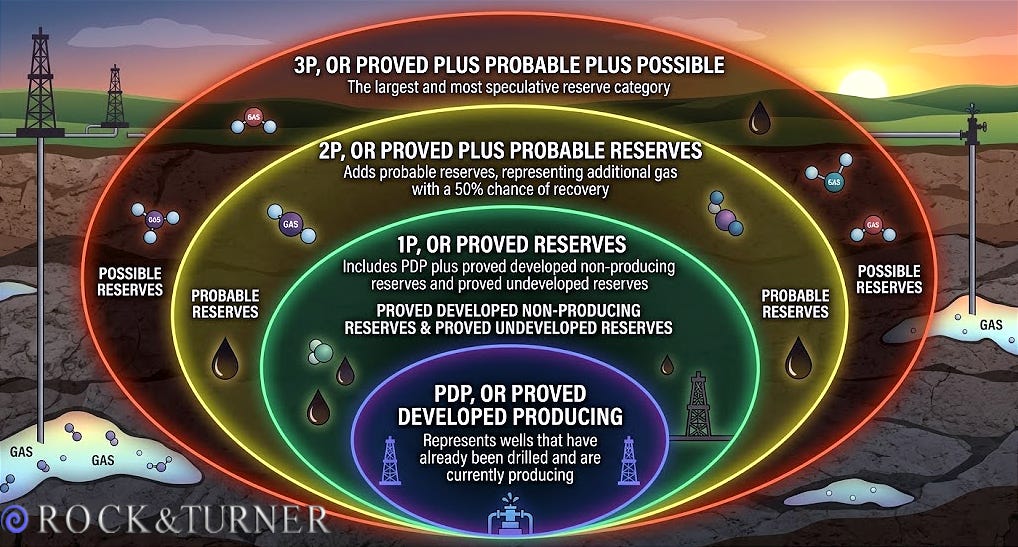
It is possible to calculate the net present value of future cash flows from each reserve category3, typically discounted at 10% (NPV10), and then deduct net debt to arrive at an indication of the underlying value of the business based on its net tangible assets.
Based on the January 1, 2026 Consultant Average Price Forecast4, PDP, 1P and 2P reserves were valued on this basis at approximately $620 million, $1.07 billion and $1.68 billion respectively.
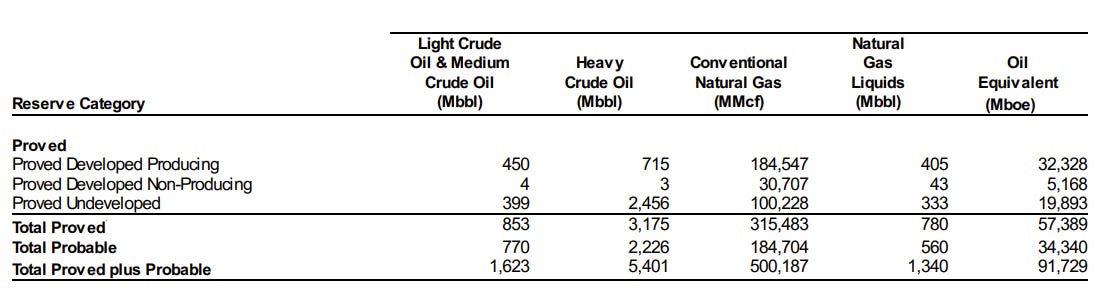

These numbers are, of course, based on assumptions. Actual reserves can be higher or lower. Forecast prices and cost assumptions will change, potentially materially, so caution is always advised. But these are the numbers on which the E&P industry is valued.
More interesting is that there are reasons to believe the assumptions may prove to be very conservative.
The latest reserve valuations may significantly understate the underlying asset base.
On the assets acquired from NAM, much of the 2P reserve valuation was calculated using NAM’s historical operating expenses, including indirect costs that Tenaz has already eliminated. Tenaz has reduced staff, changed operating policies and optimised the business. Margins will have improved since those numbers were prepared.
But there’s another, potentially more important, source of upside: volumes of reserves also appear to be understated.
The McDaniel reserve reports are arguably outdated because Tenaz has acquired superior geological data that reveals substantially more drilling locations.
Traditional seismic surveys, as have deployed in the past, use a vessel towing a long cable of receivers. As an analogy, think of a very low resolution digital camera producing pixelated images. They are better than nothing, but far from perfect.
Tenaz is now using state of the art Ocean-Bottom-Node, or OBN, 3D seismic technology. OBN places dozens of autonomous nodes directly on the ocean floor, where they can record sound waves from multiple directions over a period of weeks. The result is a much higher-resolution image of the geological structures thousands of metres below the seabed.
This matters particularly in the Dutch North Sea. It is a mature basin, but the geology is complex and highly faulted. Gas can remain trapped in small pockets that were overlooked when the fields were originally developed decades ago.
The new technology is particularly well suited to identifying this so-called “bypassed pay”, and the implication is significant.
The current 2P reserves of approximately 32 MMboe, together with 15 contingent fields representing another 38 MMboe, are based on the older dataset. They include only 5.3 net wells, while the new seismic work has identified ‘dozens’ more potential locations. Those locations are not yet included in official 2P reserves.
Consequently, they are not included in the current McDaniel NPV10 calculation prepared in January 2026, but they will almost certainly be included in the next annual report, due in January 2027.
For an investor, that suggests a brief window is open to capture hidden value. The market is largely valuing Tenaz on the reserves it can see. The opportunity lies in the reserves it can’t see… yet.
The Triton 10 jack-up barge workover programme provides another source of growth.
Tenaz has identified approximately 50 offshore workover opportunities (A workover involves maintaining or repairing an existing well to restore or increase production).
The economics are compelling because Tenaz is not starting from scratch. The wellbore and infrastructure already exist. Workovers are therefore considerably cheaper and faster than drilling new wells.
The company has indicated that these programmes typically generate IRRs above 100%, with payback periods of six months or less.
This provides a multi-year programme of low-cost production additions.
The benefits of the increased 2026 capital budget should begin to show from 2027 onwards.
More broadly, Tenaz expects to exit 2026 at a production rate of up to 27,000 boe/d, compared with approximately 17,125 boe/d in the first half of the year. So the production ramp-up is becoming evident. This trend is anticipated to continue into 2027 and beyond.
This brings us to three central valuation questions.
Quality and longevity of the existing assets: What premium should Tenaz command to the value of its published tangible net assets to account for this hidden value?
Optionality embedded in the acquisition programme and exploration portfolio: What premium should be added to capture the optionality of management reinvesting cash flows into expanding its asset base with more wonderful deals like the GEMS and NAM assets?
European natural gas prices: If Henry Hub rises materially because of structural US gas demand from data centers and other sources, that will drive higher European TTF prices, and so how much upside potential is there in the natural gas commodity itself?
Investors will need to formulate their own opinions on these questions.
Other Factors To Consider
The financial performance is already improving rapidly.
First-quarter 2026 revenue surged to C$131.16 million from C$16.29 million a year earlier, while funds from operations reached approximately $65 million.
The company reported a net loss of C$111.08 million, but that number is misleading. The loss was driven entirely by mark-to-market accounting on the hedge book. When gas prices rise, the unrealised loss on hedges is recognised immediately even though no cash leaves the business.
Strip out that accounting effect and the underlying business is generating strong and growing operating cash flow.
Free cash flows are impacted by high CAPEX, but most of that is growth CAPEX, not maintenance CAPEX. Make that adjustement and free cash flow margins are close to 15%.
In terms of revenue numbers, the volatile nature of underlying natural gas prices heavily impacts the top line. As with any commodity market, Tenaz is a price taker, not a price maker.
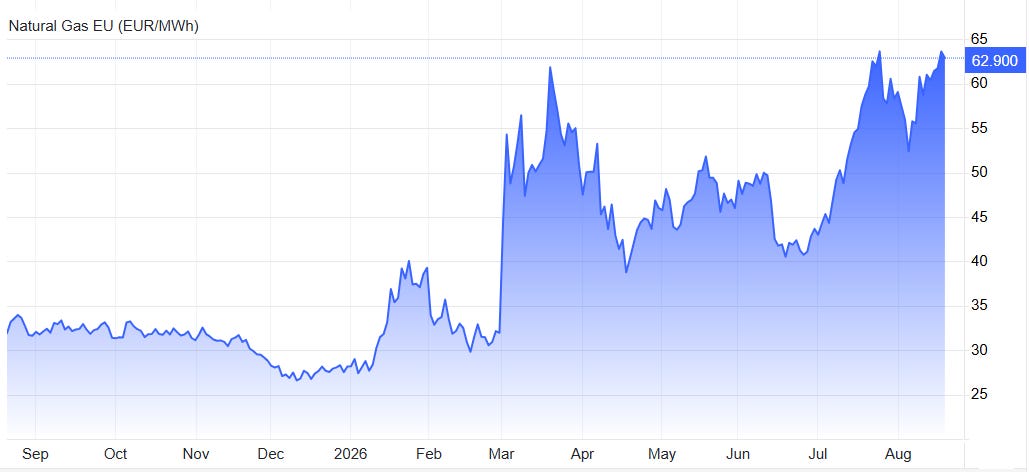
Gas prices have been elevated since the Iranian conflict began, and this has flattered revenues for Tenaz. As mentioned earlier, the floor price is now close to €29/MWh. If Henry Hub prices move up to $5/MMBtu. in 2027 or 2028, that lifts the European floor price to around €45/MWh.
It is important to note that 56% of production is hedged over the next twelve months, meaning that just over half is locked in to a fixed price, with only the balance benefiting from the recent strong pricing. That provides downside protection while leaving substantial exposure to higher gas prices.
The quantity of volume hedged over subsequent years is far lower, meaning that sustained higher prices will have a more profound impact. It may also enable Tenaz to lock in higher hedge prices.
The current hedging schedule:
56% in 2026, at an average price of €31.83/MWh ($15.11/Mcf)
41% in 2027, at an average price of €34.06/MWh ($16.17/Mcf)
8% in 2028, at an average price of €30.31/MWh ($14.39/Mcf)
Net debt is projected at only 1.1x funds from operations in 2026, so the balance sheet is strong.
So to sum it up, Tenaz is growing production, generating cash, reducing its dependence on debt and accumulating a portfolio of exploration and development opportunities that are not fully reflected in its current reserve numbers.
This is not simply a bet on higher European gas prices. It’s a bet on a management team that has demonstrated an ability to acquire unwanted assets at attractive prices, improve them operationally, and compound production and cash flow without taking excessive financial risk.
As production ramps through 2026, the company should generate significant free cash flow. Other than investing in growth and reducing debt, that would open the door to the payment of dividends or the repurchasing of shares.
For investors with patience and a willingness to tolerate commodity-price volatility, Tenaz offers an unusual combination of asset value, management quality, low-cost growth and free exploration optionality.
Golar LNG (Nasdaq: GLNG)
The Pure Play Floating LNG (FLNG) Operator

Golar LNG presents a uniquely compelling investment proposition.
The company has orchestrated one of the most remarkable transformations in the energy sector over the past six years, evolving from a complex conglomerate into the world’s only scaled pure-play floating LNG (FLNG) operator.
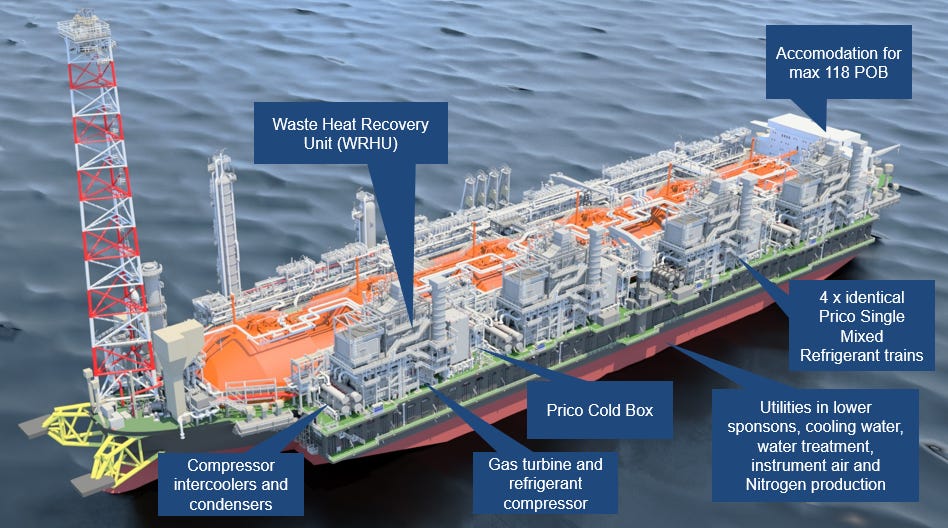
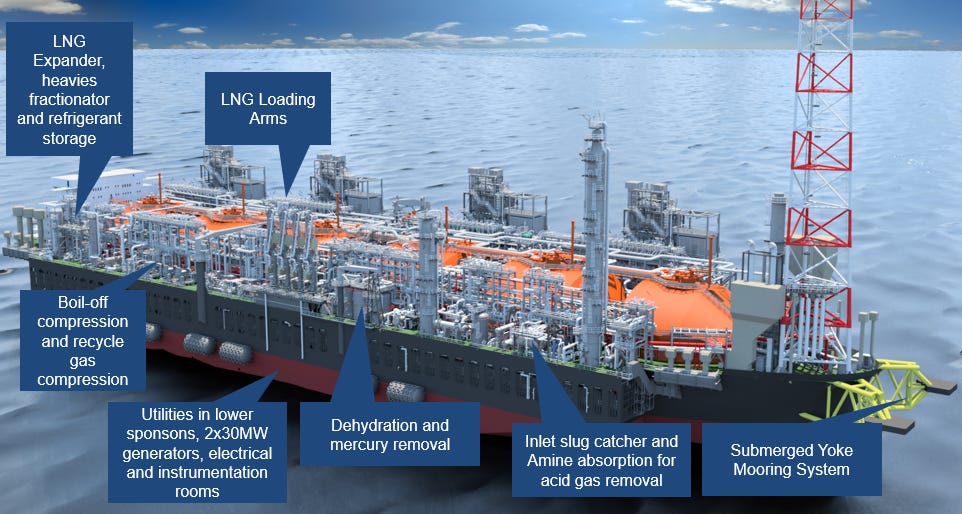
This journey has not been without its complexities, but the result is a business model that is arguably simpler, more robust, and more valuable than at any point in its history.
The leadership at Golar LNG combines deep industry experience with a proven track record in the very FLNG business model that defines the company’s success.
Karl Fredrik Staubo, appointed CEO in May 2021, has been instrumental in the company’s transformation. His background is particularly relevant: he spent a decade advising and investing in shipping and energy with Magni Partners and Clarksons Platou Securities before joining Golar as CFO in 2020. This financial and strategic pedigree aligns perfectly with the company’s need to navigate complex project financing and capital allocation decisions.
His leadership team is equally seasoned:
Eduardo Maranhão (CFO, appointed 2021) brings extensive experience in international energy project financing from institutions like Santander and Citibank, and previously served as CFO of Hygo Energy Transition, a former Golar affiliate.
Ragnar Nes (COO, appointed 2022), a technical expert with over a decade in FPSO operations and ship management, responsible for the day-to-day execution of the FLNG fleet.
Federico Petersen (CCO, joined 2024), a recent addition with deep commercial and M&A experience from Schlumberger, Equinor, and BG Group, signaling a focus on expanding Golar’s commercial pipeline.
Morten Skjong (CTO, appointed 2024), an internal promotion who previously managed the critical Mk II FLNG project, ensuring technical continuity.
The Board of Directors, led by Tor Olav Trøim (Chairman since 2017), provides substantial industry and strategic weight. Trøim himself has over 30 years of leadership in energy and maritime, with previous CEO roles at Seadrill and Frontline.
A key recent appointment is Benoît de la Fouchardière, who joined the Board in May 2025. He is a director of Perenco S.A. , a major independent oil and gas company and a current shareholder of Golar LNG. His appointment strengthens the link between the company and a strategic partner.
In all, 15% of the business is held by insiders, with Chairman Tor Olav Trøim among the largest shareholders, with a significant personal holding of ~3.1 million shares, aligning his interests directly with external shareholders.
What Golar has built is an FLNG-as-a-service platform, and the commercial model is structurally distinct from that of a traditional energy producer.
Golar doesn’t take commodity price risk on the bulk of its revenue; instead, it charges a fixed annual capacity fee for each of its vessels. It effectively collects a toll on the gas that flows through it, while retaining valuable upside through commodity-linked bonus mechanisms.
This structure provides a cash flow profile that looks far more like infrastructure than energy, combined with an embedded options book on global gas prices that tends to activate precisely when energy markets are most dislocated.
The company’s portfolio of vessels is the most concentrated and proven in the FLNG industry.
FLNG Hilli, the pioneer, has delivered 100% commercial uptime over eight years in Cameroon, a testament to Golar’s operational execution.
FLNG Gimi, which began its 20-year contract with BP in mid-2025, has operated above its nameplate capacity, a significant positive signal.
Mark II FLNG, is under construction and represents a step-change in capability and efficiency.
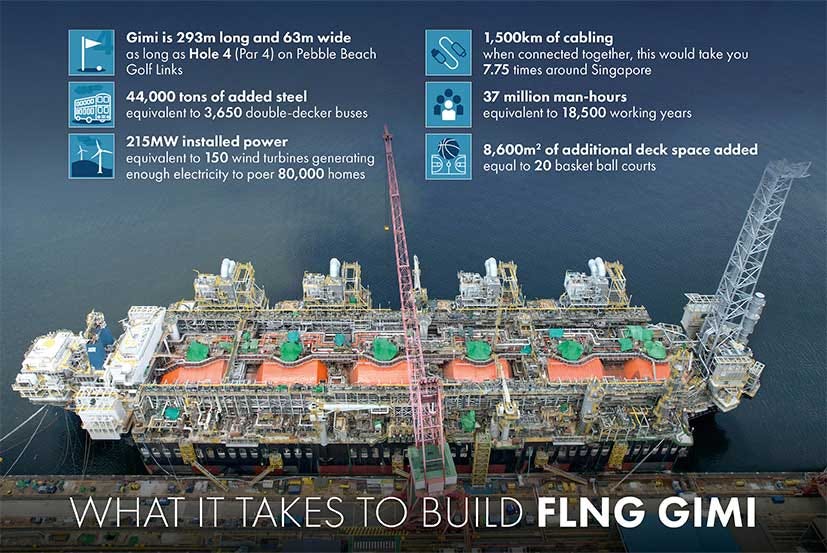
Together, these three assets, once fully operational, are projected to generate approximately $800 million in annual adjusted EBITDA, underpinned by over $17 billion in contracted EBITDA backlog.
The attraction is that it has a long-term, visible cash flow stream from a scarce and vital piece of energy infrastructure. To add balance to the narrative it is important to point out that Shell’s Prelude, the best-known large-scale FLNG asset not owned by Golar, hs suffered repeated operational issues and ought to be viewed as a reminder of how challenging floating LNG can be. However, Golar's 100% uptime on the Hilli is evidence of the value it adds to the market; the list of credible, proven operators in FLNG is extremely short.
The Argentina catalyst ought to be transformative to the company’s growth journey.
The 20-year contracts with the YPF-led consortium SESA in Argentina commits two of its three assets (the Hilli and the new Mark II unit) to monetize the vast Vaca Muerta shale formation.
Argentina’s ambition to become a major LNG exporter was previously constrained by the lack of liquefaction infrastructure and the immense capital and execution risk of a traditional onshore project. But FLNG, backed by Golar’s proven track record, offered a practical and commercially viable solution.
The contract structure for the Argentine operations is highly attractive. It features a fixed base tariff and a commodity-linked upside that can be a significant earnings driver. For every $1 per MMBtu increase in LNG prices above an $8 threshold, Golar can capture $100 million in additional EBITDA. This provides enormous torque to the investment case if energy prices remain structurally higher, as anticipated.
It should be noted that Gimi is the only one of Golar’s FLNG assets without commodity-linked upside. This was because the contract was signed before FLNG was fully validated, at a time when Golar’s negotiating position was weaker. This explains why Gimi's contribution is structurally different from the Hilli and Mark II.
In respect of those other two vessels, the significant infrastructure investments being made by SESA, including pipelines and compression systems, further de-risk the project and demonstrate a deep commitment to its success.
By 2028, when both vessels are online, this will be the primary driver of Golar’s cash flow, significantly transforming the company’s earnings power.
Another key aspect of the Argentine contracts is the inflation protection through CPI-linked mechanisms from year six onward.
In Argentina, a country where a deeply ingrained societal distrust of the peso is rooted in a history of monetary trauma, hyperinflation, and repeated economic crises, the inflation protection in Golar's 20-year SESA contracts is not merely a prudent financial clause, but an essential structural feature for preserving the real value of its earnings.
For the avoidance of doubt, Golar, charges a fixed annual capacity fee in dollars on its FLNG vessels, so that element is not exposed to Argentine Peso devaluation risk. The exposure arises when the costs of running its business in Argentina, such as salaries, insurance, repairs, maintenance, and other operational costs, rise faster than the dollar's purchasing power.
The CPI-linked adjustment mechanisms, which activate from the sixth year of the contract, mitigate this risk by directly linking the charter hire to an official measure of local inflation. This is akin to a cost-of-living adjustment (COLA), ensuring that the real value of the contract's revenue is maintained against the corrosive effects of Argentine price increases. It allows Golar to pass through the impact of local cost pressures to the project owner (SESA), safeguarding its earnings profile over the two-decade life of the asset.
Under Argentine President Javier Milei's economic plan, with early signs of slowing price hikes, the future is potentially more stable, yet the structural risk remains a core consideration for any long-term international energy infrastructure investment in Argentina.
Golar has effectively built a defensive shield against the country's most persistent economic risk, turning a potential liability of operating in a historically volatile nation into a structural strength of its contract.
The recent conflict in the Middle East and the subsequent attacks on Qatari energy infrastructure have been a seismic event for the LNG industry. The physical damage to liquefaction trains at Ras Laffan, which are estimated to upto five years to repair, has shifted what many viewed as a temporary flow disruption into a structural supply deficit.
For Golar, this creates a dual benefit. Firstly, the higher price environment directly enhances the value of the commodity-linked bonuses embedded in its contracts, particularly for the Hilli’s current contract and its future deal in Argentina. Secondly, and perhaps more importantly, the new market reality underscores the strategic value of FLNG.
The world needs to diversify its LNG supply sources away from a few key players and regions. FLNG offers a faster, more flexible, and less capital-intensive solution to bring new gas to market.
This creates a powerful tailwind for Golar’s future growth pipeline, potentially accelerating the award of contracts for more FLNG units.
This explains the confirmation of an Engineering, Procurement, and Construction (EPC) deal for a fourth FLNG vessel, with a total project budget of approximately $2.45 billion, which adds a new dimension to the growth narrative.
The company has taken a prudent stance on committing capital to this fourth vessel, choosing to mature commercial terms before commissioning this long-lead time item. This is almost certainly a sign of disciplined management rather than a lack of ambition, but it can test the patience of the market.
This vessel, which will increase Golar’s controlled liquefaction capacity by about 40% to over 12 million tons per annum, represents a tangible step in its long-term expansion plans.
It materially extends the company’s growth runway and underscores its intent to scale its FLNG platform.
The challenge is to manage the execution and capital allocation risks associated with such a large project, but the payoff (a significantly larger, more diversified earnings stream) is substantial.
The market’s reaction has been mixed. The stock shows strong year-to-date gains but some shorter-term softening, which suggests that investors are weighing this growth potential against the execution and financing risks of the interim period .
It’s important to acknowledge the current phase is one of transition.
While the long-term contracted backlog is clear, 2026 and 2027 are expected to be periods of negative free cash flow. This is due to the gap between the Hilli’s Cameroon contract ending and its redeployment in Argentina, the need to fund the completion of the Mark II, and the $350 million of capex required to prepare Hilli for its new role.
The valuation of Golar LNG is a story of two parts.
On one hand, the mean street analyst valuation sits around $61 per share, a 16% premium to the prevailing market price. That valuation is anchored by the $17 billion contracted EBITDA backlog and the expectation of a significant (4x) increase in earnings by 2028.
On the other hand, its current earnings multiple tells a story of a growth company that may be priced for perfection. The bull case relies heavily on the successful execution of the Argentina project, the delivery of the Mark II, and the continued strength of LNG demand to support its commodity-linked upside.
Ultimately, Golar LNG represents a high-conviction idea for investors who can look through the short-term financing noise and see the exceptional value of a unique and irreplaceable asset base. It’s a bet on a multi-decade trend in energy, a bet on the proven execution of a management team, and a bet on a world that increasingly needs the flexible, efficient, and reliable solution that Golar provides.
The journey may have its bumps, but the destination (an $800 million+ EBITDA infrastructure giant) makes the risk/reward profile profoundly interesting for those with the patience to see it through.
Gaztransport & Technigaz SA (Paris: GTT)
The LNG Royalty Business
Founded in 1963 and headquartered in Saint-Rémy-lès-Chevreuse, France, the merger of Gaztransport & Technigaz in 1994 created the company we see today. Its IPO occured in 2014.
GTT is a technology and engineering company, provides cryogenic membrane containment systems for the maritime transportation and storage of liquefied gases including LNG (Liquefied Natural Gas), hence its relevance to this investment theme.
It occupies a unique, highly profitable bottleneck position in the global energy infrastructure supply chain. The company holds an effective monopoly, controlling over 80% to 85% of the global market, for membrane containment technology used in LNG carriers (LNGCs), Floating Storage Regasification Units (FSRUs), and onshore/offshore storage tanks.
The company has a high-margin, asset-light business model. It functions as an engineering and IP-licensing company. Rather than building ships or heavy machinery, it licenses its patented cryogenic containment designs (Mark III and NO96 systems) to major shipyards incuding HD Hyundai, Samsung Heavy Industries, Hanwha Ocean and Hudong-Zhonghua. This generates high operating margins, often 95% gross margins and EBITDA margins over 50%, and high free cash flow conversion.
As demand for LNG increases, so too does the number of LNG Carrier (LNGC) ships, a trend that is forecast to continue.
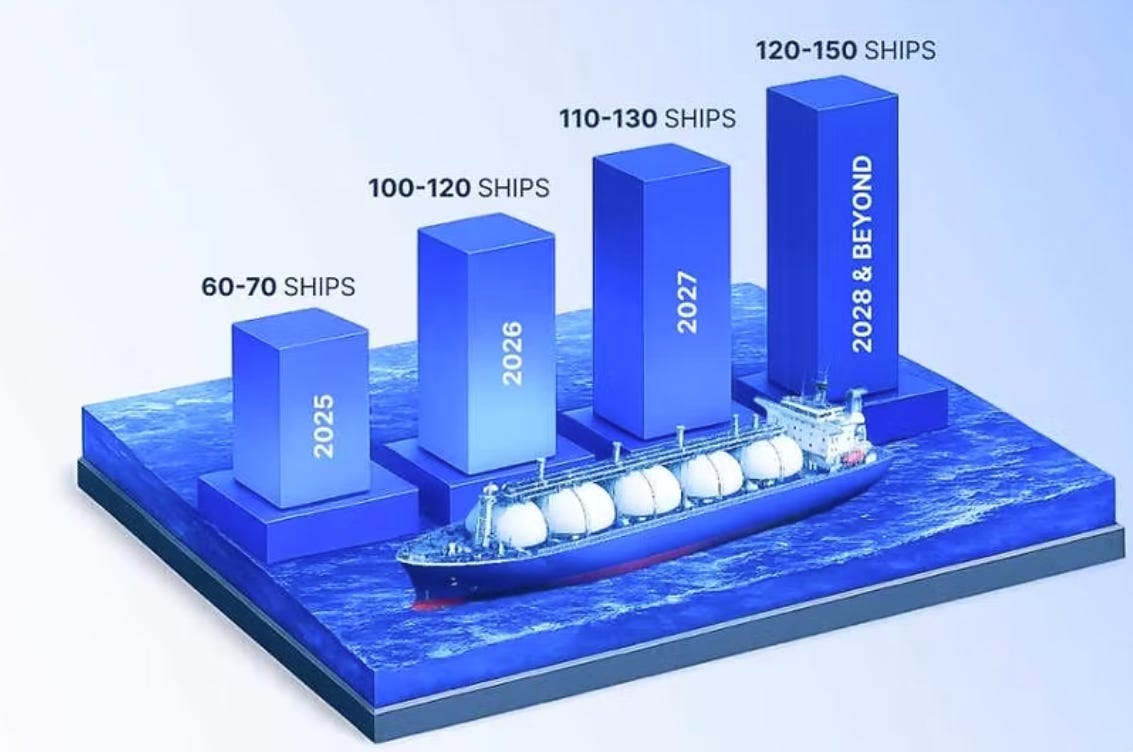
GTT is a key beneficiary of the multi-year LNG export capacity boom. Global demand for newbuild LNGCs remains near record highs, shipyards face order backlogs stretching out 4 to 5 years, and these ships enjoy decades of service. This means that GTT has long-term visibility into recurring royalty streams.
GTT maintains a portfolio of over 1,000 active patents which represents a huge moat. Additionally, the switching cost for a shipyard or shipowner is immense: altering containment systems requires re-skilling workforce crews, altering shipyard manufacturing lines, and taking on unproven cryogenic safety risks.
That having been said, this is an industry subject to extreme cyclicality. GTT’s revenue depends heavily on new vessel orders. When final investment decisions (FIDs) on new LNG liquefaction terminals stall or shipyards run out of dry-dock slots, order intake can plummet for multi-year stretches.
There can also be regulatory and geopolitical trade friction. Sanctions, such as those affecting Russian Arctic LNG projects have previously forced GTT to suspend contracts.
So this investment thesis is not risk free.
GTT recently completed a long-planned, orderly transition in its top executive leadership:
Philippe Berterottière served as Chairman & CEO for 16 years (from 2009 through late 2025). Under his tenure, GTT went public, scaled its global dominance in membrane containment, and built its asset-light royalty model.
He recently stepped back from daily executive operational duties to serve strictly as Chairman of the Board.
The newly appointed CEO is François Michel. He took office on January 5, 2026. Michel joined GTT from technology group John Cockerill, where he served as CEO, bringing extensive operational background across energy, green hydrogen, and industrial engineering.
Thierry Hochoa was appointed CFO in September 2023. He brings more than 25 years of finance experience, having held senior executive roles at CMA-CGM, Bourbon Offshore, and Technip (including CFO roles on mega-LNG projects like Yamal).
In addition to the senior management changes, GTT’s corporate strategy is also undergoing a structured transition from a pure-play LNG carrier technology licensor into an integrated clean-tech maritime & energy infrastructure group.
The historical core business was LNG containment: designing membrane tanks for bulk LNG transport across ocean trade routes. This business was naturally limited to LNG shipping vessels, which as a percentage of all ships, are relatively few in number.
However, in response to International Maritime Organisation (IMO) emissions regulations, commercial fleets (containerships, cruise ships, bulkers) are now replacing heavy fuel oil with LNG as bunker fuel. GTT supplies fitted membrane fuel tanks directly to shipowners, capturing a new addressable market outside traditional gas carriers.
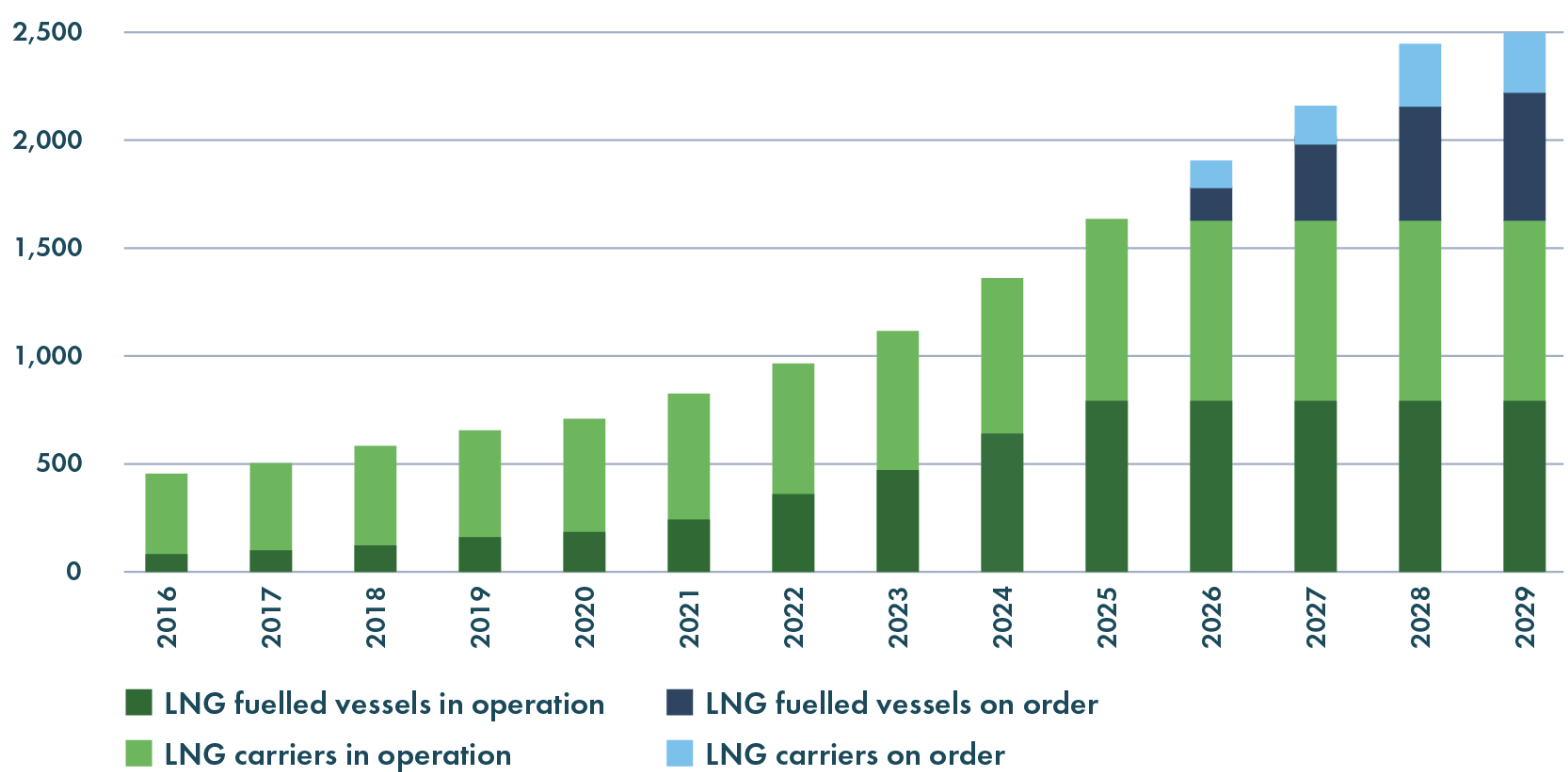
Then there’s the digital and smart shipping solutions segment of the business. Through strategic acquisitions (such as Marorka, BSafety, and OSEAN), GTT built a digital division providing vessel performance optimization, route planning, and real-time operational analytics to reduce fuel burn and boil-off rates.
Looking to the future, in 2020, GTT acquired Elogen (formerly Areva H2Gen), a designer and manufacturer of Proton Exchange Membrane (PEM) electrolysers for green hydrogen production. Hydrogen (often transported in ammonia) is expected to play a major role in decarbonizing industries and heavy transport, but handling hydrogen, especially in liquid form, is an ultra-demanding cryogenic challenge. Liquid hydrogen needs to be kept at -253°C, even colder than LNG and GTT is one of the few players with relevant cryogenic expertise to do this. This happens to overlap with GTT’s core competency in managing very cold, volatile liquid gases. While currently a minor financial contributor, it positions GTT to license containment and production tech for liquid hydrogen and ammonia as the marine industry decarbonizes over the coming decades and switches to this clean fuel.
This diversified model is helping GTT balance a traditionally cyclical core business with more structural, long-term opportunities. LNG carrier orders can fluctuate with energy investment cycles, but the company’s newer ventures (services, digital, alternative fuels) aim to smooth out the peaks and troughs by generating more steady revenue and keeping GTT relevant as industry needs evolve.
GTT sits squarely at the crossroads of: (1) the global LNG expansion in the wake of energy transition and security needs, (2) the coming hydrogen economy, and (3) the drive to decarbonize maritime transport. Each of these areas provides substantial growth opportunity for many years into the future.
Each of these strategic avenues, such as LNG expansion, hydrogen, greener shipping, provide layered growth potential on top of GTT’s baseline business. If even one of these areas experiences faster-than-expected uptake (for example, a sudden policy-driven surge in hydrogen investment, or a widespread adoption of LNG fueling in commercial fleets), GTT’s growth profile could tilt from steady to spectacular. Conversely, even if some take longer to materialize, GTT’s core business is robust enough to keep delivering results in the meantime. This multi-pronged positioning is why GTT is often seen as both a defensive play and a call option on the future of clean energy in maritime.
Since, we are focusing on the LNG market, where GTT maintains an 80%+ market share in LNG carrier containment, it is important to understand who else plays in this space to test the durability of its dominance.
South Korean shipyards, which build the vast majority of the world’s LNG carriers, have repeatedly tried to break GTT’s royalty monopoly to keep design fees in-house. Korea Gas Corporation (KOGAS) developed KC-1 (and subsequently KC-2), while HD Hyundai developed its own Solidus membrane system.
These technologies have struggled with commercial traction, micro-crack insulation issues, and higher boil-off rates (BOR) when compared to GTT’s Mark III and NO96 systems, leaving GTT’s competitive moat intact, at least for now.
Chinese companies are the latest to try muscling in on GTT’s virtual monopoly. However, GTT maintains a key advantage. It has earned trust over many decades and its solutions are tried and tested. It is in no way complacent and keeps investing in R&D, regularly filing tens of new patents. If you were building a new ship costing hundreds of millions of dollars, wouldn’t you be hesitant to embrace unproven alternatives for critical infrastructure like an LNG tank?
Historically, Moss Maritime produced the Moss-Rosenberg LNG transporation system, recognizable by spherical aluminum tanks protruding above the ship’s deck.
These were historically dominant in early-generation LNG fleets but they suffer from poor space utilization leaving dead volume inside the hull, higher aerodynamic drag, and heavier overall vessel weight compared to GTT’s flush membrane systems. As such, they are largely considered yesterday’s technology.
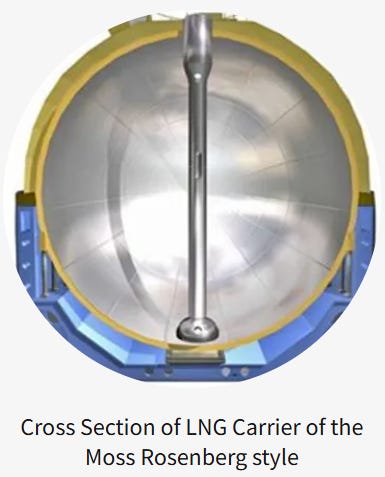
Then there are Japan Marine United developed self-supporting Prismatic Type-B (SPB) tanks which hides below deck like GTT membranes but are structurally independent heavy metal tanks. They are occasionally used for specialized FPSOs or floating units, but are far more expensive and labor-intensive to construct than GTT membrane layers.
Companies including Chart Industries, Wärtsilä and MAN Energy Solutions produce Type-C pressurized tanks for small-scale LNG transport, coastal vessels, and smaller LNG-fueled ships, but they become exponentially too heavy, costly, and volume-inefficient when scaled up to standard commercial size leaving GTT unchallenged in mid-to-large scale vessels.
In short, the Gaz Transport (GTT) membrane system is the best in class technology, which explains its dominant position in the market.
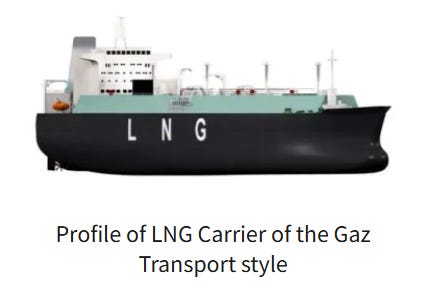
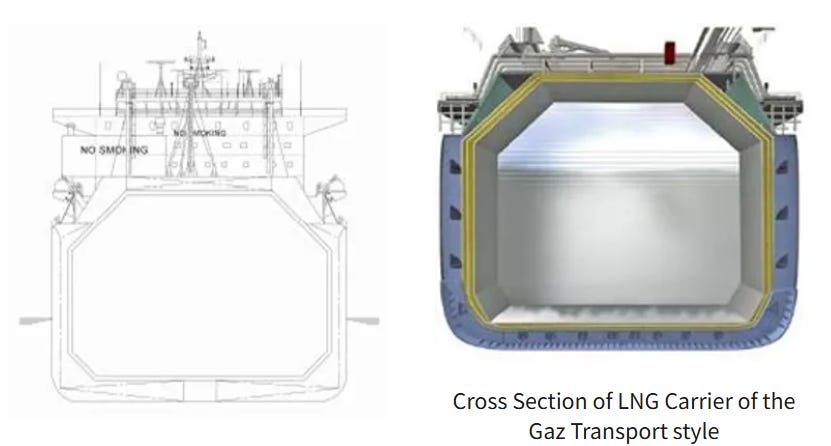
GTT generates strong free cash flow in line with its earnings. Over the last 12 months, operating cash flow was around €396 million against minimal capex needs (annual capital expenditures are only on the order of tens of millions). This means the company can distribute most of its profits to shareholders as dividends (~80% payout ratio), while still investing in R&D and bolt-on acquisitions. Indeed, GTT’s balance sheet carries little financial debt (the business has historically maintained a net cash position), giving it flexibility for strategic moves. It is essentially a defensive bond-like income investment that offers equity upside, a rare combination, although for non-French investors, beware of the withholding tax on dividends.
GTT offers exposure to critical global megatrends (energy transition, energy security, decarbonization) in a way that doesn’t require betting on unproven startups or volatile commodity plays. It’s a picks-and-shovels provider to the LNG gold rush and an arms dealer in the war on maritime emissions, all wrapped into one company.
Evolution PowerX (TSX: E)
The Natural Gas Power Platform

Founded in 2004, Evolution PowerX, formerly Enterprise Group, is an interesting investment because the company is undergoing a fundamental transformation.
This is not simply a change of name.
Under founders Leonard Jaroszuk and Des O’Kell, the company is transitioning from a traditional oilfield services rental business into a higher-growth, higher-margin power solutions and natural gas powered energy infrastructure platform.
As the strategy succeeds, the market will stop valuing Evolution as a cyclical oilfield services company and start valuing it for what it has become: a distributed power generation business positioned to benefit from the multi-decade electrification of industrial sites, which includes data centers.
The legacy business provides the foundation, the new power business provides the growth.
Before delving into the transformation, it is important to first understand the legacy business.
The Legacy Business
Imagine you are an oil and gas company exploring and extracting hydrocarbon fuels in a remote part of Canada, often hundreds of kilometres from the power grid and operating in extreme weather conditions.
You need lighting, heating, temporary buildings, accommodation and general site infrastructure.
That is where Evolution comes in. Three of its legacy businesses, Westar Oilfield Rentals, Arctic Therm International and Hart Oilfield Rentals, provide a one-stop solution for remote industrial sites.
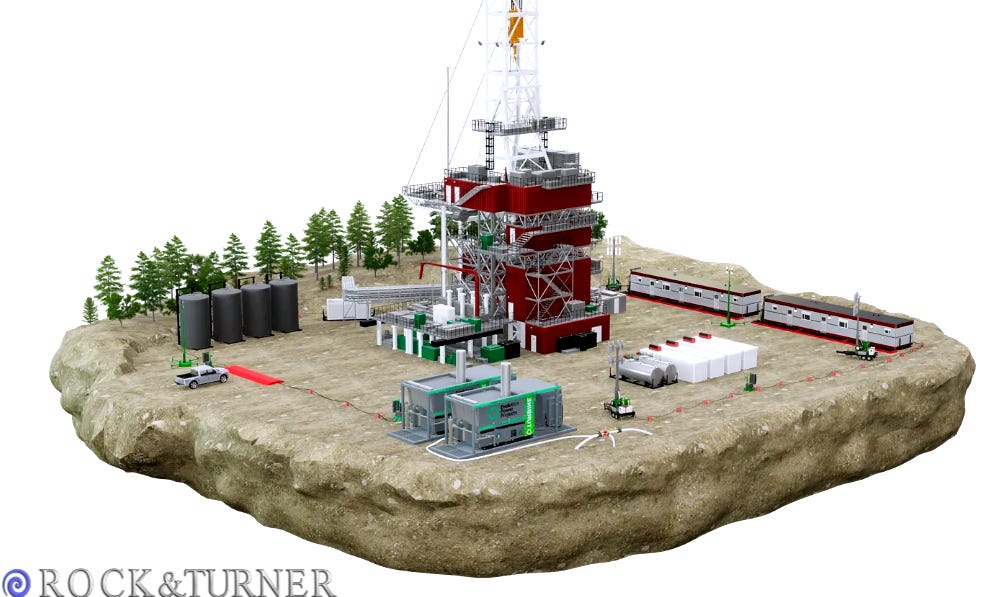
The business is profitable and cash generative, but it is no longer the main attraction.
Today the tip of the spear is Evolution Power Projects, the company’s other division.
This segment provides mobile natural gas turbine power generation, offering customers fuel-cost savings of up to 86% compared with diesel generators5, while also significantly reducing greenhouse gas emissions. The combination of these benefits drives strong customer demand.
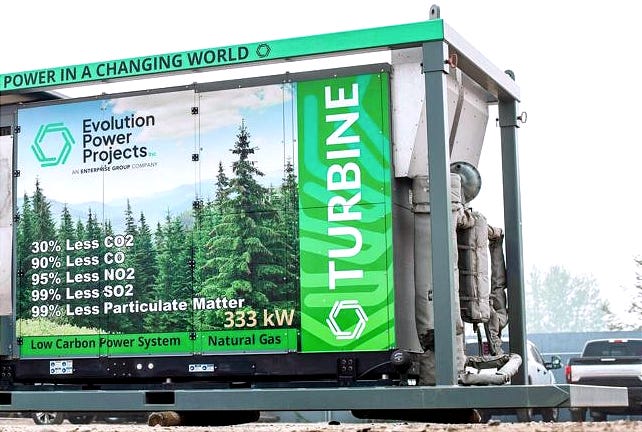
Evolution has become a leading provider of site power systems, turbine electrification and infrastructure services in Canada, and it sits at the intersection of three powerful secular trends.
First, the replacement of diesel with natural gas for remote power generation, driven by both economics and increasingly stringent environmental requirements.
Second, the emergence of demand for distributed, off-grid power across a range of industries, from oil and gas to mining and, potentially, AI data centers.
Third, Canada’s emergence as a global LNG supplier, which should drive a major increase in investment by exploration and production (E&P) companies in Western Canada.
What makes the opportunity particularly interesting is that Evolution has built competitive advantages that are not easily replicated.
In relation to microturbines, Evolution strengthened its position by acquiring FlexEnergy Canada. Flex energy is one of only three microturbine manufacturers globally. Now Evolution have exclusive control over the supply of Flex microturbines across the commercial and industrial sectors in Alberta and British Columbia.
These microturbines are typically 200 or 333 kW units.
Evolution subsequently signed an exclusive distribution agreement with Signal Power Group for its SPG4 gas turbine, based on Honeywell’s T55 engine.
Each SPG4 produces 3.2 MW and that is key. Large power requirements were previously served by stacking microturbines. Now, one 3.2 MW SPG4 can replace roughly ten microturbines, freeing those smaller units to serve other customers.
The larger turbines can also deliver power at a lower cost per kilowatt than a stack of microturbines. This helps drive demand and growth.
Unlike the FlexEnergy acquisition, the Signal Power distribution agreement requires relatively little upfront capital. There is no corporate acquisition or legal fees; instead Evolution simply buys the SPG4 units as and when it needs them to meet customer demand.
The SPG4 is small, but exceptionally durable and efficient. It has aerospace-grade power density (its the same turbine used in Chinook Helicopters), it’s had millions of operating hours in mission-critical applications and it has very high fuel efficiency.
Those characteristics matter when the customer requires continuous baseload power and where reliability is critical.
This is therefore not simply a field-power product. It’s a distributed generation platform that can potentially be applied wherever large amounts of reliable electricity are required away from the grid.
The addressable market for off-grid power generation extends well beyond oil and gas. Mining is an obvious application, while AI data centers are also very interesting.
CSA approval for the SPG4 is imminent, ready for deployment in the fourth quarter of 2026. Evolution will both rent these units, or sell them with service and maintenance contracts attached.
Which brings us to Evolution’s second competitive advantage.
It’s not enough to own the turbines. It is also necessary to have the inhouse expertise to deploy them, maintain them and service them.
Evolution has spent years transitioning its workforce from a diesel-based mechanical operation to one built around 480-volt electrical systems.
That required developing a workforce of master and journeyman electricians and learning, through years of trial and error, how to operate and maintain these systems in demanding environments (Canada is a country of temperature and climatic extremes).
This means that a competitor cannot simply buy a turbine and replicate the business overnight. The intellectual capital is in the people and the operating capability. That workforce is now itself a competitive asset, a cornered resource.
The final competitive advantage is easy to overlook.
Evolution is vertically integrated across four complementary divisions:
Evolution Power Projects provides power generation and microgrid connectivity.
Westar provides site offices and accommodation.
Arctic Therm provides flameless heating.
Hart provides 24/7 service and maintenance.
The whole is arguably worth more than the sum of its parts. No competitors offer customers a similarly integrated, one-stop solution for remote sites.
For a customer, dealing with a single provider is far more attractive than coordinating multiple specialist suppliers. It reduces management complexity, simplifies logistics and, crucially, reduces the risk of something going wrong.
That matters enormously to major oil and gas companies. A disruption at a remote site can be extraordinarily costly, while the amount paid to Evolution for equipment and services is relatively immaterial by comparison. When the cost of failure is so high and Evolution has established itself as a trusted and reliable supplier, there is little incentive for customers to switch.
This creates deep customer relationships, high switching costs and a recurring revenue stream from repeat business.
Evolution, therefore, shouldn’t be viewed simply as a company that rents site equipment. It is embedding itself into the customer’s operations. That is a subtle but important competitive advantage: once Evolution becomes part of the infrastructure keeping a remote site running, replacing it becomes considerably more complicated than simply choosing another equipment rental company.
The Transformation
Evolution’s transformation into an energy infrastructure platform is still in its infancy. The company only changed its name a few weeks ago, yet the underlying business is already moving in a very different direction.
This is a small-cap company with little or no analyst coverage, so the market has yet to fully recognise what is happening. The caterpillar is becoming a butterfly, but the market is still valuing the caterpillar.
That creates the opportunity. So, with the transformation in mind, let’s turn our attention to Evolution as an investment.
A Temporary Setback
The share price suffered a significant drawdown in 2025, largely because of three issues. None fundamentally changed the long-term thesis.
First, one of Enterprise’s largest customers, Petronas, paused activity while working through a major asset sale, the MidOcean transaction discussed earlier. The work in question wasn’t cancelled. It was delayed.
Second, the Canadian LNG infrastructure build-out was delayed. LNG Canada did not reach full throughput until March 2026, around nine months later than originally expected, which weighed on exploration and production activity.
Third, and related to the LNG delay, Canadian natural gas prices collapsed.
Western Canadian production had reached record levels in anticipation of the new LNG export capacity, averaging approximately 19 Bcf/d. The export infrastructure, however, wasn’t ready. Pipelines were full and there was nowhere for the excess gas to go.
The result was a localised glut and a collapse in AECO, the Western Canadian benchmark price. Conditions became so extreme that prices regularly turned negative at the wellhead. Canadian producers were forced to undertake some of the most aggressive voluntary production shut-ins in their history simply to avoid paying someone to take their gas.
It was a brutal environment for Canadian E&P companies.
Evolution, however, is not a natural gas producer. That distinction is important.
The Commodity Price Isn’t the Business Model
Evolution does not have direct exposure to the price of natural gas. What matters is whether the economics of oil and gas production are sufficiently attractive to keep E&P companies drilling and investing.
If natural gas prices collapse and destroy drilling economics, Evolution will eventually see lower demand for its equipment and services. If the underlying industry remains profitable, however, Evolution continues supplying the equipment and infrastructure required to develop those assets.
It sells the picks and shovels.
There is another reason why Evolution’s customers are somewhat insulated from weak dry-gas prices. Their production mix is skewed towards higher-value liquids, including condensate and natural gas liquids (NGLs), rather than pure methane. These liquids tend to be priced more like oil and petrochemical feedstocks, making them more resilient when standalone natural gas prices are weak. They also provide additional upside when gas prices recover.
The LNG Opportunity
Now consider how the structural outlook for Canadian natural gas is changing, and what that could mean for Evolution.
Canada has abundant natural gas resources, but historically it has had only one significant international customer: the United States. That is beginning to change.
The emergence of LNG exports represents a potentially multi-decade expansion in the markets available to Western Canadian gas producers. The US has historically paid relatively modest prices for Canadian gas, whereas international LNG markets can support substantially higher prices.
It is tempting, therefore, to assume that Evolution’s fortunes are directly linked to AECO, the Canadian gas benchmark. That is not quite right.
The largest participants in Canadian LNG projects are not simply buying gas on the open AECO market and exporting it.
LNG Canada is a joint venture between Shell, Petronas, PetroChina, Mitsubishi and KOGAS. These companies produce gas from the Montney formation in British Columbia and transport it directly to the coast through the Coastal GasLink pipeline. That gas effectively bypasses the AECO trading hub, meaning the international LNG premium does not flow directly into the local spot market.
The economics of Canadian LNG are therefore largely determined by international natural gas prices rather than the local AECO price.
From One Market to Several
Until now, LNG has accounted for only a small proportion of the Canadian gas market. Western Canadian production is approximately 19 Bcf/d, compared with around 2 Bcf/d of LNG Canada Phase 1 export capacity.
The overwhelming majority of Canadian gas therefore still has only two destinations: Canada or the United States.
As long as Canada depends on the US to absorb its surplus production, AECO prices will ultimately be constrained by what the US market is prepared to pay. That is one reason AECO remains depressed today.
The upside comes from several directions.
If the US gas market moves from surplus to deficit over the next 12 to 18 months, US prices could rise sharply, pulling Canadian AECO prices higher with them. That would improve drilling economics and stimulate E&P activity.
At the same time, Western Canada is building additional intra-basin connectivity, including projects such as the Yellowhead Pipeline. As pipeline constraints ease and tolls decline after 2026, the discount between Canadian gas and Henry Hub should gradually narrow.
Then there is the much larger LNG build-out.
LNG Canada Phase 1, with 14 MMtpa of capacity, will eventually be complemented by Phase 2, which adds another 14 MMtpa. Beyond that, several additional projects are moving forward.
Woodfibre LNG, with 2.1 MMtpa of capacity, is already around 70% constructed, with first cargoes targeted for the end of 2027.
Cedar LNG, a 3.3 MMtpa floating LNG project, is around 50% constructed, with start-up targeted for late 2028.
Ksi Lisims LNG, with potential capacity of approximately 12 MMtpa, remains at an earlier stage. It is, however, progressing through the federal Major Projects Office and has been fast-tracked following a 20-year offtake agreement with Uniper, the German utility. Deliveries are expected to begin in 2032.
The result is that Canadian LNG export capacity could more than triple over the next five years.
For Evolution, the significance is straightforward: more export capacity supports more drilling, and more drilling means more demand for Evolution’s equipment and services.
Management believes Evolution is currently serving only around 15% of the sites it could potentially address. If that estimate is even broadly correct, the runway is enormous.
From Equipment Rental to Power Infrastructure
There are, of course, near-term risks. Weather is one of them.
An unusually warm and dry El Niño winter across North America could suppress seasonal heating demand and prevent the significant near-term increase in natural gas prices that some investors are anticipating.
These short-term variables are unavoidable. The more important question is what the business looks like over a multi-year period.
Here, Evolution appears directionally very well positioned. The company is effectively selling power infrastructure into a world that increasingly needs reliable, off-grid electricity in vast quantities.
The financial results are beginning to demonstrate what this transformation could mean.
The 2025 financial year was weak for the reasons outlined above. The quarterly numbers in 2026, however, are robust and moving firmly higher. Gross margins are already above 40% and are expected to approach 50% over the next couple of years. Management is targeting EBITDA margins of close to 40%, compared with approximately 37.5% today.
That compares favourably with the roughly 15% to 25% EBITDA margins typically generated by more traditional equipment-based energy services businesses.
The economics of the Evolution model are fundamentally different.
The company is moving aggressively into high-value power infrastructure, and that market is already showing signs of tightness.
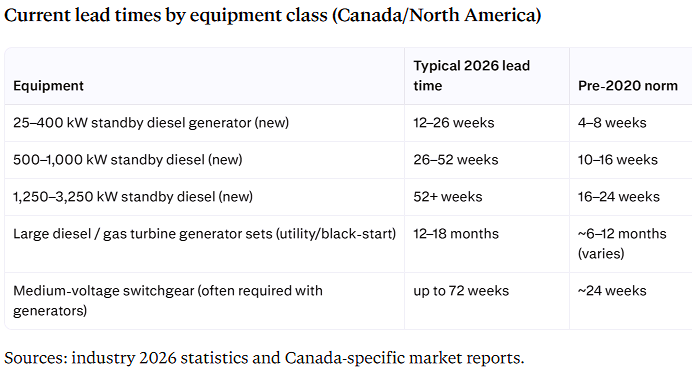
The AI infrastructure build-out is driving high utilisation across the power-generation industry, while major OEMs such as Cummins and Caterpillar in diesel gensets and GE Vernova in utility-scale gas turbines are effectively sold out into 2028 and beyond.
In a market this tight, owning a fleet of available generators creates enormous earnings power. Evolution’s existing fleet can command high utilisation rates, while growing demand provides an incentive to expand the fleet further.
There is an important caveat, however. Evolution’s turbines are not designed to meet the power requirements of hyperscale data centers. Those facilities require permanent, utility-scale power generation.
Evolution’s opportunity lies elsewhere: customers with smaller power requirements, temporary power needs, or locations where portability and speed of deployment are more important than scale.
That may ultimately prove to be a very attractive niche. Evolution does not need to compete head-on with the largest turbine manufacturers. It simply needs to own the right equipment, deploy it where grid power is unavailable or unreliable, and earn attractive returns in a market where available power is becoming increasingly scarce.
Management and Summing It All Up
When founders are still running a business with the same passion and enthusiasm they had when it was a startup more than two decades ago, that usually bodes well for an investment.
Leonard Jaroszuk and Des O’Kell have managed Evolution for its entire existence and still own approximately 40% of the company. That represents meaningful alignment with outside shareholders.
More importantly, this is a management team that has already navigated a brutal seven-year commodity downturn during the 2010s, a period that destroyed many businesses across the sector. They survived through disciplined decision-making and by thinking in years rather than quarters.
There is another subtle but important point here. When a business is heavily insider-owned, it can gradually become a lifestyle business, with management extracting earnings to fund their own income rather than reinvesting for growth. That is not what has happened at Evolution.
After a quarter of a century, management is still choosing to reinvest rather than pay a dividend. Those little things matter. When the growth runway is this long, the ability to reinvest capital at attractive rates of return should be the priority. This is a management team that appears willing to put the long-term interests of the business ahead of its own immediate financial benefit, which is increasingly rare.
The balance sheet provides further comfort. Evolution has a strong financial position, with its debt facility approximately 40% underutilised, giving it ample capacity to fund organic growth and expand its turbine fleet as demand requires.
The 2025 equity raise was an exception rather than a template for future capital allocation. Management believed the opportunity to acquire FlexCanada was too attractive to pass up, but the transaction was too large to fund entirely from available cash. It is difficult to see a repeat of that situation unless another unusually compelling acquisition opportunity emerges.
Management has also made its view on the valuation clear. Believing the shares to be materially undervalued, it has been using the Normal Course Issuer Bid (NCIB) to repurchase shares at prices it considers below intrinsic value. Buying back shares below intrinsic value is highly accretive to continuing shareholders.
That is exactly what I would want to see from founder-owners who believe the market is mispricing their business.
The market still appears to be valuing Evolution primarily on what it has historically been rather than what it is becoming. That disconnect is often where the best investment opportunities are found.
At approximately C$1.70 per share, Evolution trades at around 9x estimated 2026 EBITDA and 7.5x estimated 2027 EBITDA. For a company with gross margins approaching 50%, EBITDA margins nearing 40% and the potential for strong double-digit annual revenue growth over the coming years, that looks difficult to justify.
Given the transformation underway, a re-rating into double-digit EBITDA multiples does not seem particularly demanding. Some might argue it is well overdue.

One gigawatt of continuous generation from an efficient combined-cycle gas turbine consumes roughly 0.15 Bcf/d of natural gas.
E&P reserve categories:
PDP, or Proved Developed Producing, represents wells that have already been drilled and are currently producing.
1P, or Proved Reserves, includes PDP plus proved developed non-producing reserves and proved undeveloped reserves.
2P, or Proved plus Probable Reserves, adds probable reserves, representing additional gas with a 50% chance of recovery.
3P, or Proved plus Probable plus Possible, is the largest and most speculative reserve category.
Ibid
Based on an average of the price decks of three independent engineering firms, GLJ Ltd., Sproule Associates Limited and McDaniel & Associates Consultants Ltd. (the "Consultant Average Price Forecast") at January 1, 2026
Natural gas that would have otherwise been flared as a byproduct of oil extraction, is used to generate power, displacing costly and dirty diesel used in other generators.
One week on from publishing this article, both EU and Asian natural gas prices (TTF and JKM respectively, on a USD/MMBTu basis) trade in line at close to $24 versus $3 in the United States. The spread has widened to a multiple of 8x. This fully supports the LNG investment narrative.