


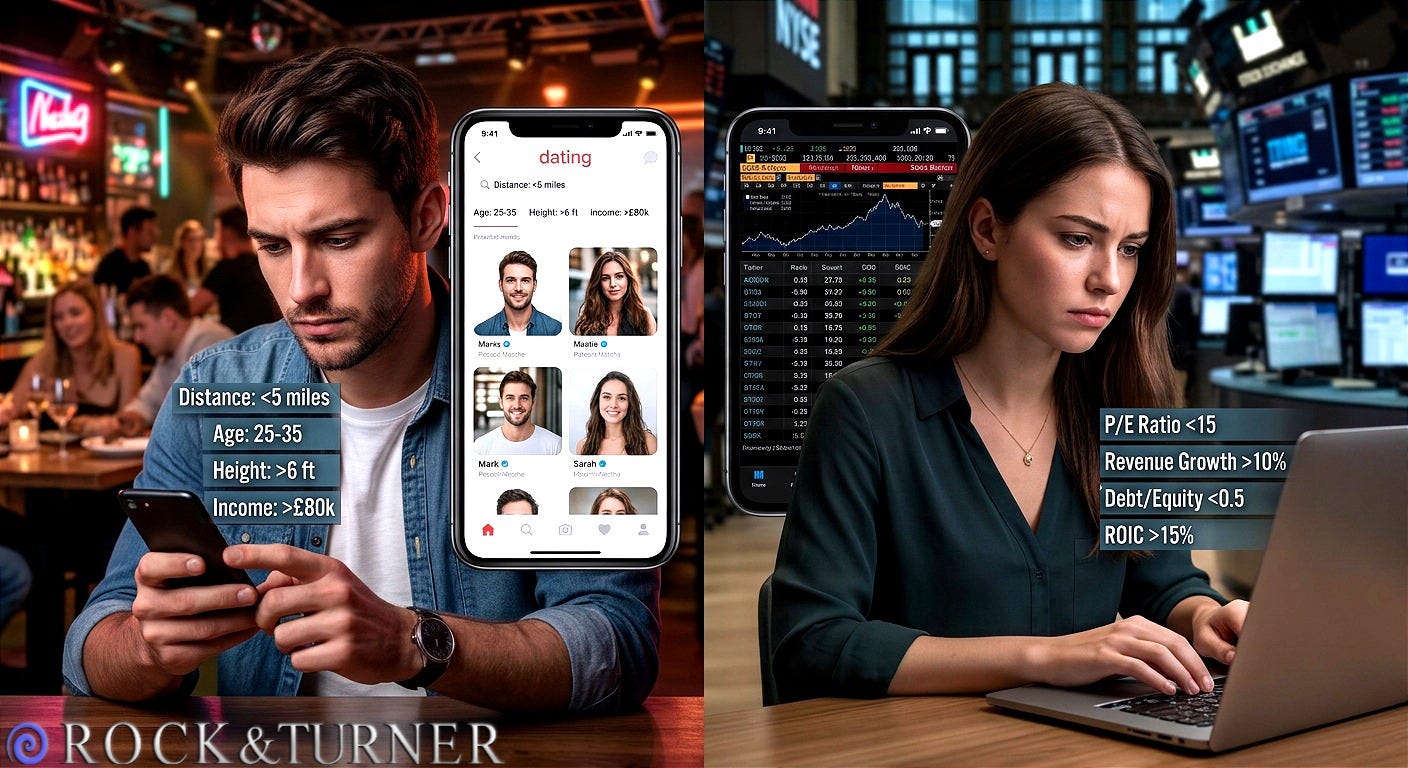
Imagine being single, wanting to find love, and deciding, tonight’s the night.
You go to the local nightclub, and decide that you’re coming home with your soulmate.
Yeah right!
That’s never going to end well.
You don’t find love because you’re looking for it. You stumble across it unexpectedly. You meet someone who catches your attention, you get talking, and gradually discover that there might be something special there.
As absurd as this situation may sound, isn’t it exactly the way most people invest?
They have capital in their pocket, and they can’t resist the urge to put it to work. So they go out looking for an investment, not content until they find something.
They end up with something that’s not great, but not terrible either. A compromise. The least-worst option available at the time.
Buffett once observed about most investors, “If we have a lot of money around, we’re a little dumber than usual.”
He would never make such a rudimentary mistake, which explains why Berkshire Hathaway under his leadership accumulated a cash pile of close to $400 billion.
But I digress. Let’s return to our dating analogy.
Meeting one’s soulmate in a nighclub is so last millennium. I guess I’m showing my age!
People today use dating apps. Of course they do!
They approach the whole dating thing like an equity analyst.
They set their filters: between 35 and 45, six feet tall, brown hair, within 20 miles, university educated, earns more than £100,000, likes dogs, doesn’t smoke.
Click.
The algorithm produces 12 candidates.
Excellent. Or is it?
The problem is that you’re now optimising for what can be measured rather than what actually matters. You can screen for height, income and distance, but the algorithm has no idea whether you’ll still enjoy talking to the person after three hours over dinner.
Stock screeners work much the same way. You tell the screener what you’re looking for: revenue growth above 15%, ROIC above 20%, net debt below 1x EBITDA, expanding margins and a P/E below 20x.
Click.
Here are your 23 stocks.
Excellent. Time to invest.
Except a screener can’t tell you whether the management team is exceptional, whether the competitive advantage is durable, whether the accounting is telling the truth, whether the industry structure is improving or deteriorating, or whether the economics of the business will look completely different five years from now.
It’s the equivalent of going on a first date and asking, So, your salary is above £100,000 and you’re well educated. When can we get married?
That’s not investing. That’s procurement.
The other problem is what happens once you have your list of candidates. You start feeling compelled to do something with it. After all, you’ve spent time building the screen. You have 23 companies sitting there, patiently waiting for your attention.
Surely one of them must be the one.
So you start rationalising.
Well, the margins aren’t quite as good as I’d like, but they are improving.
The CEO seems slightly questionable, but the valuation is attractive.
The industry is terrible, but perhaps that’s already reflected in the price.
Would you marry someone because, technically, she ticked six out of your eight boxes?
None of the best investors, the really good ones, use dating apps. They wait. They understand the power of delayed gratification.
They know that sometimes the smartest move is to sit on $380 billion in cash until something truly extraordinary comes along, even if that means retiring before finding it.
So, the next time you feel the urge to put capital to work, resist it.
Just like soulmates, the best investments aren’t forced. They’re found.
They are more likely to emerge from an unexpected observation, an unusual situation, a great management team, a structural change in an industry or simply a business that makes you stop and think, ‘Hang on, this is interesting’.
The best things in life don’t come in neat packages. Keep an open mind and be patient.
When it arrives, it may be shorter than six feet tall and have blonde hair, but it will make your pulse quicken. It will just feel right.
In investing, as in life, you rarely know what you were looking for until you find it.


I think your analogy is pertaining in the fact that, as in dating, most stocks are only held for a few months. The main difference though is that you are not frowned upon to hold more than one stock! In my view, searching for compounders with screeners is just an exercise in finding beautiful spreadsheets. Unfortunately, some financial metrics like growth are mean reverting and others can be distorted, and as you mention, qualitative factors like management are not screenable.
An interesting application I have been thinking about but haven’t had time to look into yet is to do the complete opposite that people are doing. Such as to screen on declining earnings, historically low margins, declining share price, high multiples, high leverage… whatever comes out of that will have low sentiment, low investor attention and a high chance of mean reversion. Not in order to buy fundamentally weak stocks randomly but to look for overlooked opportunities. In your dating analogy, it’s closer to the one night stand where you just hold for 2-3 years and cash out.
The intentionality is key here! It is not the same to buy a stock at depressed valuation with a 2-5 year exit than to chase the best looking stocks. The stocks that are worth holding for 1-2 decades are rare. If you have 380Bn in cash on the other hand, you have a different problem than most people…
Great article ! This is so true. It really is. The numbers are all there sometimes. The company is profitable. But the business isn't always one you want to root for or even be associated with. Great analogy James. Don't force things in life.