


Company: Universal Music Group (Amsterdam: UMG)
Share price: 14.50 Euro
Market Cap: 26 bn Euro
Float: 56.4%
Special Situation: Market myopia: knee jerk over selling
DISCLAIMER & DISCLOSURE: The author is invested in Universal Music Group at the date of publication but that may change. The views expressed are those of the author and may without notice. The author has no duty or obligation to update this information. Some content is sourced from third parties believed to be reliable, but accuracy is not guaranteed. Forward-looking statements involve assumptions, risks, and uncertainties, meaning actual outcomes may differ from those envisaged in this analysis. Past performance is not indicative of future results. All investments carry risk, including financial loss. This analysis is for educational purposes only and does not constitute investment advice or recommendations of any kind. Conduct your own research and seek professional advice before investing.
This is not one of my usual deep dives. This is a special situation which presented itself today. It’s been on my watchlist for a while and it went ‘ON SALE’ in the market today. So here is a very short overview for your benefit.
Universal Music Group (UMG) sits at the very heart of the global music industry, operating as one of the world’s “Big Three” major record labels alongside Sony Music and Warner Music Group.
Historically, UMG grew out of a century of music industry consolidation, tracing its roots back through MCA, PolyGram, and the legendary Decca and Deutsche Grammophon catalogs before taking its modern shape under the French conglomerate Vivendi, which spun it off into a public listing in 2021.
What makes UMG uniquely valuable. and structurally distinct from traditional corporate entities, is its ultimate identity as a massive, compounding intellectual property royalty engine.
UMG controls a vast majority of the world’s most valuable music catalogs, owning or administering master recordings and publishing rights for iconic artists ranging from Beatles-era classics to modern mega-stars like Taylor Swift, Drake, and Billie Eilish. These master recordings are pristine economic assets: they require virtually no ongoing maintenance capital, suffer no physical depreciation, and generate high-margin cash flows every time a track is streamed on Spotify, played on TikTok, synced in a movie, or broadcast on the radio.
Bill Ackman’s Pershing Square Fund pitched for Universal Music Group just three months ago, offering to buy the business for the equivalent of roughly $64 billion, or €54 billion.
What happened next is interesting.
The Bolloré Group, the family-controlled French conglomerate, is a major investor in UMG. It owns 18.4% directly, but its economic interest is significantly larger. Bolloré owns 29.3% of Vivendi, which in turn owns 13.4% of UMG. Combined, that position was enough to block the deal.
A controlling family stake can be a moat. The Bolloré family has demonstrated long-term commitment, they have held and added to the position over years, not treated it as a trading vehicle. Unlike activist investors hunting a quick exit, family control typically aligns with multi-decade value creation. This is particularly valuable in the music industry, where artist relationships, licensing negotiations, and cultural capital matter as much as financial engineering.
On the flip side, European family businesses, particularly French ones, often prioritise stability and dividend extraction over aggressive capital allocation. The Bolloré family may prefer steady cash generation, explaining its interst in UMG: music royalty businesses are highly cash-generative. The Bolloré family’s stake and voting power means they have veto power over major decisions while minority shareholders have no meaningful say. If the family decides UMG is a long-term hold and prefers long-term income generation to capital gains, minority shareholders are locked in.
In any event, in May 2026, Cyrille Bolloré publicly urged the UMG board to reject Ackman's takeover proposal, a decisive signal that the family was not interested in selling at the offered price.
“UMG's long-term growth in streaming, live music, and superfan monetization remains high.”
Cyrille Bolloré, CEO Bolloré Group, who served on the UMG board until stepping down in July 2026
Two months later, on 28th July, 2026, Cyrille Bolloré resigned from the UMG board effective immediately.
Where the two events related?
Accordingly, the Pershing Square bid was rejected.
Yet today, the market appears to be pricing this world-class business at a staggering discount.
UMG currently has a market capitalisation of roughly €26 billion and an enterprise value of around €30 billion. In other words, the company is now trading at roughly half the value at which Ackman was prepared to buy it.
So what changed?
Perhaps the reason the Pershing Square offer was rejected was not that the price was too low, but that the structure was not attractive enough.
Ackman’s proposed transaction involved €9.4 billion in cash, plus 0.77 shares of newly issued stock in New UMG for each UMG share held. It also involved moving UMG’s primary listing from Amsterdam to the United States.
The clue may have been in a comment from Cyrille Bolloré at the time:
“If the share price were around 27–28 euros, it would certainly be worth considering selling a portion of the holding.”
Ackman was UMG’s fourth-largest shareholder, with a stake just under 5%, but exited the investment after his takeover offer was rejected. The shares were placed via an overnight block trade at €17.66 each, which included UMG itself buying back €250 million of its stock directly from the fund
Ackman had long argued that the market was failing to properly value UMG on a sum-of-the-parts basis, but that his takeover attempt which was designed to unlock that valuation gap hadn’t worked as intended.
That argument prompted UMG to monetize half of its 3.16% stake in Spotify, using the proceeds in part to help fund a €1 billion share buyback programme. If the market offers the opportunity to buy back your stock at about 50 cents on the dollar, why not take it.
All of which makes the recent sell-off in UMG shares following its Q2 earnings even more remarkable.
Just three months ago, someone was prepared to pay roughly twice today’s market value for the business, and the company itself was willing to buy-back its own shares rather than selling the business too cheaply. Yet today, the market appears to be saying that the same business is worth half as much as Ackman offered.
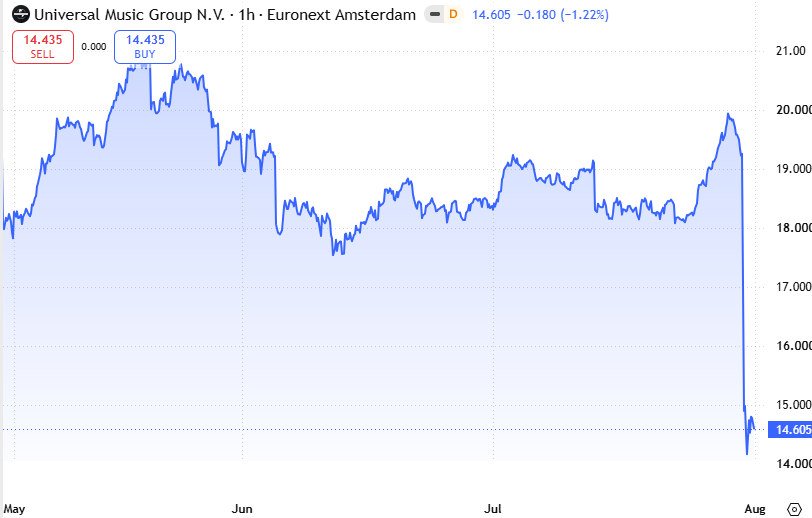
The 25% drawdown in the stock, which closed at 14.60 Euro at the end of July 2026, reflects short-term noise and cyclical margin pressure rather than any fundamental deterioration of the underlying asset base.
Much of the current market anxiety stems from a fundamental misunderstanding of the recent Downtown acquisition. Via its Virgin Music Group (VMG) subsidiary, UMG acquired Downtown for $775 million in cash, integrating independent distribution, publishing administration, and royalty services.
European Union antitrust approval required divesting the Curve royalty accounting platform, but this removed the regulatory overhang and the deal completed in February this year.
Lower-margin service revenues and integration expenses are currently masking the strategic value of building a unified platform for independent artists, but these pressures are entirely transitory.
Mathematically, this disconnect defies logic. Prior to closing the Downtown deal, UMG traded at a far higher valuation than where it trades today. Now you get a significantly enlarged business with superior scale, cross-selling potential, and market share, but at a distinct discount to the old standalone entity. On a sum-of-the-parts basis, it makes no sense. The current pricing treats an expanded revenue engine as if it were worth less than before.
The market is reacting to quarterly numbers, not looking at the big picture, completely ignoring the broader strategic transformation.
Q2 revenue still grew by 13.3%, proving the business is far from broken, and with EBITDA margins holding firm at 20.5% as the Downtown integration wraps up, an earnings rebound looks imminent.
Management clearly agrees, having only just completed a €500 million Euro share buyback at prices well above current levels. When an informed buyer like Ackman sees double-the-upside and management buys back stock, that sends a strong valuation signal.
If Cyrille Bolloré’s board exit precedes a formal announcement, that would reset sentiment. Perhaps the Bollore family will make an offer to acquire the business. Alternatively, if another activist (or consortium) tables a bid at a level below that of Pershing Square but above the current market valuation, that would pressure the Bolloré family to at least match it in defence of their rejection of Ackman’s higher bid. There are multiple catalysts that are likely to cause the share price to bounce.
The current drama looks less like a crisis and more like an investment opportunity.


Some food for thoughts :
1. The ackaman offer valued UMG around ~22€ (and not 27-28€), the gap being a dividend to be paid by the new UMG.
2. Bollore was historically seller on the market (with no unique counterparty that get larger influence on the group) at 27-28€ but not at 22€
3. the new UMG offer would have changed shareholder rights and reduce Bollore position. It is a pure "control premium" but Bollore definitely doesn't want to give up their current predominant position in current UMG on the cheap. I am not sure he would have sold at 28€ without strong guarantees over future influence on the new UMG
4. On top of potential lucrative deal for Ackman at 22€, getting larger control on UMG would have also created flywheel effect for his asset management company with fresh money subscription.
_
Overall, the deal failed about insufficient valuation and matters about lower future shareholder influence for Bollore
UMG was happily buy backing shares around 18€. Bollore had also been a buyer around this level.
I would be interesting to see if Bollore buys back again at 15€ and to what extent UMG is accelerating their buyback.
_
My TP is about 25-28€. I was not a buyer yet a 18€ but I am in at 15€
Pershing Square sold all of its remaining stake right after their bid was rejected for ~18€ per share.