


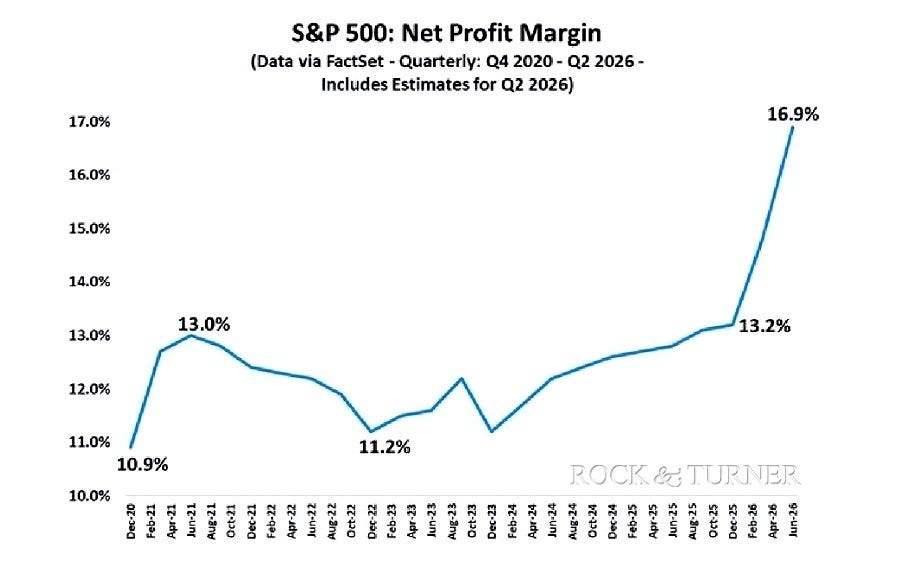
“A 370 basis point increase would means margins have expanded by 28% in a single quarter from prior peak elevated levels.
Margins simply don’t expand like this under normal circumstances. So how can this be? Can we trust the data?
The answer is both yes and no.”
The S&P 500’s net profit margin held steady at around 5–6% through the post-war decades, rising to roughly 7% around the turn of the millennium.
The average was 5.6% in the 1990s, rising to 6.3% in the 2000s as companies experienced the benefits from globalization, productivity gains and cost efficiencies.
Then margins stepped up again, averaging 8.8% in the 2010s. Part of this was structural. The index had become increasingly dominated by high-margin, asset-light technology companies.
But much of the improvement was cyclical and policy-driven.
Zero interest rate policy following the Global Financial Crisis dramatically reduced financing costs. Then came the 2017 Tax Cuts and Jobs Act, which cut the US corporate tax rate to 21%, providing a significant one-off boost to corporate net margins.
The pandemic produced a brief trough in 2020, followed by an extraordinary spike in 2021–22. Reopening demand, fiscal stimulus, pricing power and operating leverage pushed earnings up faster than costs. By mid-2021, S&P 500 net profit margins had reached an all-time peak of around 13%, which looked stretched and unsustainable.
Then the tide turned, and margins began heading south.
Inflation, rising wages, supply-chain disruption, de-globalization and higher interest rates began to push costs higher. The forces that had driven margin expansion during the first two decades of the century were slowly unwinding.
Net margins softened, falling to around 11.2% by the end of 2022.
The consensus view among analysts and economists was that mean reversion would eventually take margins back into single digits.
Then came ChatGPT.
The AI revolution began, and spending exploded as enterprises across the economy rushed to experiment with AI. The hyperscalers, which now dominate the S&P 500, were the primary beneficiaries.
Margins began moving higher again.
But there is an important detail here. The improvement has been driven disproportionately by a very small group of companies. Roughly ten companies now account for close to 40% of the S&P 500 by weight, and their extraordinary margins have had an outsized impact on the index.
By the beginning of 2026, S&P 500 net margins were back around 13%.
However, in recent days, FactSet data revealed something extraordinary: net profit margins had not merely breached the previous 13% ceiling. They had shattered it.
A number close to 14% would have set a new record. 15% would have been astonishing. 16% would have been even more remarkable.
But the number is almost 17% (see chart above).
The obvious question is: how can this be?
The Q2 2026 number implies an exceptional 370 basis point quarter-on-quarter expansion in S&P 500 net margins, creating a pronounced breakout from the historical trend and raising an obvious question about both the durability and composition of the uplift.
Put simply, a 370 basis point increase would means margins have expanded by 28% in a single quarter from prior peak elevated levels.
Margins simply don’t expand like this under normal circumstances.
So how can this be? Can we trust the data?
The answer is both yes and no.
There is no reason to believe FactSet is wrong. The numbers are what the accounting says they are.
But accounting conventions are creating a significant distortion.
The AI revolution has produced an unprecedented wave of capital expenditure. The hyperscalers are expected to spend around $800 billion this year alone and roughly $3 trillion over the next three years.
We have never seen investment on this scale before. That matters because the accounting treatment of the spending creates a timing mismatch.
This year’s $800 billion has to go somewhere. NVIDIA, Micron and hundreds of other companies will recognise all of that spending as revenue this year. Their profits rise immediately, and that flows straight through into the S&P 500 earnings and margin data.
But the companies spending the money don’t expense the $800 billion immediately. They capitalise it.
The cash has left the building, but only a small portion of the cost appears on the S&P500 income statement this year. The remainder will be depreciated over many years. Some haven’t started to be depreciated because they are deemed ‘construction in progress’ assets, so a large amount of this spending is currently absent from the income statement.
So we have a peculiar situation within the index data. Unprecedented volumes of revenue are recognised today, while the corresponding cost is mostly absent from the income statement; it’s a mismatch.
That creates a temporary distortion in reported profitability, and when the numbers are being used to value the entire market, that distortion matters enormously.
Pricing the S&P 500 on a 16.9% net margin as though it were a sustainable is folly. Significant adjustments need to be made to the numbers.
More importantly, the mechanism eventually works in reverse.
When AI capital spending inevitably slows, particularly once too many data centres have been built, index revenues drop off a cliff. But the capital expenditures of yesteryear will continue flowing through the income statements as depreciation, year after year.
Profits will compress and the net earnings pendulum, which has swung too far in one direction now, is likely to swing too far the other way in the not too distant future.
So the pertinent question is not where S&P 500 margins are today. The question is where they will average over the next five or six years. That’s the number that really matters.
It won’t be 16.9%. It’s highly unlikely to be 13%. Given how much of the recent margin expansion has been driven by temporary factors, don’t be surprised if the answer is a single-digit number.
Accrual accounting has its benefits, but the issue highlighted in this post demonstrates that it also has its limitations.
The best leading indicator of the S&P 500’s underlying economics is arguably its free cash flow.
As the chart below demonstrates, free cash flow is telling a very different story from reported net margins.
For years, S&P 500 free cash flow yields oscillated around 5%. Then, quite suddenly, they began to fall precipitously.
The pivotal year was 2023, when the AI investment cycle began in earnest following the launch of ChatGPT. That was when capital expenditure started to go crazy.
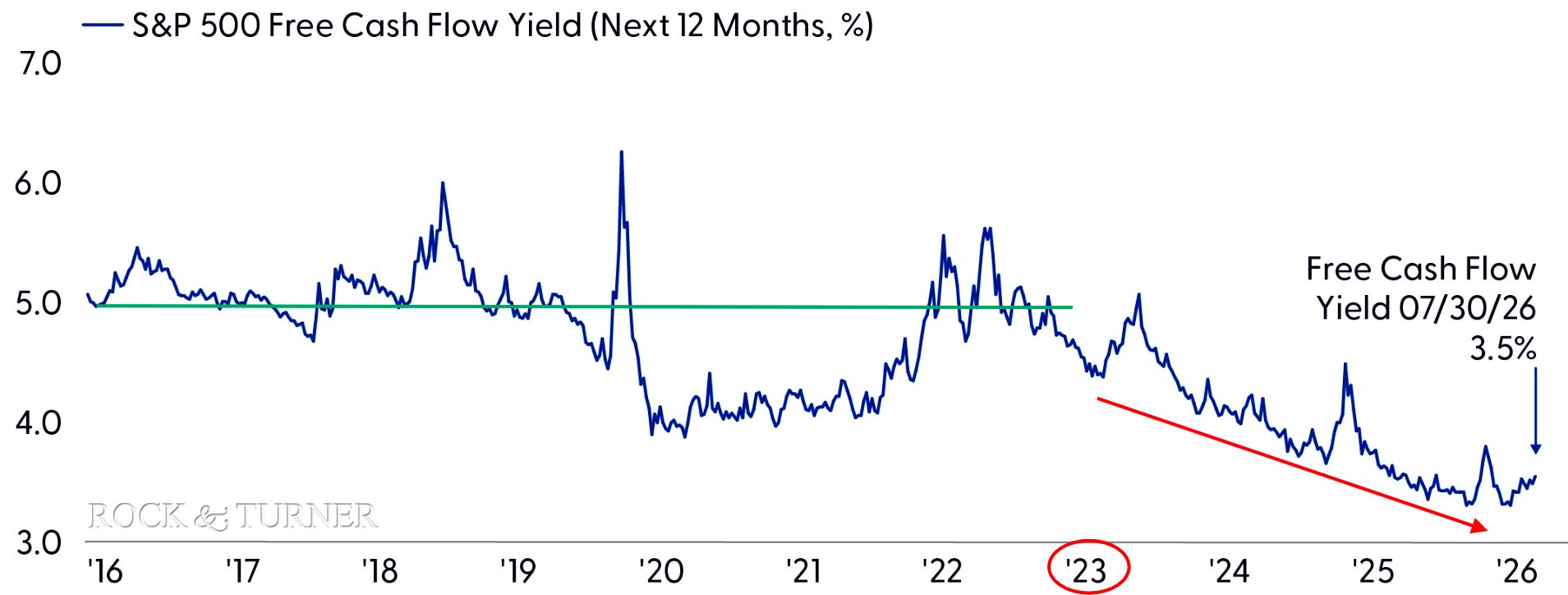
The contrast is striking. Reported net margins are at record highs. Free cash flow yields are collapsing.
Accrual accounting will eventually catch up with cash flows. It always does.
But there is another, more important point.
The S&P 500 margin is not an independent number. It is a composite of the financial results of its 500 constituent companies.
So if the index-level data is being distorted, the problem doesn’t lie with the index itself. The distortion must originate in the underlying corporate data.
In other words, the numbers being reported by the individual companies may be perfectly correct from an accounting perspective, yet still misleading from an economic perspective.
That matters because investors use those reported numbers to value businesses.
If the current 16.9% S&P 500 net margin is being temporarily inflated by the accounting treatment of an unprecedented CAPEX investment cycle, then investors need to adjust the earnings of the underlying companies accordingly.
Otherwise, they are effectively valuing the market on a distorted denominator.
But I suspect most of the market will miss the nuance.
Instead, a 17% net margin will be heralded as evidence that AI is delivering an extraordinary improvement in productivity. Higher margins will be interpreted as proof that the enormous investment in AI is already generating superior economic returns.
That, in turn, will be used to justify allocating even more capital to an already highly valued market; and that’s where the real danger lies.
As Mark Twain once said: “It ain’t what you don’t know that gets you into trouble; it’s what you know for sure that just ain’t so.”


If you enjoyed this, please also see:


I suspect FactSet also includes the mark to market revaluation of equity stakes held by GOOG and AMZN in their definition of net profit, which just exacerbates the issue. Normally, wouldn't move the needle, but given we're talking about tens of billions here...
Spot on!