



There is a lot for investors to worry about right now.
Markets are behaving erratically and unpredictably. We are operating in a financial system deeply fractured by its own contradictions and now showing signs of increasing strain.
On one side, a euphoric equity market, fuelled by the AI narrative, is pricing in something close to a pristine soft landing. On the other, the bond market is sounding alarms over rising yields, persistent inflation and geopolitical risk It’s a dichotomy that cannot sustain itself.
Governments are running large structural deficits. Corporations are borrowing heavily to finance ambitious investment programmes. Meanwhile, the AI infrastructure buildout is competing for a finite pool of capital.
The assumption underpinning much of the AI boom, that capital would remain abundant and cheap, is colliding with the bond market's sobering reality check. The resulting reckoning could manifest as a violent repricing, with highly leveraged growth stocks particularly vulnerable.
Even the AI investment boom itself is adding to the inflationary pressure. Hyperscaler CAPEX is driving demand for chips, equipment, construction, labour and energy, pushing up the cost of each.
At the same time, governments have little reason to dislike inflation. They may never say it publicly, but higher inflation erodes the real burden of their enormous debt piles.
The era of near-zero interest rates is over, and investors expecting a return to that world may be disappointed.
Government bond yields are rising as investors demand greater compensation for inflation, fiscal risk and the sheer volume of debt being issued. The result is an uncomfortable combination: higher borrowing costs, elevated asset valuations, persistent inflationary pressure and increasingly constrained fiscal policy.
The problem is particularly acute in the United States. Federal debt has reached extraordinary levels, while interest payments are becoming an increasingly significant claim on government revenues.
The Congressional Budget Office expects inflation to remain above the Federal Reserve’s 2% target during 2026, while the Federal Reserve itself has acknowledged that inflation remains stubbornly elevated.
For investors, these are not abstract macroeconomic statistics.
They affect the discount rate applied to future cash flows, the cost of corporate debt, the margins businesses can earn, the sustainability of government finances, the value of bonds, the attractiveness of equities and, ultimately, the purchasing power of the money sitting in our bank accounts.
Yet there is a problem.
We spend enormous amounts of time discussing interest rates, inflation, government debt and quantitative easing without necessarily understanding the monetary plumbing underneath them.
So before we can work out what all of this means for investors, we need to go back to first principles.
Inflation isn’t simply good or bad. Who benefits from it, and who loses?
What role does the money supply actually play in creating inflation?
Why does creating money sometimes appear to generate prosperity, while at other times it produces asset bubbles, consumer-price inflation and systemic instability?
What might central banks do next, and why?
Understanding these mechanics is critical. Because if the monetary environment is changing, investors need to understand not just what’s happening, but why it’s happening and what it means for the capital they own.
So let’s start with the monetary machine itself.
Dear Reader
If you have a strong understanding of economics, you can head straight to PART 2.
If not, I’d strongly recommend taking the time to read Part 1. It lays the foundations for everything that follows and will make Part 2 much easier to understand.
Don’t worry, it isn’t heavy reading. It’s actually very interesting and ought to aid in your investment journey.
PART 1:
The Economics - Understanding How The Machine Works
How Commercial Banks Create Money
To most people, a bank feels like a giant, velvet-lined piggy bank. You hand the teller your hard-earned cash for safekeeping, and the bank turns around and lends that exact money to your neighbour.
It charges your neighbour a higher interest rate than it pays you, pockets the difference, and everyone goes home happy.
It’s a clean mental model, but it’s not quite the way it works in the real world.
When you walk into a bank and ask for a $1 million mortgage, the loan officer doesn’t open a vault and count out stacks of bills left behind by local savers.
Instead, the bank assesses your income, checks that you can make the repayments plus interest, asks you to sign a contract and then performs an act of financial alchemy.
It clicks a button. Suddenly, $1 million appears in your bank account.
That money didn’t come from another customer’s savings account. It didn’t come out of a vault. It was created, there and then.
This is how new money enters the broad money supply.
This is one of the most important concepts in understanding a modern monetary economy. Commercial banks create money when they create credit.
To understand why this matters, we need to distinguish between two different forms of money
Base Money and Broad Money
When people hear the phrase “printing money,” they naturally picture physical Gutenberg-style printing presses churning out brand-new stacks of banknotes.
That’s not quite right either.
Yes, notes and coins need to be produced before they enter your wallet. But in modern economies, physical currency plays a surprisingly minor role in expanding the overall money supply.
The money that sits in your current account is not a pile of physical banknotes waiting somewhere in a vault. It’s a digital liability of your commercial bank.
More than 90% of broad money exists as digital deposits.
This distinction matters because while central banks control base money, commercial banks are primarily responsible for creating broad money through lending as described earlier.
All commercial banks (Citi, Bank of America and so on) are required to hold a reserve account at the central bank. The central bank pays interest on reserves, anchoring short‑term rates.
Banks don’t lend out central-bank reserves. Instead they contain digital balances that commercial banks hold at the central bank to meet regulatory requirements and settle payments between each other. So If I pay you $100 using online banking, my account reduces by $100 at my bank, yours will increase by the same amount at your bank, and the two banks will settle with each other via central bank reserves.
These reserve accounts, in addition to notes and coins in circulation, make up base money.
When a commercial bank needs physical banknotes to restock its ATMs and branches, it obtains those notes from the central bank, paying for them with its digital reserves.
It is therefore effectively swapping one form of broad money for another. Nothing fundamental has changed in the overall monetary system. The monetary base hasn’t suddenly expanded simply because more banknotes are circulating.
This is why the phrase “printing money” can be so misleading.
It doesn’t matter very much how many banknotes the central bank has printed. What matters is how much purchasing power is being created through the financial system, and where is it going.
The Central Bank’s Role
So where does the central bank fit into all of this?
The central bank controls monetary policy, principally through interest rates, and it can also expand the monetary base by creating digital reserves.
When a central bank wants to inject liquidity into the financial system, it can create reserves with a keyboard stroke and use them to purchase government or corporate bonds from financial institutions.
This is known as Quantitative Easing (QE).
The commercial bank receives reserves in exchange for the bond. The composition of its balance sheet changes: a long-dated, interest-rate-sensitive asset is replaced with highly liquid, risk-free reserves.
This can improve bank liquidity, reduce portfolio risk and free up balance-sheet capacity, making it easier for banks to extend credit into the real economy.
But there is an important distinction.
QE does not automatically mean that an equivalent amount of new money appears in consumers’ current accounts. The central bank is only creating base money.
Once again, it is the commercial banks that create broad money when they use their balance sheets to create loans and deposits.
That distinction is critical.
The real engine of broad money creation is the commercial banking system.
Broad money, referred to by economists as M2, generally expands steadily over time, but occasionally accelerates dramatically when extraordinary circumstances cause banks, governments and central banks to expand their balance sheets simultaneously.
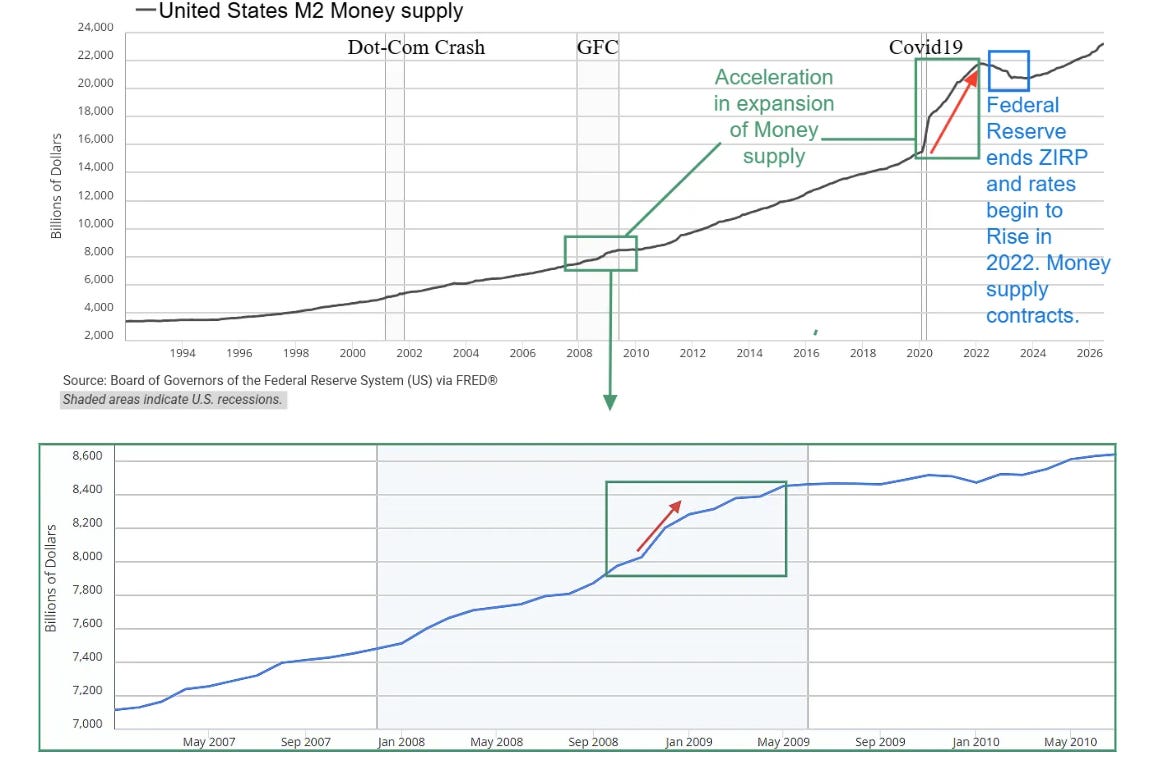
That happened during the Global Financial Crisis. In 2008, central banks cut interest rates towards zero and introduced QE. The Federal Reserve purchased assets with newly created reserves and the monetary system expanded aggressively.
Then came COVID-19. The monetary expansion was even more dramatic. Zero interest rates were still in place. QE continued. Governments mailed trillions of dollars of stimulus cheques to households, expanded unemployment benefits and provided forgivable loans to businesses. The result was an extraordinary expansion in the money supply.
Then the direction changed. The ZIRP era ended in March 2022 and QE went into reverse. Quantitative Tightening saw securities roll off central-bank balance sheets without being reinvested. The blue box on the chart captures the consequence: broad money contracted as the system began to deleverage.
The Magic Keyboard Works Both Ways
Now let’s turn our thoughts back to that $1 million mortgage we discussed earlier.
You ask your bank for a mortgage. The bank approves it. A million dollars appears in your account. Brand-new money has entered existence.
But what happens when you repay it?
You transfer money from your current account to the bank. The bank reduces the value of the mortgage on its asset side. At the same time, it reduces the deposit on its liability side.
Both sides of the balance sheet shrink. The money disappears.
This is the mirror image of money creation. Commercial banks create money when they create loans. Debt repayment removes that money.
If new loans are being created faster than existing loans are being repaid, broad money expands. Similarly, broad money contracts when repayments exceed loan creation. Simple.
That distinction is crucial because an expanding money supply is generally supportive of economic growth, while a contracting money supply can have the opposite effect.
It also brings us to one of the great ironies of modern economics: Inflation.
Where Does the Money Go?
We are taught to think of inflation as an inherently bad thing: the steady erosion of what our money can buy.
But society’s perception of inflation depends heavily on where the new money goes.
When banks create money and it’s used to buy residential property, home owners celebrate because it increases the value of real estate generally.
We call it wealth creation.
It doesn’t seem to matter that the next generation may now be priced out of the housing market.
Similarly, we all like rising share prices. Yet that’s another form of inflation (asset-price inflation rather than consumer-price inflation) and it isn’t captured in measures such as CPI.⁵
When stock portfolios rise, shareholders feel richer even if they haven’t sold a single share. That paper wealth can boost confidence and spending.
High equity valuations also reduce a company’s cost of capital. When valuations are elevated, companies can raise fresh capital more easily, enabling them to expand.
That additional corporate spending increases demand for land, materials and labour, pushing up the price of all three. Eventually, those higher costs leak into the real economy.
So we celebrate when our house prices climb and equity markets rally, but when the same price expansion reaches the petrol pump or the supermarket, the reaction changes completely. Suddenly inflation is a crisis; something terrible.
Human beings are strange creatures.
So is inflation good or bad?
The answer is: it depends.
More specifically, it depends on what happens to the newly created purchasing power.
When Debt Creates Prosperity
Imagine a commercial bank lends newly created money to a coalition of engineers, entrepreneurs and builders.
Money supply will expand and initially, this looks inflationary.
The builders use debt financing to hire construction crews, buy materials and rent heavy machinery.
Demand suddenly surges. The price of copper rises. Concrete becomes more expensive. Skilled labour is in short supply. Wages increase.
But then something interesting happens.
A year or two later, the construction dust settles.
Standing in the valley are brand-new, state-of-the-art automated manufacturing plants powered by an off-grid geothermal clean-energy supply.
Every day, thousands of affordable goods are produced. Economies of scale reduce production costs. Because energy is now cheap and plentiful, local businesses see their electricity bills fall. Their costs decline. Their efficiency rises.
The money that was created through the banking system has created something real: economic benefit.
The newly created money didn’t necessarily produce lasting inflation because it was offset when the economy’s capacity to produce goods and services expanded alongside it.
This is the productive side of credit creation.
When the money supply grows faster than the economy’s capacity to produce goods and services, prices rise. But if output expands quickly enough to absorb the extra purchasing power, inflation remains muted.
In that case, the town becomes more prosperous while a dollar still buys roughly what it did before: economic gain without meaningful inflation.
That’s why inflation is not inherently good or bad; its impact depends on whether it is financing growth, and doing so fast enough to match the increase in money supply.
The ambitious AI buildout is a case in point. If the debt financed capital expenditure ultimately creates enough productive capacity, it could justify the investment and absorb the money created to finance it. But the eye-watering scale of the investment means investors need to ask a harder question: what happens if the capital cycle runs ahead of the economic returns?
That’s the question that matters.
When Debt Creates Fragility
Continuing the same narrative, imagine newly created money flowing into something that already exists, such as the existing stock of residential property.
If a bank lends against a mortgage, money supply expands, but there are no new goods being created by the transaction.
There’s simply more purchasing power chasing the same number of houses.
This is where the economy becomes a high-stakes auction. Everyone pays more. Nobody gets anything new.
There is an important caveat here.
Debt used to build new homes is different because it finances construction, employs workers and creates additional housing stock.
Debt used to bid up the price of existing housing simply transfers ownership at a higher price.
When interest rates are virtually zero, as they were for more than a decade following the Global Financial Crisis, this dynamic can become particularly powerful.
The rally lifted everything: stocks, property, and the newly invented digital assets known as cryptocurrencies.
Economists called it the ‘everything bubble’. The newly created money hasn’t built anything productive. It’s simply been poured into a game of financial musical chairs.
On paper, people felt wealthier. They borrowed against their increasingly valuable homes. More money supply was created. That finds its way into the real economy as they spend on cars, restaurants and holidays. The economy appeared to be booming, but structurally it was exceptionally fragile, and all that leveraged spending drives inflation further.
And that brings us to the central bank.
The Cold Garden Hose
The central bank governor can’t sit behind every commercial bank’s lending officer to slow down the rate at which he is creating money through new loans.
But he can influence the economics of lending.
Think of it as turning a cold garden hose onto a party that has become a little too lively.
He raises interest rates on Base Money (Base Rates) and the economics change.
The price banks pay to settle their reserve accounts rises. To protect their margins, those higher funding costs are passed through to you and me.
A 3% mortgage becomes a 7% mortgage. Families delay buying houses. Businesses cancel expansion plans. Loan demand weakens.
The magic keyboards at commercial banks begin to go quiet. Fewer loans are signed. Fewer new dollars enter circulation. Meanwhile, existing borrowers repay debt and when that principal is repaid, the money supply contracts.
Eventually, the consequences begin to spread. House prices level off. Restaurant bookings decline. People delay buying a new car. Businesses become more cautious. The runaway train of inflation slows.
This is the mechanism through which monetary tightening works, and it works in both directions.
When debt repayment across the economy outpaces new loan origination, the economy enters a process of deleveraging. Broad money shrinks. Credit contracts. Spending falls. Deflationary pressure builds.
This is why commercial bank balance sheets are so important. They are the primary engines of a modern economy: it can roar, or it can stall.
The objective of central banks is to keep the engine running without allowing it to overheat.
Think of it as Goldilocks economics: Not too hot, not too cold, but just right.
Why 2% Inflation?
Every wondered why the Federal Reserve, Bank of England and most other developed-world central banks aim for roughly 2% inflation rather than zero?
When falling prices are caused by productivity improvements, they can be extremely beneficial. The Industrial Revolution provides an obvious example. So this kind of deflation would be welcomed.
The type of deflation central bankers fear is ‘demand-deficient deflation’: Economist John Maynard Keynes argued that when consumers expect prices to fall, they can postpone purchases. Why buy something today if it will be cheaper tomorrow? That reduces demand. Businesses respond by cutting production. Workers lose jobs. Wages fall. Spending falls further. The process can become self-reinforcing.
This is the primary reason central banks want a buffer above zero.
If the target were 0%, there would be little room to cut real interest rates before the economy slipped into a downward demand-deficient deflationary spiral.
Another reason the inflation target is set above zero is that CPI, the official measure of inflation, tends to overstate the true increase in the cost of living.
CPI tracks the price of a representative “basket” of goods and services, but it cannot fully capture two important effects.
First, CPI records what we pay, but can’t perfectly capture the additional value we receive for that money as products improve over time. Second, consumers adapt when prices rise. If beef becomes too expensive, they buy chicken. If one brand raises its prices, they switch to another. CPI accounts for these things, but only slowly and imperfectly.
The result is that the true increase in the cost of living is typically somewhat lower than the headline CPI figure suggests.
In other words, a 2% CPI target may correspond to something closer to stable, or gently rising, true living costs, while still providing the economy with a small but important buffer against deflation.
Additionally, a small amount of inflation provides a neat mechanism that allows employers to reduce real labour costs without explicitly cutting nominal wages during a cyclical downturn. Keeping wages flat while prices rise slightly reduces the real cost of labour for a business without the risk of damaging the morale of the work force.
There is another, more subtle reason.
If money retained its purchasing power forever, people would have a greater incentive to hoard it. A small amount of inflation encourages people to seek investments capable of generating returns above the inflation rate in order to preserve their purchasing power.
That capital flows, directly or indirectly, into financial markets and ultimately finances economic growth.
So perhaps 2% really is the Goldilocks number.
When Higher Rates Break Things
The cold garden hose is an awkward tool for cooling the economy. But as far as central bankers are concerned, a chilly room is a small price to pay to stop the house from burning down.
There is, however, a problem.
The hose can break things.
Interest rates are not simply a dial that central bankers turn to control inflation. They change the value of assets throughout the financial system.
Silicon Valley Bank and Signature Bank demonstrated the danger.
Both banks had significant exposure to long-duration assets, including U.S. Treasuries and mortgage-backed securities, funded by short-term, demandable deposits. In 2023, when interest rates rose, the market value of these assets fell. Suddenly, the banks’ assets were worth substantially less than their liabilities.
People panicked and fearing a bank default, a classic bank run followed. Everyone wanted their money out at the same time.
Both banks collapsed.
This is why, when a financial system has accumulated a decade of leverage, the consequences can be unpredictable.
When Inflation Becomes Hyperinflation
History also teaches us why inflation must be kept under control.
When inflation becomes sufficiently extreme, the problem stops being rising prices. It becomes a loss of confidence in money itself.
Think about Weimar Germany in 1923 or Zimbabwe in 2008.
In such circumstances, the state can be forced to bypass the conventional commercial-banking credit system altogether. Tax revenues become insufficient to meet government obligations. The government creates money to fund expenditures and obligations. The currency loses value. The exchange rate collapses.
The loss of confidence encourages people to spend their money as quickly as possible before it loses more value. That increases the velocity of money. The faster the money circulates, the more prices rise.
The government responds by creating even more money, and the process feeds on itself. Eventually, money becomes almost worthless. Prices can double within days. Banknotes have to be printed in absurdly large denominations.

People’s savings are destroyed.
The social and political consequences can be devastating.
This is hyperinflation.
Speed Is the Secret Ingredient
Considering hyperinflation raises another interesting question.
If central banks created so much money through QE after the Global Financial Crisis, why didn’t we get hyperinflation then?
The answer is that inflation doesn’t simply depend on how much money exists. It also depends on how quickly that money circulates, known as the velocity of money.
Following the Global Financial Crisis, fear and uncertainty encouraged people to sit on their hands and do nothing. Institutions hoarded liquidity as a buffer against the unknown. Banks accumulated reserves. Households were also cautious. Businesses were reluctant to invest.
Money existed, but much of it wasn’t moving.
The result was that the huge expansion in central-bank reserves didn’t translate into an equivalent explosion in consumer prices.
COVID was different.
When economies reopened after the lock-down period, consumers suddenly had the ability, and in many cases the cash, to spend. The banking system and governments had created enormous quantities of additional purchasing power. The money that had previously been sitting idle began circulating rapidly.
That combination was explosive: More money plus greater velocity.
That helps explain the inflation spike of 2021–23.
The lesson is important. You can’t understand inflation simply by looking at money supply. You have to understand where the money is, who owns it and how quickly it’s circulating.
The Gold Standard Wasn’t What You Think
This brings us to another common misconception.
Many people believe the Gold Standard prevented banks from creating money.
It didn’t.
Commercial banks still created money through credit creation. The difference was that the system had a constraint.
The promise was that banknotes could ultimately be converted into gold. However, centuries ago, banks realised that depositors rarely, if ever, turned up to withdraw all their physical gold at the same time.
So bankers began issuing paper receipts for gold held in their vaults.
These receipts became transferable securities. The bearer could redeem the note for gold, but most people simply used the paper receipt to buy goods because it was equivalent in value. There was no need for them to call on the physical gold.
These notes circulated widely and that was the beginning of paper money.
Because very few notes were ever being redeemed for gold, bankers began issuing more paper claims than they had physical gold in their vaults. This was known as fractional-reserve banking under a Gold Standard.
The common belief that every banknote was backed dollar-for-dollar by a bar of gold sitting in a vault is nothing more than a relic of ancient history. It didn’t work that way under the Gold Standard.
Banks needed just enough gold to satisfy withdrawals.
If redemptions became excessive, they raised interest rates to attract deposits and prevent gold from flowing out.
Gold flows therefore acted as a constraint on the monetary system. When gold flowed into a country, its monetary capacity expanded. When gold flowed out, it contracted.
The problem was that gold production could not always keep pace with economic growth. The result was periodic deflationary crises, including those of 1873, 1893 and 1907. In each of those, prices and wages fell, while the debt burdens increased.
The modern fiat system eventually removed the physical gold anchor entirely in 1971.
The constraint was replaced with something much less tangible: central-bank policy, interest rates and financial regulation.
This, very conveniently, brings us back to the problems investors face today.
PART 2:
An Investors Dilemma
The Crisis We Face Today
The structural expansion of global debt over the past two decades represents a fundamental shift in macroeconomics.
Debt expansion moved from being an engine of economic growth, to an emergency response to a crisis, to something increasingly embedded in the policy machinery itself.
The Global Financial Crisis was the turning point.
When commercial banks faced insolvency, their balance sheets were effectively supported by the state. Central banks cut interest rates to zero, while in Europe and Japan they were negative.
They introduced QE and purchased trillions of dollars of government bonds.
What was intended to be emergency medicine became standard operating procedure for more than a decade.
By suppressing risk-free interest rates, monetary authorities systematically reduced discount rates.
The result was a dramatic repricing of financial assets. Cheap money encouraged leverage across government balance sheets, private equity, corporations, households and real estate.
Then COVID arrived. The pandemic combined supply-side disruption with enormous fiscal stimulus.
Governments sent money directly to households. They guaranteed loans. They subsidised businesses.
Meanwhile, Central banks maintained extraordinarily accommodative monetary policy.
The result was a structural increase in global debt, and this is where the problem becomes more subtle.
In a healthy market, the cost of capital acts as a filter. A project needs to generate a return above its cost of capital to justify receiving funding. Yet, when interest rates approach zero, that filter becomes extremely weak. The hurdle rate collapses.
Capital can flow into assets not because they generate attractive economic returns, but because there is nowhere else for cheap money to go.
This is what happened with housing. Ultralow mortgage rates pushed capital into existing housing stock, driving house prices dramatically higher relative to incomes.
A huge wealth divide emerged.
The same dynamic appeared across financial markets. As fiat money expanded, investors sought hard assets that could protect purchasing power. Gold rose. Cryptocurrencies emerged as a new asset class. Excess liquidity flooded financial markets. Unprofitable technology companies achieved extraordinary valuations. Meme assets became a phenomenon. Financial engineering flourished. Leveraged buyouts could be structured around cheap debt.
Money was flowing into assets rather than productive capacity. At this point, central banks should have slammed on the brakes. But who wants to be the person that ends the party when everyone seemed to be having so much fun?
So debt continued to expand, and ran completely out of control, both in the private and public sectors.
This chapter of economic history is likely become a cautionary tale of central bank failings.
The Debt Trap
The United States now faces a particularly difficult mathematical problem.
National debt has exceeded $40 trillion (some would argue it’s closer to $220 trillion if you include Social Security and Medicare liabilities).
At an average Treasury yield of 4–5%, the interest bill becomes enormous.
Every additional percentage point in the average cost of government borrowing translates into hundreds of billions of dollars of additional annual interest expense as debt rolls over.
The Congressional Budget Office expects publicly held federal debt to continue rising faster than the economy, while the U.S. Government Accountability Office describes the fiscal trajectory as unsustainable.
This creates a policy dilemma.
Raise interest rates to control inflation and you increase the cost of servicing government debt.
Higher rates also depress economic activity, increase unemployment and make private borrowing more expensive.
But lower rates or inject more liquidity to stimulate growth and you risk weakening the currency, reigniting inflation and encouraging another round of debt accumulation.
The policy response to the GFC and Covid crisis has become the new crisis.
This is what makes the current environment so different. The problem isn’t simply inflation. It isn’t simply debt. It isn’t simply interest rates.
It’s the interaction between all three.
Japan: A Glimpse of the Future?
Japan provides an interesting case study.
Decades of zero and negative interest-rate policies, combined with enormous monetary expansion, pushed government debt to extraordinary levels (around 260% of GDP).
The result is a central bank trapped between two undesirable outcomes.
If the Bank of Japan (BOJ) raises rates materially, government debt-servicing costs rise sharply.
But if the BOJ keeps rates suppressed indefinitely, the interest-rate differential with other developed economies encourages capital to leave Japan, weakening the yen.
Japan is a net importer. A weaker currency therefore makes oil, LNG and other essential imports more expensive. The country would essentially import inflation and household purchasing power falls.
So the BOJ is consequently caught between protecting the government balance sheet and protecting the purchasing power of the Japanese consumer.
It is a precarious position.
Japan has demonstrated that modest rate increases are possible with a small number of modest rate hikes in the past few years (July 2024 and January 2025), but they can create immediate fiscal strain. It puts pressure on the government’s budget, which is then forced to raise taxes to cover the shortfall, which weakens spending and weighs on the economy.
The result can become a self-correcting feedback loop where deflationary pressure increases.
This is the macroeconomic trilemma.
The Japanese situation is also inextricably linked to the United States.
Japan is one of the largest holders of U.S. Treasury securities. If Japanese policymakers need to sell foreign assets to support the yen, they could become sellers of U.S. Treasuries. A seller of that magnitude could put further upward pressure on U.S. yields.
That would be particularly inconvenient for an already heavily indebted American government.
The important point isn’t whether Japan is about to collapse. It isn’t. It’s about risk contagion spreading from one jurisdiction to another.
This explains why Scott Bessent, US Treaury Secretary, has been trying to prop up the Japanese currency, buying $10 billion worth of Yen and using its foreign exchange reserves (Euro) as currency.
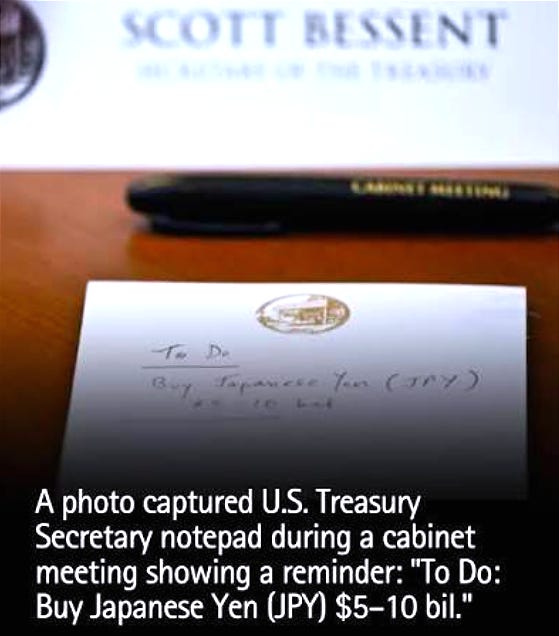
The U.S. Treasury historically doesn’t intervene in Foreign Exchange markets to support foreign currencies unless it’s part of a coordinated G7 agreement to stabilize markets, which this was not. That’s what makes it particularly noteworthy. Is it a sign that the US Government is becoming increasingly concerned about the fragility of its economic situation?
So far, Scott Bessent’s effort has been fruitless. The Yen continues to weaken.
All eyes are on the interest rate decisions due later in September in both the US and Japan.
The AI CAPEX Problem
The US debt financing issue is now being exacerbated by the AI buildout, which requires an extraordinary amount of capital expenditure.
Hyperscalers are borrowing hundreds of billions of dollars to finance data centres, power infrastructure, chips and associated technology.
These companies have historically produced such strong cash flows that they were able to finance their own growth internally. But the scale of the AI spending changed that. Now the hyperscalers are issuing huge amounts of debt through the capital markets.
That means AI investment is competing with governments and other corporations for a finite pool of capital.
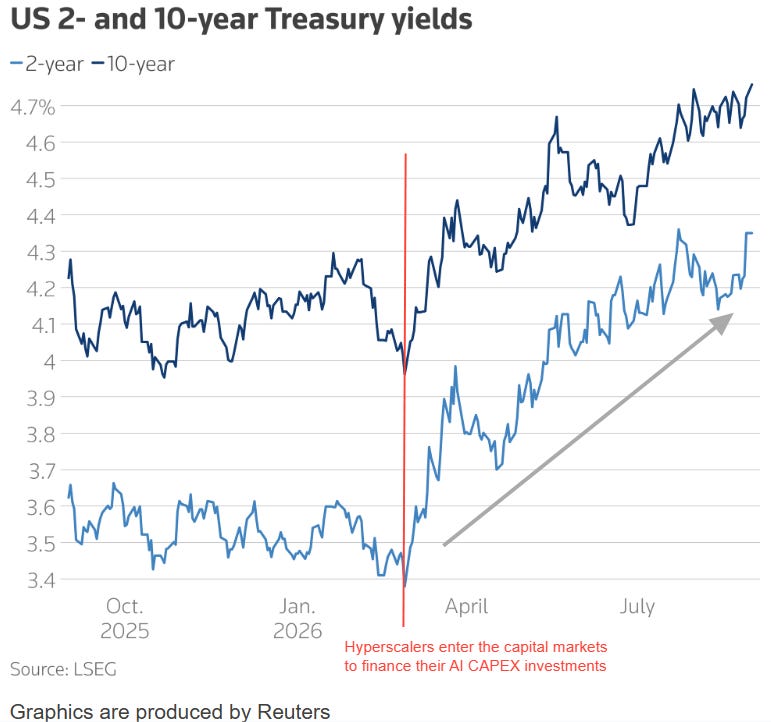
The consequences are already visible in bond markets.
Higher government borrowing requirements, corporate debt issuance and concerns about inflation are all contributing to upward pressure on long-term yields.
This is proving increasingly problematic for the US government.
It has come at the worst possible time.
As discussed, the BOJ may ultimately need to liquidate part of its US Treasury holdings to support the yen. Now Norway’s $2.3 trillion sovereign wealth fund is proposing to restructure its government bond portfolio, a move that could see it reduce its US Treasury holdings by around $80 billion.
So it isn’t just that governments and corporations are competing for a finite pool of debt capital. Some of the very investors who have historically provided that capital are beginning to reduce their appetite for government bonds.
The problem isn’t simply that there is more debt to absorb. The problem is that some of yesterday’s biggest buyers may no longer want to buy it.
Inflation: The Escape Valve
High debt is inherently deflationary over time. Income that could otherwise fund productive private investment, business expansion or consumer spending is absorbed by debt service.
But when sovereign debt becomes so large that repaying it through economic growth or taxation becomes politically or mathematically difficult, solution become limited.
Inflation, is one of them.
This explains why the Trump administration has always been keen to push base rates lower. This is the best way to fuel inflation.
The US government will never default on debt denominated in its own currency. But it will never guarantee the purchasing power of the currency used to repay that debt.
This is where financial repression enters the picture.
If policymakers can maintain nominal interest rates below the rate of inflation, the real value of government debt gradually declines.
Tax receipts increase with inflation, and the fixed debt repayments become easier to pay.
For the bond holder, a 5% yield may look attractive at first, but if inflation is running near 5%, the real return is close to zero, and that is effectively the government’s real cost of funding its debt.
The market refers to US Treasury rates as ‘risk free’. Perhaps it should think again.
The Stagflation Trap
This brings us to the macroeconomic environment that may be most difficult for investors: Stagflation.
Stagflation occurs when economic growth stagnates while inflation remains persistently elevated. The result is underutilisation of capacity which leads companies to lay off workers, resulting in elevated unemployement.
It’s the combination policymakers least want because they fall into the stagflation trap.
If policymakers raise rates to tackle inflation, they risk worsening the recession. If they cut rates, they risk worsening inflation.
The usual economic tools cannot solve both problems simultaneously.
Stagflation is a risk for the US not because high debt automatically causes it, but because large deficits and elevated debt can make it harder to bring inflation down without tipping growth into stagnation.
Supply‑side shocks amplify the mix. Energy price spikes together with trade and geopolitical tensions, tariffs and deglobalization can push inflation up while weighing on economic activity, creating the “slow growth + sticky inflation” pattern associated with stagflation.
If Stagflation is a possibility, investors
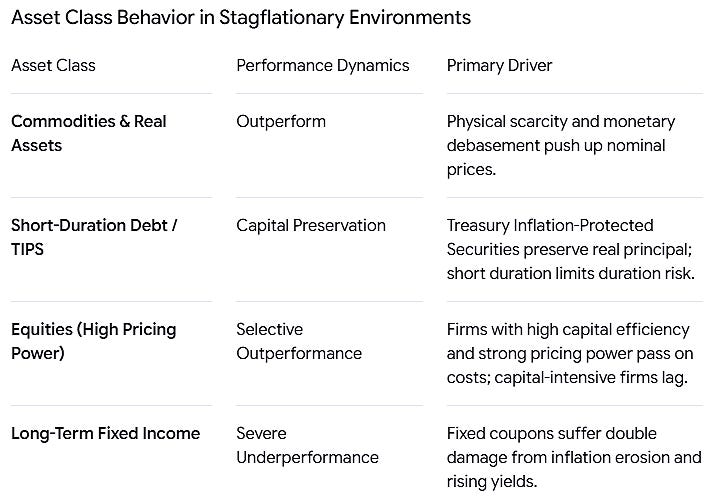
Don’t Forget Shadow Banking
There is one further complication.
So far, the discussion has focused heavily on commercial banks.
But the modern financial system is considerably more complicated.
Non-bank financial institutions ( private credit funds, money-market mutual funds, hedge funds and other forms of market-based finance) now play an enormous role in corporate lending.
These institutions don’t operate exactly like commercial banks. Specifically, they don’t take deposits, so they aren’t subject to the same capital adequacy requirements that were introduced to protect depositors.
This creates a parallel system of credit creation that is less transparent and, in some respects, harder to regulate.
The monetary system is therefore no longer simply a story about central banks and commercial banks. It’s an interconnected network of banks, governments, asset managers, private-credit funds, corporations and households.
Money can move through the system in ways that are difficult to see until something breaks.
That matters enormously to investors.
The Problem for Investors
So where does all of this leave us?
The traditional 60/40 portfolio becomes less reliable as a strategy.
Rising inflation erodes the real value of fixed-income assets.
At the same time, higher rates, if they arrive, can compress equity valuation multiples.
Corporate revenues may rise in nominal terms while real margins deteriorate because input costs are rising and volumes are weakening.
So what do you do?
The answer isn’t to abandon equities.
Nor is it adopt an investment strategy predicated on macro assumptions and attempts to model the precise path of inflation, interest rates or government bond yields.
The answer is to become much more selective about what kind of businesses you own.
Businesses with pricing power. Businesses with high returns on capital. Businesses that require little incremental capital. Businesses that generate abundant free cash flow. Businesses whose revenues can rise with nominal GDP without requiring a corresponding increase in their capital requirements. Businesses with strong balance sheets. Businesses whose economic value comes from productive assets rather than financial leverage. Royalty businesses that will earn returns in tomorrow’s inflated dollars on investments made at pre-inflated levels. Perhaps most importantly, businesses capable of compounding their intrinsic value faster than the currency is losing purchasing power.
Look Through the Money Illusion
There is another useful way to think about the investment environment.
Ask yourself: How much of the rise in asset prices is genuine economic growth, and how much is simply monetary dilution?
One way investors attempt to answer that question is by comparing the S&P 500 with the U.S. broad money supply.
If the S&P 500 rises 10% but M2 also rises 10%, then the index hasn’t increased in purchasing-power terms relative to the total stock of money.
The apparent gain is partly an illusion created by the dilution of the unit of account.
Conversely, if equities rise significantly faster than money supply, then something more interesting may be happening. Perhaps corporate earnings are growing. Perhaps productivity is improving. Perhaps investors are allocating a greater proportion of available capital to equities. Perhaps valuations are expanding.
The ratio therefore provides another lens through which to examine the market.
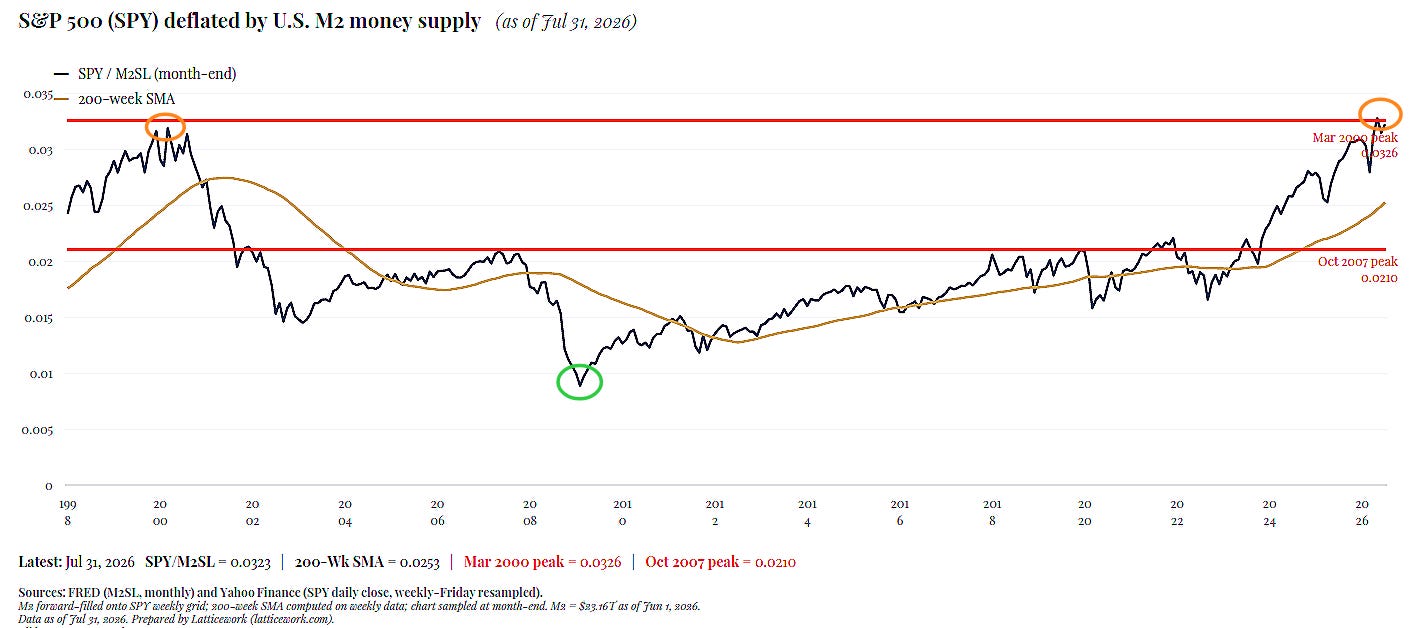
The chart shows something particularly interesting.
The trough following the Global Financial Crisis represented a generational opportunity: equities were exceptionally cheap relative to the amount of money available (the green circle).
At the opposite extreme, the ratio reached very high levels in 2000 before the dot-com crash, and today it finds itself at similarly elevated levels (the orange circles).
That doesn’t mean a crash is imminent. This isn’t a timing tool. The ratio can remain stretched for years.
This chart shows how much money exists, not how fast it’s circulating. It also leaves out global liquidity and the big slice of U.S. stocks owned by foreign investors. For that reason, it’s a fairly blunt tool. Nonetheless, it provides clear evidence that money supply influences asset prices.
It also reminds us that a corporate equity may rise in nominal terms, but that may not be a reflection of improving economics within the business. The macro environment may be doing all the heavy lifting.
What Should Investors Be Thinking About?
Perhaps the most important conclusion isn’t a forecast. It is an attempt to understand the monetary machine itself.
The money isn’t necessarily the problem. What matters is what the money is doing.
That leaves investors with some uncomfortable questions:
Are today’s elevated asset valuations being supported by genuine improvements in productivity and earnings, or by an abundance of liquidity?
If the latter, what happens when we see deleveraging of the system and money supply contracts?
What happens to the margins of highly leveraged businesses if the cost of capital remains structurally higher?
Which companies have high capital-burn rates, and how resilient are their business models if higher rates make debt less accessible and if elevated risk results in a sharp drop in their share price, making equity financing more expensive?
What happens to the purchasing power of cash if policymakers ultimately decide that financial repression is preferable to confronting a sovereign debt crisis?
Which businesses can continue to generate attractive returns if inflation remains persistently above central-bank targets?
Thinking through these questions won’t eliminate investment risk. It may, however, help investors avoid allocating capital to businesses whose economics depend on a monetary environment that may no longer exist.
What worked in the past may not work nearly as well in the future.
When the landscape changes, our thinking needs to change with it.
That may mean looking beyond the businesses that thrived during an era of cheap money and abundant liquidity, and paying greater attention to companies with strong balance sheets, pricing power, high returns on capital and the ability to generate cash through different economic environments.
In other words, a changing monetary landscape may require a different approach to investing, perhaps a more defensive one.


What a mess this is. But somewhere there is an opportunity. Maybe it is the beginning of mass inflation or depression. A repeat of the 1930's...2030's ? Gold and just a very few industries stayed healthy in the 1930's depression. People who bought equities at very low prices and hung on to them did well. A new digital currency backed by something other than ink perhaps ? Should be an interesting period of history.
Always!! Valuations inflated by excess liquidity face severe structural margin compression as capital costs stay elevated inside a secular deleveraging regime 💸.